

Audio By Carbonatix
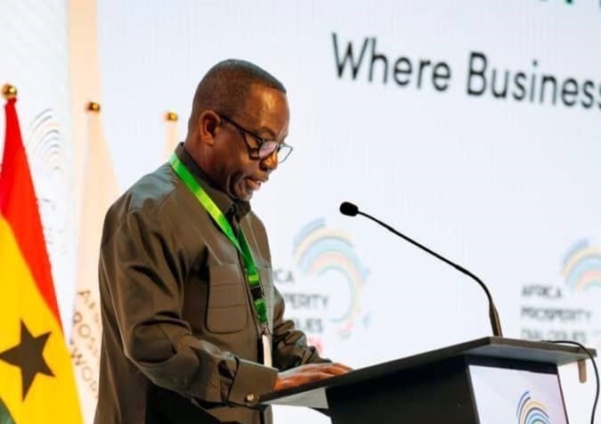
The Executive Chairman of KGL Group, Alex Apau Dadey, says the future of Africa’s economic transformation depends on the deliberate building and protection of African-owned enterprises capable of competing on the global stage.
Speaking at APD 2026, Mr Dadey made a compelling case for the emergence of strong African business champions as the true drivers of sustainable growth, industrialisation, and long-term prosperity across the continent.
“If we want sustainable growth in Africa, we must deliberately build African business champions that can compete globally,” he said.
“History shows us that lasting economic transformation is driven by enterprises that scale beyond domestic markets, businesses that meet global standards, attract international capital, and compete on quality, governance, and execution.”
According to Mr Dadey, Africa does not suffer from a shortage of entrepreneurs or ideas. Rather, the continent’s greatest challenge lies in converting innovation into scale and protecting indigenous success from failure.
“Africa does not lack entrepreneurs. Africa lacks protection for successful entrepreneurs,” he noted.
“Across the continent, when an African business moves from survival to significance, it attracts attention, not celebration, not partnership, but scrutiny. The systematic destabilisation of African business champions once they become competitive is worrying.”
He stressed that building African champions is not about exclusion or nationalism, but about inclusion and ownership in global value chains.
“Building great African businesses is not about leaving Africa behind; it is about taking Africa with us,” he said.
“An Africa built by African global champions is an Africa that is resilient, confident, and competitive.”
Mr Dadey further described local business champions as far more than wealthy individuals, positioning them instead as stabilising forces within African economies.
He explained that African-owned enterprises play a critical role in anchoring supply chains, sustaining local production, investing in research and development, and providing patient capital that remains committed even when external financing retreats.
He also called for a rethinking of public–private partnerships across the continent, urging the private sector to move beyond purely commercial engagement.
According to him, Wealth created through PPPs should make a lasting impact in the communities they operate in.
The Private sector should not limit PPPs to only commercial collaboration, but also be responsible corporate citizens, filling in critical social intervention gaps left uncovered by governments, not as charity, but as investment in long-term stability, trust, and shared prosperity.
However, Mr Dadey cautioned that African enterprise faces a more subtle but increasingly dangerous threat in the modern economy, the weaponisation of narratives. He warned that businesses are no longer dismantled through force, but through sustained reputational and regulatory pressure.
“In today’s economy, companies are not destroyed with tanks,” he said.
“They are dismantled through headlines, hashtags, consultant reports, and so-called neutral policy advice. Once control of the narrative is lost, the business is already wounded.”
Despite these challenges, he remained optimistic about Africa’s trajectory, pointing to frameworks such as the African Continental Free Trade Area as powerful enablers of scale, integration, and shared prosperity. “Africa’s greatest advantage is not just its resources or demographics,” he added.
“It is the choices we make now, and the African business champions we choose to support, protect, and empower to lead our transformation.”
Latest Stories
-
Video: Immunity should be exercised without creating classism – Inusah Fuseini on cocaine bust
21 seconds -
Ghana Air Force passes out 293 recruits after six months of intensive training
8 minutes -
EOCO vrs Baffour Awuah: EOCO should have secured warrant before arrest attempt at court – Inusah Fuseini
12 minutes -
Triple fibre cuts disrupt telecom services across Northern, Oti regions – Sam George
15 minutes -
Politicisation could undermine parliamentary probe into cocaine seizures – Dr Osae-Kwapong
22 minutes -
EOCO chases MP: Can Section 41 cure lacuna in EOCO Act? – Inusah Fuseini asks
25 minutes -
GNFS, GWL inspect fire hydrants in Ministries enclave; 23 found faulty
30 minutes -
Gov’t directs release of 50,000 bags of grain to ECOWAS
32 minutes -
Ghana, Germany deepen cooperation on railways, labour mobility
37 minutes -
Huge crowds greet Pope in Paris for open-air Mass
48 minutes -
‘I never said I’ll declare a state of emergency’ – President Mahama on galamsey
1 hour -
Bobby Banson condemns EOCO’s attempted arrest of Nana Agyei Baffour Awuah
2 hours -
When Kumasi begins to look like somebody is in charge
2 hours -
Parliamentary probe into cocaine seizure would be a waste of time – Inusah Fuseini
2 hours -
Cocaine seizure: Focus on Ghana’s reputation, not partisan blame – Osae-Kwapong
2 hours