

Audio By Carbonatix
Over a year after a far-right terrorist killed two people outside a synagogue in Halle, racist and anti-Semitic attacks are commonplace, say residents. Critics say that police and public prosecutors must do more.
A young Jewish couple with whom DW spoke in Halle said that they wanted Jewish life to be visible in Germany. For that reason, the man wears a kippah openly — though it has attracted unwanted attention. "Once we went into a big store in Halle-Neustadt and some people shouted loudly 'Jews, Jews' after us."
The couple said that this was not exceptional — their car had also been scratched and they had received threats. After the October 2019 attack on a synagogue in the city, the couple (who asked us not to name them) decided to stop remaining silent and to go to the police each time they were the target of an anti-Semitic incident.
This year on September 1, a cyclist insulted them and made anti-Semitic comments as they were walking to their car. They decided to go to the police but did not find the welcome that they expected: "We were forced to stand in the corridor and make our statements while a completely unknown man sat next to us," they explained.
They told DW that they did not feel that the police had taken them seriously or treated them appropriately.
"First, the officer told us that the utterance 'There will be consequences, Jew' was not a threat because our lives had not been threatened. I started to tremble because I noticed that the policeman didn't want to help us. On the contrary, he did everything to ensure the case would come to nothing."
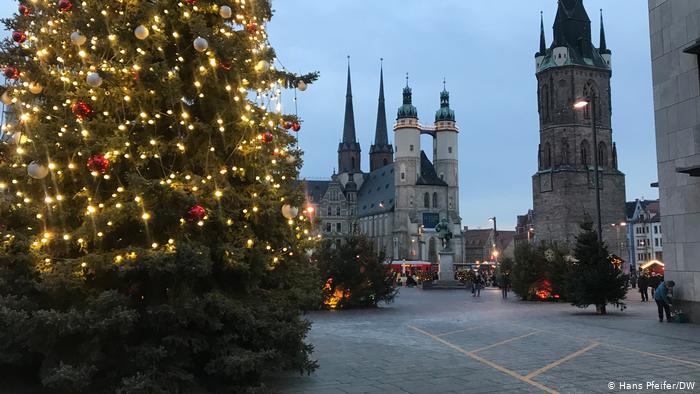
The police would not make a statement about these allegations to DW. An investigative committee is currently looking into police work in Halle on behalf of the state parliament of Saxony-Anhalt. After the attack on the synagogue, many people complained that the police had treated them as if they were "a nuisance."
'Reversal of victim-perpetrator equation'
The 26-year-old teacher Laura has also experienced regular racism and insults. She bemoans the fact that people are becoming increasingly accustomed to such incidents.
She refuses to accept them as "normal." Laura recalled an incident on a tram just a few days after the October 2019 attack at the synagogue when a white man insulted three Black people using racist terms before making the Hitler salute.
As a confrontation ensued, Laura and another woman intervened. They were slightly injured in the scuffle and later filed a complaint.
Even after the public prosecutor in Halle dropped the case, Laura's lawyer refused to give up, and eventually there was a negotiation. "I found it shocking that in court there was more talk about how we had behaved than about how the accused had behaved," said Laura.
"I got the impression that the victim-perpetrator equation had been reversed and there was an attempt to insinuate that it was not civil courage that had motivated us but a whim."
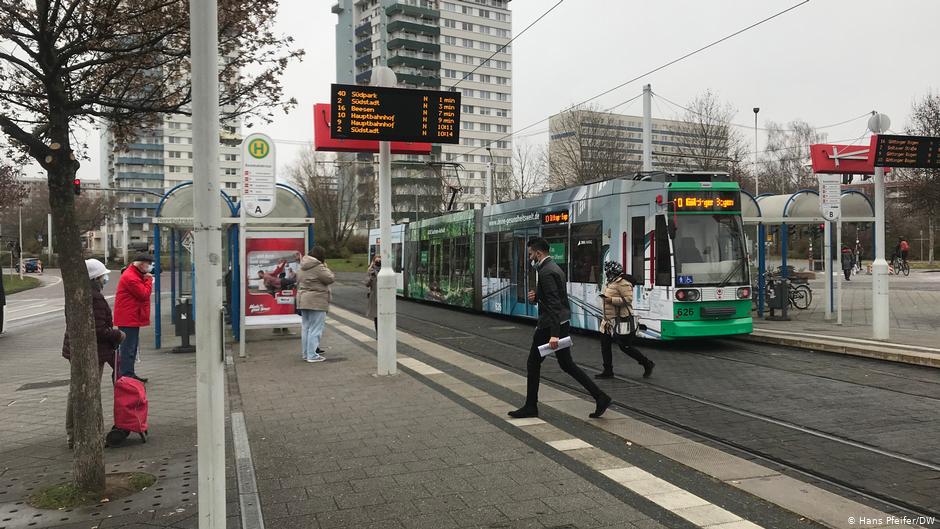
To her surprise, the accused was found not guilty. The ruling read: "In the defendant's favor, the court had to assume that he had simply defended himself against the two women, and acted in in self-defense."
This was a slap in the face. "I had done this because it's what is expected of every democratic-thinking person in such a situation; to deescalate it and to help. And then a signal comes that one shouldn't have done it at all."
For years, the Halle public prosecution office has been accused of turning a blind eye to far-right extremism. Chief prosecutor Heike Geyer rejects this accusation, telling DW that the only criterion for the office was law and order.
'I'm sorry you live in Halle'
The case of a 21-year-old Syrian who has been living in Halle since 2015 is also due in court soon. On May 1 of this year, Ahmad* was travelling by tram to Halle-Neustadt with another man.
When they got up to change lines, they were attacked by three young men who insulted them and beat them to the ground. Ahmad was kicked in the head until he lost consciousness. He says that he was lucky to survive. His attackers were charged with attempted manslaughter.
Ahmad says that he has experienced racism ever since he arrived in Germany, and that he expects it as soon as he leaves his home. "I hear people talking about me on the street, in a way that isn't nice. It doesn't happen every day, but often."
He recalls the dreams he had of his life in Germany; he thought that Halle might be the place in which he would start a family and grow old. He doesn't think this anymore.
"Somebody said to a friend of mine: ‘I'm sorry that you live in Halle.' Before the attack, I would have said: ‘Anything can happen.' After the attack, I would say: 'Me too.'"
Latest Stories
-
GCAA backs more domestic airlines to drive down airfares
9 minutes -
SHC launches nationwide audit, gives occupants 21 days to regularise property interests
20 minutes -
Manhyia South MP describes EOCO arrest attempt as ‘provocation’
25 minutes -
Appiagyei appeals to Lordina Mahama, Jane Naana over detention of Ghana Jollof accused
30 minutes -
New regional hospitals will bring specialist care closer to Oti, Savannah and Western North – Health Ministry
35 minutes -
Gender Minister delivers Mahama’s address at launch of State of Africa’s Children Report
40 minutes -
Lambussie NCCE engages stakeholders on rule of law, anti-corruption fight
45 minutes -
Lands Minister cuts sod for Phase Three of Appiatse Redevelopment Project
50 minutes -
GNFS swift response saves three bedrooms from fire at Amasaman
56 minutes -
Hate speech, vitriol, threats, and inciting comments: Can we stop it already?
1 hour -
African states must strengthen safeguards against AI-driven electoral manipulation – Kwasi Prempeh
1 hour -
Volta Economic Forum shifts from talk to real investments
1 hour -
Investing in jobs, livelihoods critical to sustaining peace – Omanhene
1 hour -
Fisheries Minister rallies scientists to develop solutions for sustainable Blue Economy
1 hour -
197% jump in drug arrests proof of stronger enforcement under NDC – Majority
1 hour