

Audio By Carbonatix
The US Senate has voted to temporarily raise the nation's debt limit, avoiding a historic default that experts say would have devastated the economy.
Senators agreed to increase the limit by $480bn (£352bn), which will cover the US until early December.
The bill was approved in a 50-48 vote, following weeks of partisan fighting.
The breakthrough came less than two weeks before the US was set to be unable to borrow money or pay off loans for the first time ever.
The bill now has to be approved by the House of Representatives, and will then be sent to President Joe Biden to be signed into law.
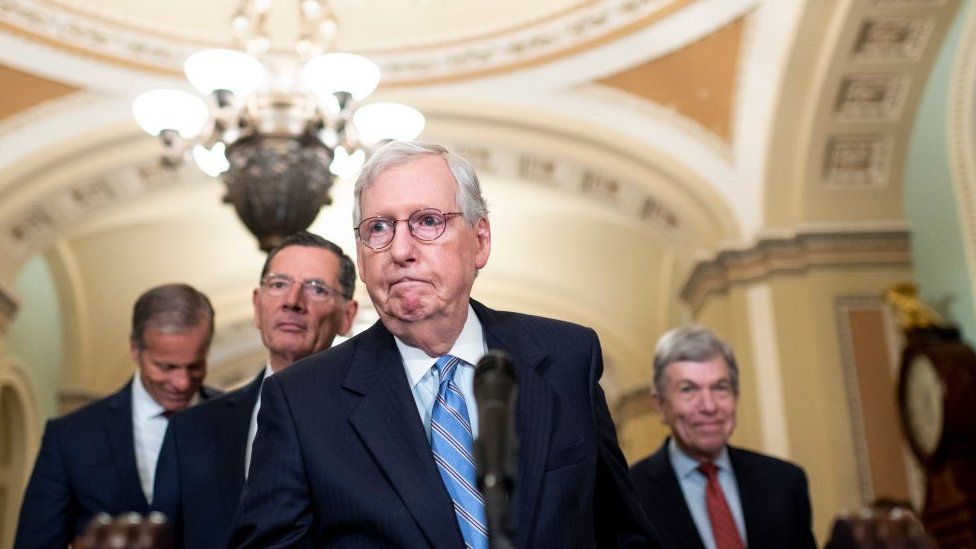
The vote in the upper house of Congress came after Republican Senate leader Mitch McConnell offered his support for a short-term extension.
Senate Republicans have previously said that raising the debt limit is the "sole responsibility" of Democrats because they hold power in the White House and both chambers of Congress.
They are frustrated by new spending proposals the Democrats are trying to push through without Republican support, and Mr McConnell tweeted last month that his party would "not facilitate another reckless, partisan taxing and spending spree".
Speaking after the vote, the Democrats' Senate Majority leader Chuck Schumer said Republicans had "played a dangerous and risky partisan game".
"What is needed now is a long-term solution so we don't go through this risky drama every few months," he added.
But several senior Republicans attacked Mr McConnell's decision to strike a deal with Mr Schumer. South Carolina Senator Lindsey Graham called the move "a complete capitulation".
US lawmakers will still have to address this issue near the new December deadline to avert a default.
If the US defaults on debts, experts say it will severely hurt the country's credit rating, plunge the global financial system into turmoil, and possibly lead to a self-inflicted recession.
What is the debt ceiling?
The US government spends more money than it collects in taxes, so it borrows to make up for the shortfall.
Borrowing is done via the US Treasury, through the issuing of bonds. US government bonds are seen as among the world's safest and most reliable investments.
In 1939, Congress established an aggregate limit or "ceiling" on how much debt the government could accumulate.
The ceiling has been lifted on more than 100 occasions to allow the government to borrow more. Congress often acts on it in a bipartisan manner and it is rarely the subject of a political standoff.
But some Republicans have voiced frustration about new Democrat spending proposals.
Democrats have pointed out that raising the debt ceiling is about paying off existing obligations rather than paying for new ones, and that President Biden's policies have only contributed to 3% of existing debts.
Latest Stories
-
Friendship: Why time matters less than continuity
3 minutes -
Africa’s AI moment: They say data is the new gold. But who is drilling it?
4 minutes -
Ghana delivers strong performance in retail market in half-year; value up 15.6% – Maverick Research
10 minutes -
The world’s oldest president left for a ‘brief stay’ in Europe. He hasn’t returned in two months
27 minutes -
Parliamentary committee commends GIPA’s investment drive, backs key reforms
32 minutes -
Livestream: Newsfile discusses AKSA energy deal, legal vacation and GoldBod losses
53 minutes -
Jason Arday: 10 things you may not know about British-born Ghanaian former Cambridge professor found dead at 41
3 hours -
KNUST partners with government to manufacture locally-made agricultural machines and smart traffic lights
3 hours -
Government to add constitutional referendum to 2027 District Assembly elections
4 hours -
Ambassador Nancy Sam meets South Africa’s Thanda to strengthen Africa tourism collaboration
4 hours -
Government disburses GH¢23.1 billion to clear road contractors’ arrears – Roads Minister
5 hours -
NPP Ashanti elections: 1,020 delegates to choose 11 regional executives
6 hours -
Galamsey: ‘Challenge is prosecution, not arrest’ — Lands Minister
7 hours -
Elliot Kabutey Tei outlines strategic blueprint to drive NPP victory in Tema East
7 hours -
MTN to build 80 new sites across the five regions of the north as part of a $1.1bn investment
7 hours