

Audio By Carbonatix
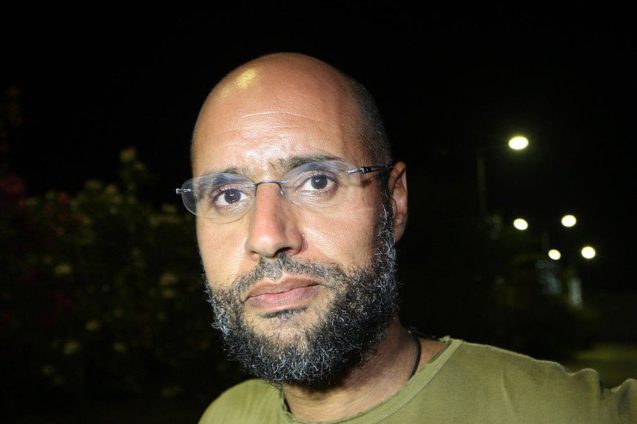
The son of Libya's late leader Muammar al-Gaddafi has registered as a candidate in the country's first direct presidential election next month.
Saif al-Islam Gaddafi was once the heir apparent to his father, but his support for a brutal crackdown on protesters 10 years ago tarnished his image.
Since that 2011 uprising, Libya has been riven by conflict.
Rights groups have raised fears the vote, scheduled for 24 December, will not be free and fair.
World powers and the UN secretary-general have warned that anyone who tries to obstruct it or falsify the outcome will face sanctions.
Photos and video circulating online show Saif al-Islam Gaddafi sitting in front of a poster for the upcoming poll, signing electoral papers.
#BREAKING#VIDEO
— Libya Review (@LibyaReview) November 14, 2021
Saif Al-Islam Gaddafi arrives in Sebha to register himself as a presidential candidate.https://t.co/PzK4AXb3CT#Libya pic.twitter.com/YUask5LHmV
Bearded and wearing traditional Libyan clothing, he addressed the camera and cited a verse from the Koran that translates as, "judge between us and our people in truth".
"God always prevails in his purpose," he also said, citing another chapter of the Muslim holy book, and adding from another section - "even if the unbelievers hate it".
It is a very different image from the one he presented before the uprising that brought down his father in 2011.
In the aftermath of Muammar Gaddafi's brutal end, Saif al-Islam Gaddafi was himself captured by a militia.
He was held for six years, receiving a death sentence that was later overturned.
Mr Gaddafi is still wanted on war crimes charges by the International Criminal Court but has gradually re-emerged onto the public stage, including via an interview to the New York Times from his villa in Zintan earlier this year [paywall].
'Divisive but not a surprise'
Mr Gaddafi's comeback has sharply divided opinion in Libya, says BBC Monitoring's Amira Fathalla. Yet there is little surprise at his leadership bid, as he has been repeatedly touted as a contender for years.
Memories in Libya are likely still too raw for him to win the presidency, says the BBC's Middle East editor Sebastian Usher, and his candidacy will further complicate the already fragile electoral process.
After years of civil war and rival powers operating in the east and west of the country, Libya is currently led by an interim government but remains politically unstable.
Disagreement between Libya's political bodies and opposing factions about the election rules and the schedule have threatened to derail the presidential vote.
Other candidates in the running are the warlord Khalifa Haftar - who previously led an insurgency from his eastern base against the UN-backed government in Tripoli, plus Prime Minister Abdulhamid al-Dbeibah and parliament speaker Aguila Saleh.
Latest Stories
-
UPSA Dean questions SIGA Report over contradictory SOE figures
57 minutes -
Cameroon’s Eto’o says African federations should support Infantino
1 hour -
UNICEF estimates 20 million children suffered online sexual abuse in one year
1 hour -
SOE profits must reflect real efficiency, not just numbers – Dr Atuahene
2 hours -
We must take critical look at SOEs and shed non-strategic ones – Dr Atuahene
2 hours -
Uber and AI-firm Wayve launch London’s first robotaxis
2 hours -
Trump $1 coin makes him first living president on US currency in a century
2 hours -
Sydney police investigate second possible mistaken identity killing in two days
3 hours -
Gauff’s flaw forgotten on winning US Open return
4 hours -
Birds stop play but Medvedev flies into third round
5 hours -
LA Clippers fined $30m by NBA over Leonard scandal
5 hours -
Uber to cut over 3,000 jobs in major global restructuring
5 hours -
Tiger Woods gets five-year driving ban after reckless driving plea
5 hours -
South African airline behind daring stadium stunt cancels next flyby
5 hours -
PURC urges ECG to address outages, metering delays
5 hours