

Audio By Carbonatix
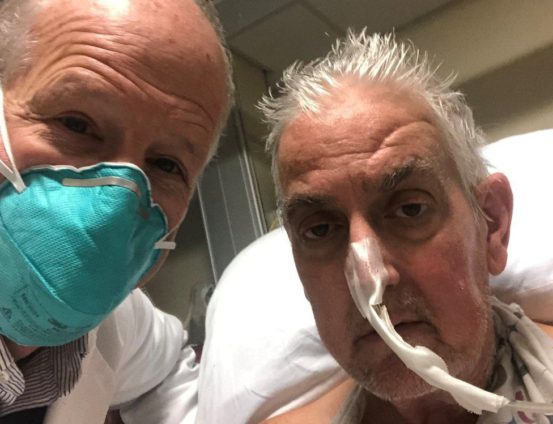
A US man has become the first person in the world to get a heart transplant from a genetically-modified pig.
David Bennett, 57, is doing well three days after the experimental seven-hour procedure in Baltimore, doctors say.
The transplant was considered the last hope of saving Mr Bennett's life, though it is not yet clear what his long-term chances of survival are.
"It was either die or do this transplant," Mr Bennett explained a day before the surgery.
"I know it's a shot in the dark, but it's my last choice," he said.
Doctors at the University of Maryland Medical Center were granted a special dispensation by the US medical regulator to carry out the procedure, on the basis that Mr Bennett - who has terminal heart disease - would otherwise have died.
He had been deemed ineligible for a human transplant, a decision that is often taken by doctors when the patient is in very poor health.
The pig used in the transplant had been genetically modified to knock out several genes that would have led to the organ being rejected by Mr Bennett's body, the AFP news agency reports.
For the medical team who carried out the transplant, it marks the culmination of years of research and could change lives around the world.
Surgeon Bartley Griffith said the surgery would bring the world "one step closer to solving the organ shortage crisis". Currently, 17 people die every day in the US waiting for a transplant, with more than 100,000 reportedly on the waiting list.
Dr Christine Lau, chair of the Department of Surgery at the University of Maryland School of Medicine, was in the operating theatre during the surgery.
"He's at more of a risk because we require more immunosuppression, slightly different than we would normally do in a human-to-human transplant. How well the patient does from now is, you know, it's never been done before so we really don't know," she told the BBC.
"People die all the time on the waiting list, waiting for organs. If we could use genetically engineered pig organs they'd never have to wait, they could basically get an organ as they needed it.
"Plus, we wouldn't have to fly all over the country at night-time to recover organs to put them into recipients," she added.
The possibility of using animal organs for so-called xenotransplantation to meet the demand has long been considered, and using pig heart valves is already common.
In October 2021, surgeons in New York announced that they had successfully transplanted a pig's kidney into a person. At the time, the operation was the most advanced experiment in the field so far.
However, the recipient on that occasion was brain dead with no hope of recovery.
Latest Stories
-
Trump administration to admit primarily Afrikaners under new refugee proposal
59 minutes -
They should have Ghana first – Ntim Fordjour warns MPs against politicising drug crisis
1 hour -
We got more than 15% – Ntim Fordjour confirms support for Parliament recall over cocaine scandal
2 hours -
Wherever there is money laundering, it is linked to terrorism – Ntim Fordjour warns over drug crisis
2 hours -
Parliament Recall: Ntim Fordjour expects emergency sitting over drug-trafficking crisis
2 hours -
Oil falls on increased Gulf supply and hopes for US-Iran talks
2 hours -
South Sudan’s Kiir dissolves government, clears hurdles to delayed election
2 hours -
Ntim Fordjour accuses government of failing to act on Ghana’s drug crisis
4 hours -
Autopsy shows Hayden Panettiere died from a drug overdose
5 hours -
Earl Spencer should pull Diana book from shelves, Piers Morgan says
5 hours -
IMF tells advanced economies to ‘bring debt down’ as borrowing costs rise
5 hours -
‘I have never felt heat like that’ – a survivor on watching 33 cellmates die in Nigeria
5 hours -
16 arrested, 4 printing hubs busted in major counterfeit currency crackdown
5 hours -
Sir Jim Ratcliffe suspends production at key UK plants blaming high gas prices
6 hours -
Major US outlets suspend shared Trump coverage in protest at media ban
6 hours