

Audio By Carbonatix
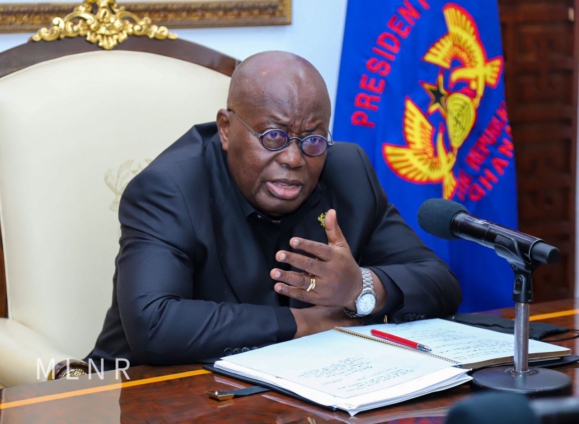
President Nana Akufo-Addo has urged African leaders to guard against the continuing consequential power of rating agencies on African economies.
The credit ratings by these rating agencies, he described, has affected the cost of borrowing and access to the international capital markets.
Speaking at the African Union meeting in Addis Ababa, Ethiopia, President Akufo-Addo charged African leaders to help reform the global financial architecture.
“We need to guard against the continuing consequential strangle of the rating agencies which has affected the costing, access to capital markets for African countries. It has during this COVID-19 period resulted in the downgrading of many African countries, exacerbating even more their funding challenges”.
“Furthermore, it is of the utmost importance that the G20 leaders stick to their commitment to reallocate to Africa SDR 100 billion they made, reached at the Paris Summit in May 2020”, he pointed out.
President Akufo-Addo continued that the IMF should not be the sole beneficiary of such rechanneling, noting “we believe that our own continental institutions, such as the African Development Bank (AFDB) and Afreximbank, should be recipients of the recycling of these SDRs. Our Finance Ministers and the United Nations Economic Commission for Africa (UNECA) have advocated for the use of regional development agencies to be included in this rechanneling.”
He also told the Assembly that African Finance Ministers, with UNECA, have consistently championed the allocation of SDRs to capitalize AfDB and AfreximBank, to help establish an African Stability Mechanism, and to initiate a Liquidity Support Facility (LSF).
The President of the Republic of Ghana advanced his argument that “we [African leaders] need to work collectively as the African Union to reform the global financial architecture even if we build and strengthen our financial institutions”.
This the President believes will address the financial challenges of some African countries.
According to the President, “the major challenges towards the establishment of the AUFIs include the slow rate of signature and ratification of the legal instruments, and the limited capacity of Member States to finance the establishment of the AUFIs. Regrettably, none of the AUFIs has reached the minimum number of ratifications required for the enabling legal instruments to enter into force, and, thereby, facilitate their substantive establishment.”
Latest Stories
-
Arise Ghana demands stronger commitment to end galamsey
1 minute -
96% of Ghanaian pensioners willing to work beyond retirement age – Study
5 minutes -
Ghana gets nuclear power plant simulator
11 minutes -
Temporary Akosombo power control facility to be ready by September – Energy Ministry
12 minutes -
GMTF, Atlantic Lifesciences explore local production of cancer and heart medicines
16 minutes -
GHS medical-legal claims hit GH¢400m in three years
22 minutes -
Mahama cautions Ghanaians not to take religious freedom for granted
38 minutes -
We need development pathway, not selection exercise – Sports Minister urges football stakeholders
45 minutes -
Government prioritises foundational learning to improve education outcomes
51 minutes -
Ghana, Côte d’Ivoire deepen maritime security cooperation through joint boundary inspection
57 minutes -
Three-hour rainfall exposes poor drainage system in Kadjebi
1 hour -
Ghana, China push AI innovation in healthcare
1 hour -
Give young people skills and the systems to create jobs
1 hour -
Food inflation never responded – Dr Yamson says Ghana must stop throwing money at short-term fixes
2 hours -
Oil set for second weekly rise as unsettled US-Iran war crimps supply
2 hours