

Audio By Carbonatix
Some Ghanaians have begun tightening their budgets to make ends meet due to the incessant increase in the cost of goods and services in the country.
Although the government has not announced an increase in utility tariffs, many suspect the tariffs have been adjusted, a development that is causing people to realign their priorities.
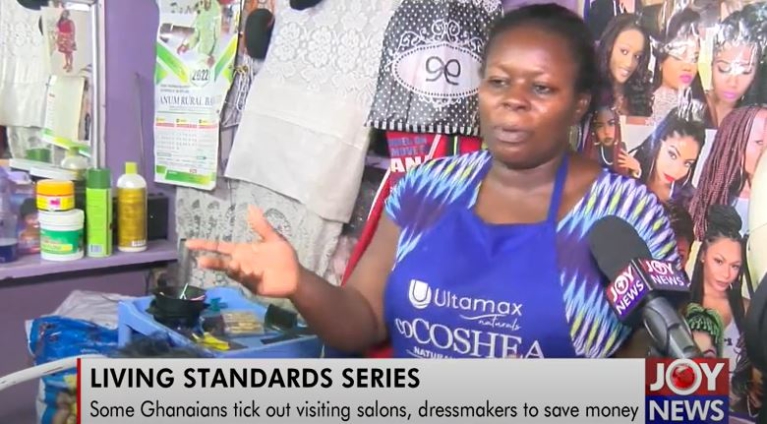
In the current episode of the JoyNews’ Living Standard Series, some residents of Kaneshie, a suburb of Accra, said they have identified a number of items, including visits to the salon and dress makers, which they have removed from their budget.
Shops in the Kaneshie market do not have their own electricity meters; administrators share electricity bills per the number of gadgets in the shop, a situation some traders have complained about.
Jennifer works inside the market as a hair stylist. She targets traders who may be too busy to visit hairdressing salons in their residential communities.
Despite the affordability of her services due to her target market, her customers have not been frequent lately.
The situation is affecting her ability to make her offset her bills, talk less of making profit.
Previously, she had four hair driers and paid over GH¢300 for electricity, but because few customers show up in her shop, paying electricity bills has become a challenge.
To solve the problem of over-billing, she has sent two hair driers home.
For two weeks, not even a single customer visited her shop. Luckily, two customers visited her shop this week. One went to braid and the other to wash her hair.
Her customer, Daavi who had not visited her for weeks, said economic difficulties are to blame. She had to relocate to beat down rent charges.
“This is where I braid my hair but for some time, financial difficulty is making it difficult. Paying of bills in my house always turns into arguments. The bills are high and I would prefer to have my own bill,” she said.
Emmanuella, who is a church administrator, joined the conversation.
She simply cannot explain how her water bills keep rising even though the Public Utilities and Regulatory Commission has not announced an adjustment of tariffs.
“For me, it’s been going high because I usually pay, so I know how much I’ve been paying over the period. Recently, the bill that came was almost GHC130 for water; so, I am wondering why the water is still going high.”
Seamstresses are also reporting low patronage because food prices are high, fuel prices are high and transport fares have equally skyrocketed.
People are left with no option than to kick out many things from their priority lists to survive.
Latest Stories
-
MamaCare CEO warns unresolved conflicts among health workers could undermine maternal and neonatal care
5 minutes -
Health professionals urged to translate medical knowledge into practice to save mothers
12 minutes -
Conflicts among care providers linked to maternal, neonatal deaths – Expert
2 hours -
GIS marks 10th TIME conference, champions improved teaching practices
2 hours -
BRICS Or Balance? What Ghana’s bid really means
2 hours -
GPRTU wants full TRAFFITECH-GH implementation to start in 2027
3 hours -
Mahama announces plans to import electric wheelchairs for PWDs
3 hours -
KGL U17 Colts 2026: Western beat Prempeh Elite Academy to set up final final with Greater Accra Region
3 hours -
Late Solanke strike salvages 10-man Spurs draw at Man United
3 hours -
Gender Ministry to monitor welfare of Nana Akua Addo’s children amid domestic violence case
3 hours -
Benedict Okyere Yeboah: Ghana’s football problem goes beyond sacking a coach
3 hours -
GPL 2026/27: Darkwah Wiafe’s winner sees All Blacks beat Kotoko
4 hours -
ITF World Tour : Patel Wins Boys’ Singles Final at J100 Accra
4 hours -
Ghana must pursue BRICS partnership if it brings economic benefits – Kpebu
4 hours -
Success and Wright Claims J100 Accra Girls’ Doubles Championship
4 hours