

Audio By Carbonatix
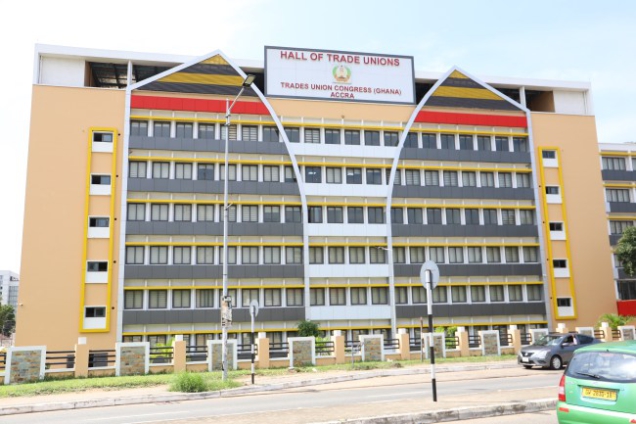
Director of the Labour and Research Institute of the Trade Union Congress (TUC), Dr. Kwabena Otoo, has called for a review of the laws that govern salaries and the conditions of service of public sector workers in the country.
According to him, the current regime allows for inequities in the payment of salaries leading to the agitations from public sector workers.
“You can console yourself that your pay is okay till you see the other person’s pay. So sometimes, the agitation is about what others are receiving. And unfortunately, those that call for a restraint on the wage bill are the ones earning the highest. It becomes difficult for those struggling with 500 and 600 to accept a call for a restraint,” he said on JoyNews’ Newsfile Saturday.
Dr. Otoo noted that in 2019, the Finance Minister, Mr. Ken Ofori-Atta, admitted that public sector workers who are paid under the Single Spine Salary Structure, are receiving low pay and assured of remedies to bridge the gap. However, this promise has come to naught.
According to him, the situation has considerably worsened.
“In 2021, when those on single spine had 4% salary increment, there are some state enterprises that got 35%, and for us this is not right. It’s unfair. It further widens the gap,” he said.
“Now when you do this comparison, people tell you ‘oh, if you’re talking about the MD of say Goil or a commercial bank, you want to peg their pay to what a private sector gives’. Okay, if that is the case then they must also give us the result the private sector gives.
“But we have a situation where collectively, they’re making losses, huge margins, their losses have increased by 200%. You cannot justify that. And those losses will eventually be picked up by the state,” he added.
To close the gap, Dr. Otoo suggested that the laws governing pay should be looked at to ensure that some people are not disproportionally paid than others.
“It is important that we close this gap, and to do that, one of the things we need to do is to look hard at the laws relating to pay and conditions of service relating to the public sector because there are different laws.
“We need to harmonise pay, we need to reduce the inequities, but we need to do that by also reviewing the laws relating to pay in the public sector,” he stressed.
Latest Stories
-
Awal Mohammed files for Nasara Organiser, vows to rebuild NPP Nasara structures ahead of 2028
42 seconds -
IERPP demands answers as GoldBod reports disappear from website
17 minutes -
Country music legend Dolly Parton dies
22 minutes -
Kwaku Antwi-Boasiako writes: UK’s £39bn social housebuilding programme – Any lessons for Ghana?
23 minutes -
Ghana targets 1,200MW new thermal power capacity by 2029 – Jinapor
25 minutes -
Ghana targets universal electricity access by 2030 as coverage nears 90%
29 minutes -
Titus-Glover files nomination to contest NPP National Organiser position
39 minutes -
NPP women’s organiser aspirant pledges 30% female representation
40 minutes -
GIPA explains key changes to Ghana’s investment regime to prospective investors in Atlanta
42 minutes -
Ghana targets 1,200MW new thermal capacity by 2029 – Jinapor
44 minutes -
SYPALA 2026: CSOs must give young people power to lead, control resources – WACSI
45 minutes -
SYPALA 2026: Rule of law, not military intervention, key to enforcing discipline – Kofi Bentil
46 minutes -
GSA defends decision to allow importation of vehicles up to 15 years old
50 minutes -
Sammy Gyamfi distracting Ghanaians from ‘BoG-GoldBod’ losses with extortion allegations – Oppong Nkrumah
50 minutes -
NACOC boss urges prosecutors to uphold integrity and rule of law
51 minutes