

Audio By Carbonatix
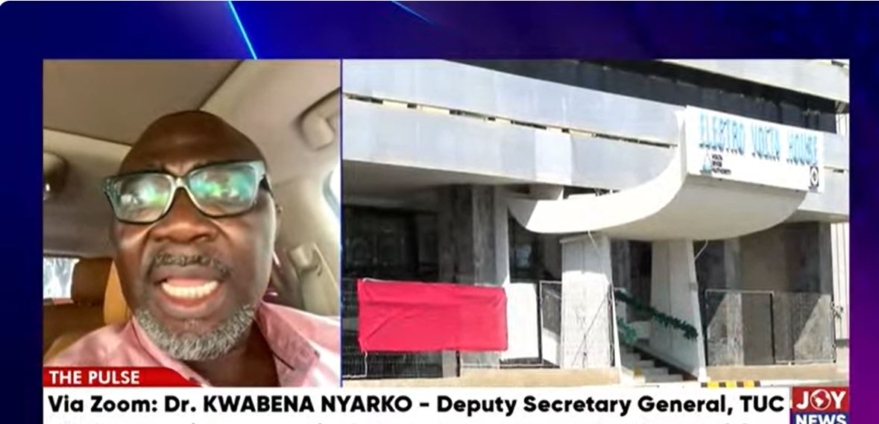
The Deputy Secretary-General of the Trade Union Congress (TUC), Dr Kwabenya Nyarko, has rejected claims that private or foreign capital is necessary to revive the Electricity Company of Ghana (ECG).
He insists that workers, in partnership with government, can turn the company around without privatisation.
This follows a disclosure by the International Monetary Fund (IMF) that the ECG is expected to be taken over by a private sector operator as part of ongoing reforms in the country’s energy sector.
Speaking on JoyNews’ The Pulse on Monday, December 29, he revealed that workers of the Public Utilities Workers’ Union (PUWU) and ECG are prepared to “go the extra mile” to rescue the power distributor, describing ongoing efforts as only the beginning.
According to him, recent collaboration between workers and government has already yielded significant revenue gains within a short period, demonstrating ECG’s potential to recover without private sector participation.
“If in five months, by working together as a team with government, we have been able to raise revenue to such a significant level, then it means we have shown that we can do it,” he stated.
Dr Nyarko assured that labour unions are ready to adopt additional measures, alongside government, to salvage ECG and preserve it as a strategic national asset, stressing that privatisation is neither inevitable nor necessary.
“There are other measures that government and workers must take, and we will do our part to ensure ECG does not require any private sector involvement,” he added.
Dr Nyarko said the argument that foreign investors bring much-needed capital has repeatedly been used to push Ghana into privatisation deals that ultimately fail to deliver on their promises.
He cited the privatisation of Ghana Telecom, which later became Vodafone and now Telecel, as a clear example. According to him, the deal was sold to Ghanaians on assurances of fresh capital injection, technology transfer, and job creation, but instead resulted in the loss of about 4,000 jobs.
“In this country, we have too many examples of private foreign companies coming with promises to invest, but at the end of the day, they come up with nothing,” he said.
Dr Nyarko argued that such promises often serve as bait to force the country into privatisation, while the expected capital injections “never materialise.”
Latest Stories
-
MPs, CSOs push for dedicated budget line for malaria
34 seconds -
Jeffrey Nortey’s viral Kanayo O. Kanayo bar gets the legend’s attention, leads to a meet-up
2 minutes -
Bagre Dam’s Annual Floods: Scientists seek a lasting solution as Northern Ghana’s farmers count the cost
2 minutes -
Why Corporate Communications Professionals Must Be Marketing-Oriented: The strategic advantage and the professional mileage
13 minutes -
DVLA hands 357 suspected cloned vehicles to GRA over customs duties
14 minutes -
Appeals will not end strike, FWSC must negotiate – GAUA General Secretary
20 minutes -
Haruna Iddrisu hails Ghana’s academic calendar as best in a decade
21 minutes -
Silent Football: A team, a dream, a $24,000 debt – the struggles of Ghana’s deaf footballers
21 minutes -
Education Minister Haruna Iddrisu demands merit-based admissions, appointments at Defence University
24 minutes -
National Defence University to strengthen Ghana’s response to emerging security threats – Haruna Iddrisu
27 minutes -
Pupil arrested after two teachers shot at French school
34 minutes -
Lamisi takes ‘Let Us Clap’ tour across five countries and 18 dates
52 minutes -
DVLA cuts roadworthy contract cost from $155.4m to GH¢2m – CEO
53 minutes -
Okyeame Kwame calls for free university education for farmers’ children
57 minutes -
Black Stars: Two decades of coaching triumphs and turmoil (2006–2026)
1 hour