

Audio By Carbonatix
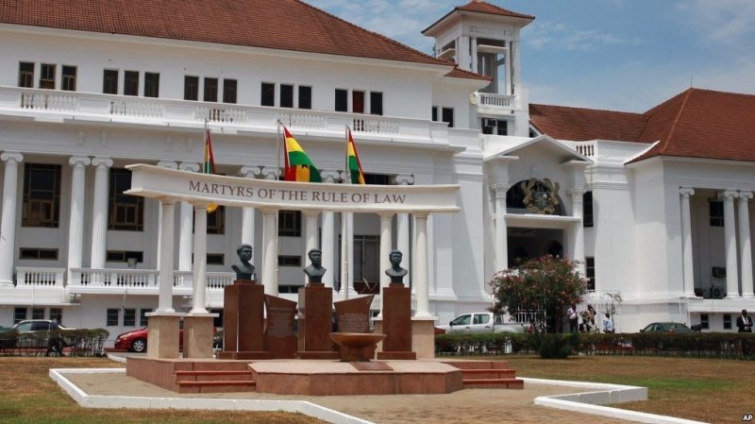
The Supreme Court on Wednesday, March 9, 2022, ruled that a Deputy Speaker of Parliament can be counted during the formation of a quorum for parliamentary decision-making and participate in voting while presiding.
The decision by the Apex Court has generated mixed reactions.
While the Majority Caucus has described it as a ‘refreshing’ outcome, many, particularly the Minority in Parliament, say the ruling is absurd and could destroy the processes in the House.
Former President John Dramani Mahama in a reaction said the Supreme Court’s unanimous ruling sets a dangerous precedent for the country’s Parliamentary procedure.
President Akufo-Addo on the other hand has stated that the ruling should put the matter to rest.
According to President Akufo-Addo, he was surprised by the furore generated on whether Deputy Speakers of Parliament could vote once they were presiding in the chamber.
It is against this background that Private Legal Practioner and host of JoyNews' "Newsfile" and "The Law" programme, Samson Lardy Anyenini, hosted two prominent Lawyers, Prof Kwaku Asare and Prof H. Kwesi Prempeh on a special edition of Super Morning Show on Monday, to provide further insights into the ruling. The show was also broadcast live on the Joy News Channel.
Commenting on the ruling, Prof Kwaku Asare stated that the ruling is not in concert with the provisions of the 1992 Constitution.
He emphasised that the 1992 Constitution does not make any provision for the Deputy Speaker to retain his vote while presiding over proceedings in the House.
He argued that “the 1957 Constitution had an explicit provision that the Deputy Speaker retains his original vote. The 1992 Constitution [on the other hand] specifically rejects that provision,” hence the ruling is not textual in relation to the 1992 Constitution.
The Executive Director of the Centre for Democratic Development (CDD)-Ghana, Prof H Kwesi Prempeh on the other hand said he found nothing wrong with giving the Deputy Speaker the powers to vote even if he's presiding over proceedings in the House.
He argued that as long as presiding Deputy Speakers are, first and foremost, MPs elected to represent communities of voters in Parliament, Parliament cannot reasonably deprive them of their right to vote merely by virtue of the fact of presiding over a sitting of Parliament.
Prof Kwesi Prempeh opined that Parliament should have applied to join as a party in the case brought before the Supreme Court by the plaintiff, Justice Abdullai.
He stated that at least, the Office of the Speaker could have found it expedient to exercise that right while the case was being adjudicated.
He explained that it was inappropriate for the Attorney-General (A-G) to be the only defendant or party to join the case since he represents the state or the government.
“In certain matters involving independent branches of government or agencies of the state, I think it is not appropriate to let the Attorney-General be the only party that is joined or the only defendant.
“Even before this judgement came up, when I saw the case I thought; ‘where is Parliament in this, where is the Speaker in this?’ I actually expected that the Parliament or the Speaker at the very least, would join the matter because that opportunity is there,” he told Samson Lardy Anyenini.
Prof Kwaku Asare also said Parliament needs to have a proper representation in Court to defend issues that impact its governance and structure.
He noted that it is inappropriate for the court to demand the revocation of a particular Parliamentary procedure where the House has no representation in the hearing or determination of a suit filed against it.
Prof Asare therefore suggested that it is high time Parliament gets its own counsel, instead of relying on the Office of the Attorney-General.
The KPMG Professor of Accounting stressed that “Parliament is a body and that body can have a representation.”
He explained that “the representation will not be for the Speaker or the Deputy Speaker or any individual Member of Parliament. It will be for Parliament.”
Prof H. Kwesi Prempeh noted further that “the Speaker can give input to the counsel, the Deputy Speakers can give input to the counsel but Parliament as a body can be represented and Parliament should consider getting its own attorney."
Latest Stories
-
Gov’t targets recruitment of 16,500 health professionals in 2026
6 minutes -
Two-week strike will not derail academic calendar – GNAT President
21 minutes -
Headmaster detained after BBC investigation into alleged sexual abuse of students
30 minutes -
GNAT pushes for clear implementation procedures of teachers’ conditions of service
50 minutes -
Recurrent strikes threaten quality of education and academic calendars – Prof Bokpin
53 minutes -
‘Cockroach’ group leaders among hundreds detained in Delhi protest
57 minutes -
Don’t let speed of information become your judgement – CJ tells new lawyers
2 hours -
World Cup visa scandal: People have leveraged public office to facilitate fraud – Senyo Hosi
2 hours -
Glut! Farmers count losses as prices crash, customers happy
2 hours -
GSA postpones auction of unserviceable vehicles
2 hours -
Man charged with attempted murder after stabbing
2 hours -
World Cup visa scandal: Senyo Hosi says issue goes beyond calls for Sports Minister’s resignation
2 hours -
Yaw Ampofo Ankrah hasn’t taken or received any money to facilitate visas – Lawyer insists
3 hours -
World Cup visa scandal: Senyo Hosi urges focus on constitutional accountability
3 hours -
La Beach demolition: Senyo Hosi condemns lack of consultation
3 hours