

Audio By Carbonatix
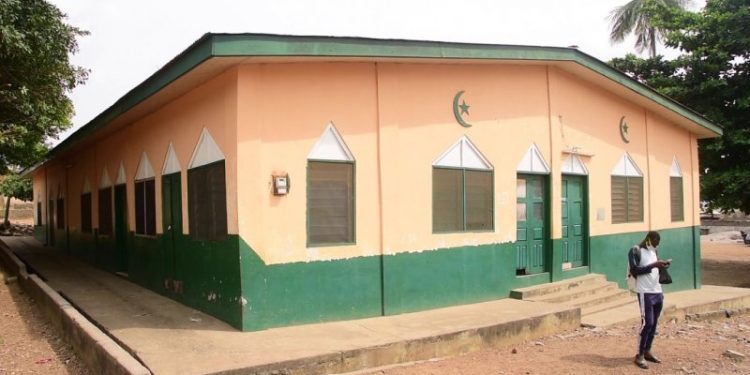
A simmering leadership crisis within the Muslim community of the Volta regional capital has reached a boiling point following a directive from the Volta Regional Security Council (REGSEC) to shut down the Ho Central Mosque.
The closure for a duration of two weeks was ordered in consultation with the Ministry for the Interior.
However, the Ulema of the Ho Zongo Community has reacted with fierce opposition, characterising the move as an affront to the rights of a peaceful congregation.
The Ulema maintains that for decades, the Ho Central Mosque has been a beacon of tranquillity.
According to their statement, the current unrest was not a spontaneous community brawl but a calculated intrusion by an outside faction.
The community alleges that a group—backed by armed men—forcefully breached the mosque’s perimeter.
Reports of gunshots fired within the sacred premises have particularly incensed the leadership, who argue that the sanctity of their place of worship was violated by criminal elements.
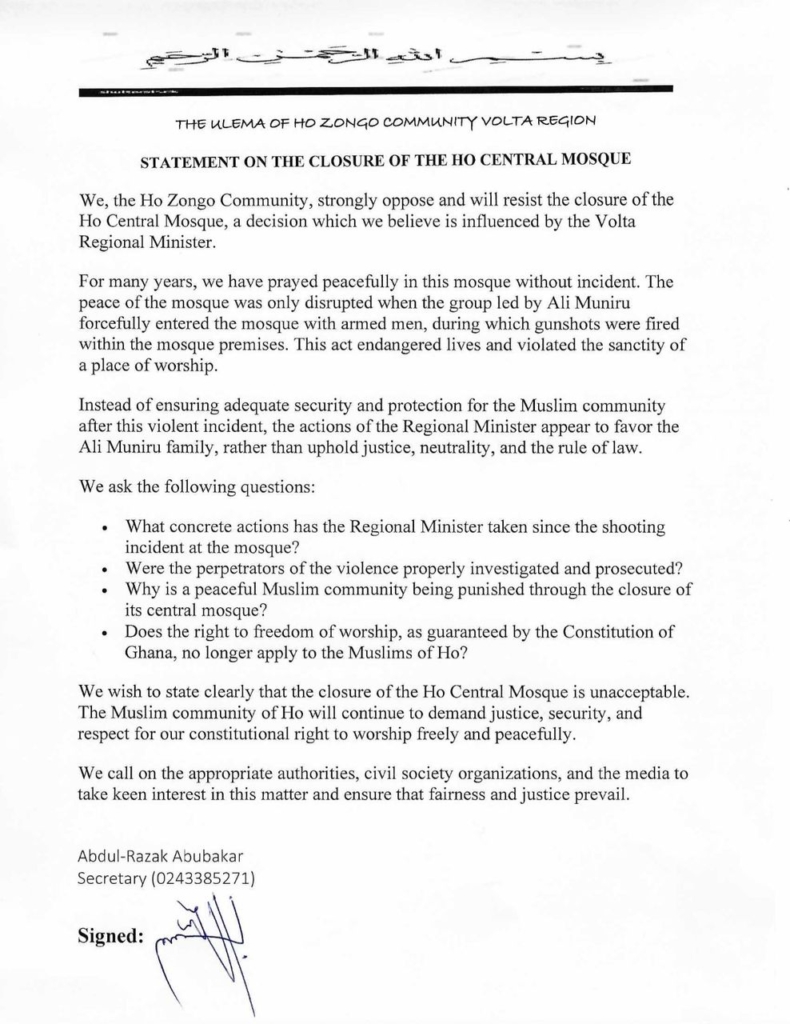
In a strongly-worded communiqué signed by the Secretary of the Ho Zongo Community, Abdul-Razak Abubakar, the leadership questioned the logic behind punishing the entire worshipping body for the actions of a violent few.
The Ulema raised three critical concerns regarding the REGSEC directive:
- Security vs. Closure: Why authorities opted for a shutdown instead of stationing adequate security to protect peaceful worshippers.
- Lack of Accountability: The perceived failure of the police to arrest and prosecute the individuals who brought firearms into the mosque.
- Neutrality: Allegations of "selective actions" by regional authorities that appear to tilt the scales in favour of one faction rather than upholding the rule of law.
The Regional Security Council defended the two-week cooling-off period, citing the need to prevent potential bloodshed during the ongoing leadership dispute.
Such closures are often used as a "stop-gap" measure under the Public Order Act to de-escalate tensions in volatile religious or chieftaincy conflicts.
However, the Ho Zongo leadership remains unconvinced.
“Muslims in Ho have worshipped peacefully at the mosque for many years without incident,” the statement reminded the public, placing the blame squarely on the "armed group" that initiated the fracas.
The Ho Zongo Community is now looking beyond the regional administration for a resolution.
They have appealed to the National Peace Council, Civil Society Organisations (CSOs), and the media to scrutinise the handling of the dispute.
The statement concluded with a plea for transparency:
“The appropriate authorities, civil society organisations and the media [must] take a keen interest in the matter to ensure fairness and justice prevail.”
Latest Stories
-
Over 38,000 commercial, 150,000 residential customers unbilled – Ghana Water MD
12 minutes -
Several injured as Sprinter bus collides with ‘trotro’ at Odorkor
12 minutes -
Ghana records progress on reparatory justice agenda – Ablakwa
29 minutes -
Mahama commissions Christian Tetteh Yohuno Ward Complex at Police Hospital
45 minutes -
Vice President calls for wider access to Ghana’s political party histories
45 minutes -
Republic Bank JoyNews Habitat Fair to connect prospective homeowners with exhibitors in Ho from October 16 to 18
55 minutes -
Obaasima Summit: ‘AI is not a spiritual attack’ — Rev. Dr. Ofori-Boateng urges young women to embrace technology
1 hour -
GHS to distribute 80,000 pairs of locally-made protective footwear to health workers
1 hour -
GoldBod boosts local jobs as 90% of gold undergoes refining in Ghana – Sammy Gyamfi
1 hour -
The search for the politically unblemished: Are we asking the impossible of public appointees?
1 hour -
Ghana seeks climate finance access for debt-restructuring countries
1 hour -
Afenyo-Markin urges stronger media scrutiny of public institutions
1 hour -
GoldBod recovers GH¢38.7m in legacy PMMC debts, targets remaining arrears
1 hour -
62 out of every 100 commercial meters inspected missing from Ghana Water database – MD
1 hour -
GoldBod gets BoG authorisation to sell forex, Sammy Gyamfi tells PAC
2 hours