

Audio By Carbonatix
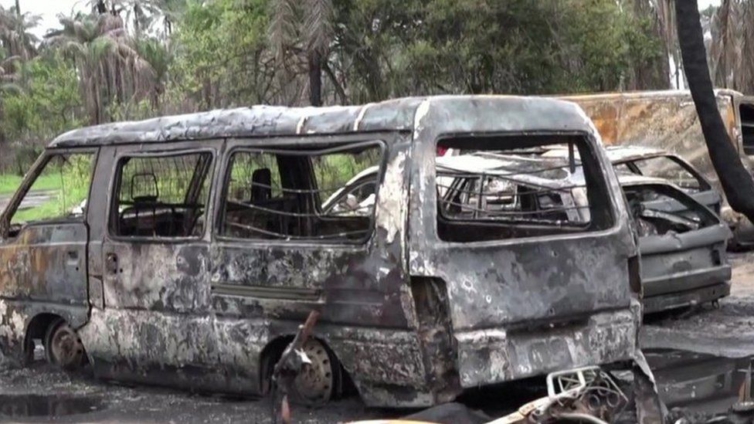
Nigeria's president has said the country is in "shock and trauma" following the deaths of at least 100 people from an explosion at an illegal oil refinery.
President Muhammadu Buhari described the incident in Imo state, southern Nigeria, as a "catastrophe and a national disaster".
Many victims were burnt beyond recognition.
The police are now looking for the owner of the illegal refinery.
The damage to fishing and farming caused by the oil industry over the decades and the failure to share the oil wealth has led some to find other ways to make money.
Illegal refining is attractive as in parts of the oil-rich Niger Delta it is seen as being relatively easy to pull off, despite efforts to halt the practice.
Dozens of people were thought to have been working at the refining plants when they were caught in the huge fire.
The death toll has risen as emergency workers go through the scene. Ifeanyi Nnaji of the National Emergency Management Agency told BBC Igbo that the number killed now stood at 109.
"We learnt many bodies are in nearby bushes and forests as some illegal operators and their patrons scampered for safety," he earlier told the AFP news agency.
Charred human remains, as well as fragments of belongings, such as flip flops, bags and clothing, were witnessed across the scene of the disaster by a journalist for the Reuters news agency.
In a statement on Sunday, Mr Buhari offered his condolences to families of the victims and said those responsible for the explosions must be caught and brought to justice.
The authorities have been struggling to curb the proliferation of illegal plants where stolen crude oil is refined. The president ordered security forces to intensify efforts to shut these refineries.
It is not yet clear what caused the explosion that happened sometime overnight into Saturday, but accidents have been common in the past at similar dangerous sites where safety measures are not enforced.
There have been concerns over a lack of precautions at such facilities as well as over the environmental pollution they cause.
But Nigeria's official oil refineries do not work to capacity, causing frequent fuel shortages and price increases across the country.
Latest Stories
-
Africa World Airlines unveils first Embraer E190 as part of 10-aircraft fleet expansion
5 minutes -
Civilian hospitalised after alleged machete attack by prison officers
22 minutes -
Toobu rejects calls to recall Parliament over 3.9-tonne cocaine shipment
1 hour -
Residents in 5 Northern Regions warned of approaching rainstorm
1 hour -
Constituency Games still a work in progress – Sports Minister
1 hour -
Team Ghana set for historic Karting Africa Showrun in Angola
1 hour -
52-year-old South African arrested with suspected heroin after arriving from Accra
2 hours -
Shatta Wale challenges UPSA students to build entrepreneurial mindsets
2 hours -
Finance Minister advises African governments to strengthen regional tax cooperation
4 hours -
NPP accuses NDC of master-minding demolition of Ho regional office fence
4 hours -
Ghana plans stronger regional power trade with Nigeria
4 hours -
GRA Commissioner-General calls for stronger tax cooperation to boost regional revenue mobilisation
4 hours -
NACOC needs more personnel to tackle drug trafficking – Toobu
4 hours -
Railway workers resist KMA eviction order, demand consultation
4 hours -
Legacy Leadership Africa Institute to host boardroom women’s leadership programme
4 hours