


Audio By Carbonatix
Fitch Solutions has maintained that Ghana will reach a staff-level agreement with the International Monetary Fund (IMF) by the first quarter of 2023.
This will mean that the country could secure a programme from the Fund by the end of quarter 1, 2023 or the second quarter of 2023.
Some economists and experts were anticipating that the country could reach a staff-level agreement with the Fund before the end of 2022 to pave way for a programme by the first quarter of 2023.
But in its latest paper on “Division within Ghana's Ruling Party to Weigh on Political Stability”, the international research firm also said should the Finance Minister, Ken Ofori-Atta, be replaced, negotiations with the IMF would likely remain largely unaffected.
“While Ofori-Atta remained opposed to an IMF bailout – we believe that he would take a more accommodative approach towards negotiations with the Fund. As such, we believe that a change of finance minister would most likely not impact the timeline of IMF negations and we would retain our view that a staff-level agreement will be reached in Q123 [quarter 1, 2023]”, it explained.
Government to face additional pressure from frequent protests
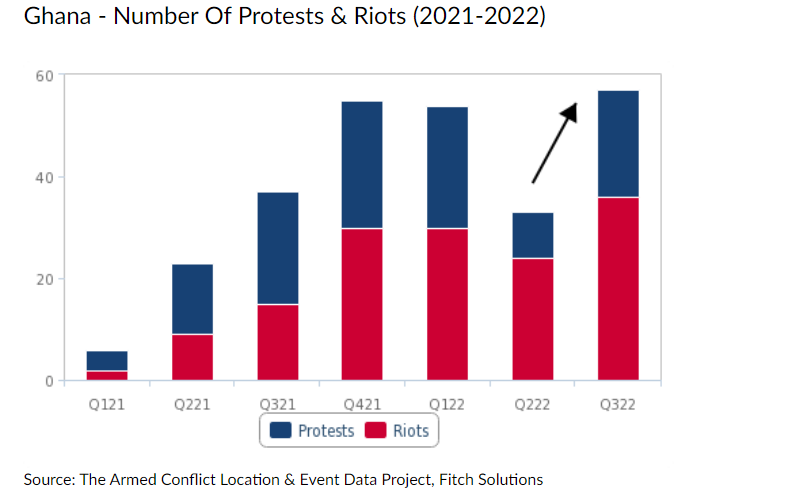
Furthermore, it said the government will face additional pressure from more frequent protests and industrial action.
“Worsening living standards amid rising consumer prices – inflation reached 40.4% year-on-year in October 2022, the highest reading since 2001 – and tighter monetary conditions have led to a 72.7% quarter-on-quarter increase in protests and riots across in quarter 3 2022. The country has also seen large industrial action in recent months, including a three-day retail strike in Accra in October [2022]".
Inflation to remain elevated, weighing on living standards
Fitch Solutions also expects inflation to remain elevated in the months ahead.
“Given that inflation is primarily driven by currency weakness, we expect price growth to remain elevated in the months ahead. Indeed, significant capital and financial account outflows caused by weakening investor sentiment will continue to weigh on the currency”.
“Our view is further informed by the fact that previous periods of significant exchange rate weakness in Ghana all lasted roughly 12-14 months, suggesting that the cedi will continue to depreciate into quarter 1, 2023 (the current sell-off started in January 2022). This will keep inflation high, weighing on living standards and eroding support for the government”.
Latest Stories
-
What Is Wrong With Us: The roads that keep counting our dead
3 minutes -
MTN condemns recent xenophobic attacks on Ghanaians in South Africa
7 minutes -
Philip Nai: What happens at your front desk can make or break your brand
18 minutes -
Ghana’s mining deaths fall sharply, but Chamber insists ‘three deaths are too many’
2 hours -
Tatale Sanguli officials destroy expired food products, warn traders
2 hours -
Police arrest two watchmen over alleged defilement of 14-year-old student
2 hours -
The woman behind General Mosquito: Could Ghana be meeting its next First Lady?
2 hours -
Court remands man over alleged Labone bank robbery attempt
2 hours -
Supreme Court to rule on injunction application on legal vacation today
2 hours -
Tamale Metropolitan Assembly distributes 10,000 bags of fertiliser to farmers
2 hours -
TUSAAG suspends strike, resumes work after renewed talks with government
2 hours -
PIAC marks 15 years of oil revenue accountability and transparency
2 hours -
Adongo calls for non-political interference in $1.46bn Heritage Fund review
2 hours -
FDA records GH¢70m surplus in 2025 amid concerns over ageing lab equipment
2 hours -
Arise Ghana demands stronger commitment to end galamsey
2 hours