

Audio By Carbonatix
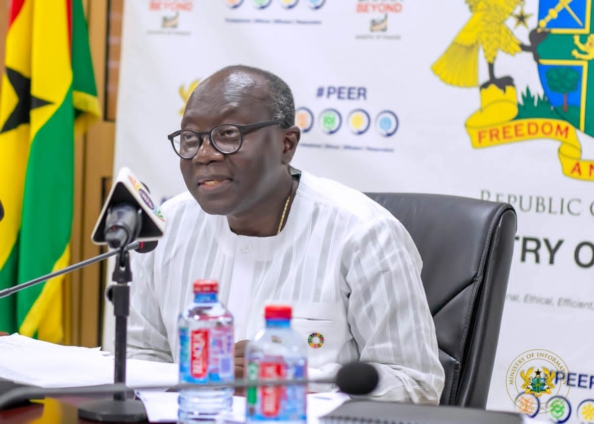
Finance Minister, Ken Ofori-Atta has described the Economic Enclave Project (EEP) as a watershed moment in Ghana’s economic history.
According to him, the EPP through the Ghana CARES programme would provide a catalytic framework to holistically address the structural challenges in the economy by shifting Ghana from import-driven to a self-sufficient and export-oriented economy.
The Economic Enclave Project under the Ghana CARES programme is a 10,000-acre mixed-use economic space which seeks to create a viable ecosystem for the private sector to engage in commercial farming.
The objective is to significantly expand Ghana’s productive capacity in rice, tomato, maize, soya, vegetables, and poultry. The EEP complements existing government agriculture initiatives (e.g. Planting for Food and Jobs and Rearing for Food and Jobs) as a targeted effort to assist the private sector to engage in commercial agriculture.
About 200,000 jobs (105,000 direct and 95,000 indirect jobs) are expected to be created by the EPP for unemployed youth, which would also provide them with a decent source of income, with beneficiaries undergoing mandatory training on good agronomic practices in rice production, group dynamics and entrepreneurship.
Mr. Ofori-Atta extended government’s invitation to individuals, private sector actors, organised groups, churches, traditional leaders, and financial institutions who could secure or own 1000 acres and above, to come on board.
“We will provide support such as land development and facilitate access to credit, including the recently approved 500million from the Development Bank Ghana” he assured.
“This is a real and collective effort to replicate the images of the mass land of cultivated fields we see while flying over other countries that are characterized as the “food baskets” of the world”, he added.
He further pointed out that the project would also help the country improve its food security and enable it to eventually optimize the single market opportunities that the African Continental Free Trade Area (AfCFTA) offered.
The implementation of the EEP is led by the Millennium Development Authority together with the key partnership of the Ministry of Finance, Ministry of Food and Agriculture, Ministry of Defence, Ministry of Energy, Ministry of Roads and Highways, Ministry of Lands and Natural Resources and the Ghana Irrigation Development Authority.
The rest are National Entrepreneurship and Innovation Programme; Ghana Incentive-based Risk-Sharing System for Agricultural Lending, Private Agriculture Value Chain Actors, MasterCard Foundation and the Youth.
The project is expected to be extended to the Greater Accra, Ashanti, Central, Western North, Savannah and Oti regions.
Latest Stories
-
Accra ranks among world’s top 20 cities for nightlife in 2026
40 minutes -
Police arrest two suspects over murder of Yidani chief and son
54 minutes -
How Albert Bondah, Fredima, Socrate Safo, Counselor Lutterodt engineered Dan Kwaku Yeboah’s comedy show
1 hour -
Yidani chief’s murder: Police arrest two suspects following intelligence tip-off
2 hours -
Government to connect 206 Volta communities to national grid within six months – Energy Minister
2 hours -
Petrol, diesel and LPG prices expected to rise marginally in September – COPEC
2 hours -
Canada installs large Lake Ontario sign in latest jab at US
2 hours -
Energy Minister commends Roads Minister for massive road projects in Volta Region
2 hours -
Executive support professionals must reposition as strategic partners – Centre for Executive Development
3 hours -
Ablakwa calls for end to African conflicts, urges leaders to create jobs
3 hours -
NSMQ 2026: Prempeh College withstands late Keta SHTS push to grab first semi-final spot
3 hours -
7 feared dead at reclaimed mining site in Atiwa East
4 hours -
Ghana Immigration Service removes 1,055 street beggars from the streets of Accra and Kumasi
4 hours -
Ghana @70: Litina outlines support services for diaspora visitors seeking to reconnect with Ghanaian roots
4 hours -
Boat carrying nearly 270 people capsizes off northern Cyprus
5 hours