

Audio By Carbonatix
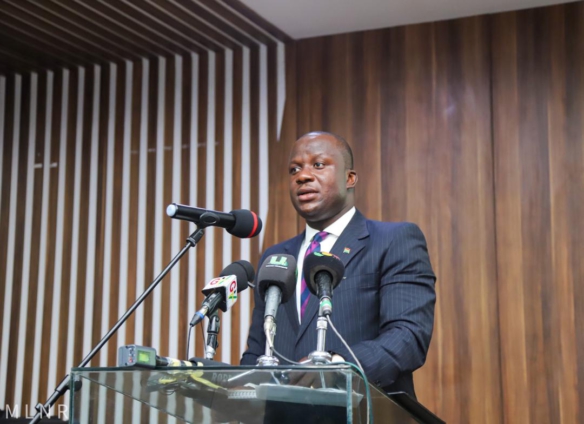
The government has strengthened the enforcement system by increasing the punishment for persons convicted for engaging in illegal mining activities, the Minister for Lands, and Natural Resources, Samuel Abu Jinapor has announced.
According to him, the ‘Operation Halt II’ also continues to support the enforcement measures, and said all prosecutions pertaining to illegal mining activities were undertaken by the Office of the Attorney-General.
The Lands Minister said about 119 cases involving 727 accused persons were pending before the Courts for various offences relating to illegal mining in the Eastern, Western and Ashanti Regions.
He added that the figure excluded 187 people convicted and sentenced to various terms of imprisonment in the Eastern Region last year.
Mr Jinapor made the announcement at the opening of a two-day transformational dialogue on artisanal and small-scale mining under the theme, 'Sustaining Environmental Security and Human Right in Small Scale Mining Operations in Ghana,' at Fiapre in the Sunyani West Municipality.
The programme, initiated by the University of Energy and Natural Resources (UENR) aimed at bringing together various stakeholders to deliberate on the issue and jointly make efforts towards a common direction.
It was attended by politicians, traditional leaders, students, members, and staff of the UENR, artisans and small-scale miners, civil society actors, representatives of large-scale mining companies and the media.
Mr Jinapor observed small-scale mining impacts a number of human rights, including the right to life, health, safe environment, water, property and development which needed to be addressed as a matter of high public interest.
He said Ghana was blessed with abundant mineral resources, which if managed properly could provide a strong base for the livelihoods of the people.
But improper management of the mineral resources through illegal mining was plaguing the country now, hence most environmentalists had been advocating that mining was just a destruction and must be stopped completely, Mr Jinapor stated.
He said mining must be done sustainably and responsibly to protect the natural environment and the rights of persons being affected by it, because that industry continues to be the bulwark of the national economy.
Professor Elvis Asare-Bediako, the Vice-Chancellor of the UENR said the institution initiated the dialogue as a way of contributing to promote responsible mining to ensure industrial and associated environmental best practices for the country’s sustainable development.
Latest Stories
-
Ghana gets new legal framework to coordinate social protection programmes
29 seconds -
DVLA plans 24-hour services as digital transformation gathers pace
5 minutes -
NACOC calls for stronger cross-border cooperation to tackle drug trafficking
7 minutes -
AFCON 2027Q: Partey back in training ahead of Côte d’Ivoire, Gambia clashes
14 minutes -
Cedi to end year at GH¢12.20 to a US dollar – Databank Research
17 minutes -
Ex-Spurs midfielder Bissouma completes Ajax move
21 minutes -
Gender Ministry targets 16 regional shelters for survivors of abuse
22 minutes -
Venezuela opposition leader Machado weighs return home amid US reticence
24 minutes -
37 Nsawam Prison inmates sit for Teacher Licensure Examination
25 minutes -
19,760 persons with disabilities benefit from Disability Common Fund – Minister
26 minutes -
Former Kosovo president Thaci sentenced to 25 years for war crimes
29 minutes -
‘Huge and heavily-laden’ SHS prospectus burdens parents, time to review – Dafeamekpor
31 minutes -
Gov’t commits nearly GH¢2bn to School Feeding Programme, reaches 4.5m children
33 minutes -
Over a million Ghanaians reached in nationwide child rights campaign – Gender Minister
36 minutes -
Over 226,000 households graduated from extreme poverty after LEAP reassessment – Gender Minister
40 minutes