

Audio By Carbonatix
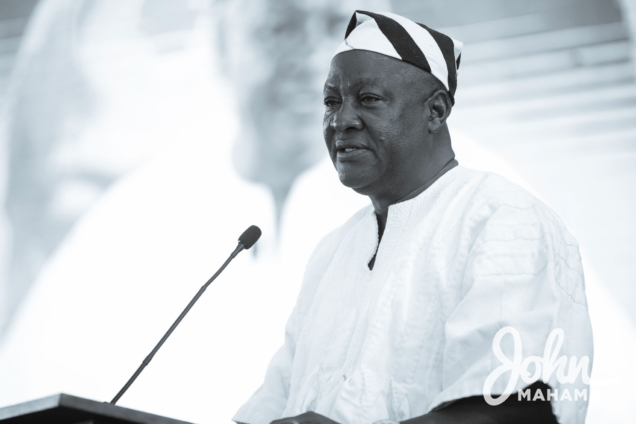
Former President John Mahama has reiterated his promise to restore the licences of some financial institutions that collapsed as part of a banking sector clean-up by the New Patriotic Party (NPP) administration.
According to Mr Mahama, this move will revive the banking industry and boost financial confidence.
Speaking at the 7th Ghana CEOs Summit and Expo held at the Kempinski Hotel in Accra, the newly elected flagbearer of the opposition NDC said, the gesture will also offer opportunities for experienced banking professionals who were laid off during the reforms to “move from the menial jobs that they were forced into with the closure of the indigenous banks.”
He argued that the Akufo-Addo-Bawumia government spent more money after closing down financial institutions that could have been allowed to operate with less financial support.
“I cannot to this day understand why a GH¢4 billion problem was made to cost the taxpayers GHS25 billion. These banks were asked to capitalize to GHS400 million, and if there were even 10 of them, that would be GHS4 billion and yet with the closure of banks, we incurred a public debt of GHS25 billion guaranteeing depositors' accounts.”
In view of this, the former President said he was convinced that the decision by the NPP government to shut down these financial institutions was mainly political.
“Indeed, for some of these banks, there was no problem. It was purely politics or personal vendetta. One bank was shutdown solely because its principal shareholder was being investigated for corruption in a case involving a state enterprise.”
Mr. Mahama further added that for businesses in the country to thrive, government must be apolitical in how it deals with the private sector.
“We must create an environment where businesses are allowed to grow no matter their political, ethnic or other colorization," he said
About the banking sector cleanup
The government in 2017 undertook the banking sector clean-up under the supervision of the Finance Minister, Ken Ofori-Atta.
The exercise saw a reduction in the number of banks from 34 to 23, whilst 347 microfinance institutions, 15 savings and loans and eight finance houses had their licences revoked.
A number of the institutions that had the licences revoked were found to have varying degrees of corporate governance lapses.
The total estimated cost of the state’s fiscal intervention, excluding interest payments, from 2017 to 2019 was pegged at GH¢16.4 billion.
The government in 2020 claimed that it spent about GH¢21 billion on the banking sector clean-up exercise.
Some of the financial institutions that disagreed with the revocation sued the government and the cases are still pending in court.
Latest Stories
-
Cyber Security Authority: Ghana led Operation Blackout, not FBI
4 minutes -
GH¢800,000 goods destroyed as fire engulfs Kia Rhino truck on Apedwa-Kibi Road
35 minutes -
Chief Justice calls for supportive workplaces to address mental health stigma
35 minutes -
NVI CEO defends GH¢13m spending on training, workshops and conferences
36 minutes -
Ghana targets first locally manufactured vaccine by 2027
39 minutes -
Teachers suspend strike after reaching agreement with government
50 minutes -
Council of State describes talks with striking teachers as fruitful
1 hour -
Adjaye Associates opens new Accra studio with public space for cultural exchange
1 hour -
BoG to issue new Credit Risk Directive as NPL ratio in the Savings and Loans sector deteriorates
1 hour -
You can preach in a stationary vehicle, but not when it’s moving – Mahama clarifies
1 hour -
Alhaji Iddrisu Mustapha: The educated professional seeking to bring experience to NDC Western Region leadership
2 hours -
Former Deputy Trade and Industry Minister Nana Ama Dokua called to Ghana Bar
2 hours -
Old Edubiase Methodist Basic School pupils turn traders, farmers as teachers’ strike bites harder
2 hours -
Prudential Bank secures GH¢1.13bn investment from Bloom Africa
2 hours -
Ernest Kwasi Okoh
2 hours