

Audio By Carbonatix
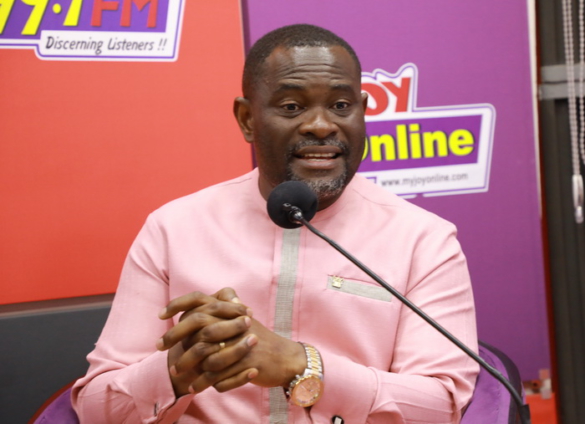
Deputy Finance Minister Dr John Ampontuah Kumah is assuring the public of government’s resort to restore public debt sustainability in order to recover the economy.
He says government intends to undertake structural reforms such as; introducing tax policy reforms, revenue administration changes and public financial management systems.
According to him, sectors which also require optimum attention include the cocoa and energy sectors, stating that the expenditure inefficiency and the issue of lack of consistency in the payment of monies to sustain electricity flow need to be addressed respectively.
“We also want to focus on certain structural deficiencies in the economy. For instance, the cocoa sector; the amount of expenditure inefficiencies in the cocoa sector have to be addressed.
“The energy sector; the Independent Power Producer (IPP) commitment and regular payment you need to do to sustain the electricity to be on – some efficiencies have to be improved,” he said on JoyNews’ Newsfile on Saturday.
He added that should the inefficiencies that have characterised government’s expenditure be addressed, arguments against its flagship programmes would become mute.
Speaking on government’s flagship programme, the minister argued that the flagship programmes are necessarily not the cause of Ghana’s fiscal issues.
He cited that government’s budget for 2023 was about ¢190 billion. Out of this, he said ¢56 billion has been apportioned for debt repayment whereas ¢45 billion is going into compensation and wages.
Another ¢35 billion has been budgeted for statutory payment obligations and about ¢16 billion for goods and services.
According to him, budgetary allocation for government’s Free S.H.S policy for 2023 was just ¢2.9 billion, an amount to educate “1.3 million of the population,” adding that there is nothing wrong with that.
Dr Kumah, therefore, speculated that people arguing that the government’s flagship programmes are incurring fiscal challenges are just being sentimental. He expressed that contrary to the perceptions, debt obligations have been responsible for the fiscal challenges. This, he said informed the government’s pursuit of an International Monetary Fund (IMF) programme.
Latest Stories
-
Ghana’s fuel market is built for turbulence – NPA’s Edudzi Tamakloe explains why
1 hour -
Postponement not an option as Kenya races to be ready for Afcon 2027
2 hours -
ICE agent shoots and wounds man in Texas as locals demand answers
2 hours -
Ed Sheeran admits ‘mistakes’ at first show since Macklemore controversy
2 hours -
We are ready for the turbulence – NPA boss on Ghana’s fuel crisis
3 hours -
Lady I wanted serious relationship with said she’s not ready – Rema
3 hours -
I’ll never discuss my finances with man, even if he’s my husband – Nancy Isime
3 hours -
Wizkid, Wande Coal advised me on how to leave school for music – Davido
4 hours -
Senegal job an ‘absolute dream’ for new boss Vieira
4 hours -
Harry and Meghan’s media treatment echoes what happened to Diana, Earl Spencer tells BBC
4 hours -
Nvidia boss rejects AI extinction fears as ‘doomsday narratives’
4 hours -
Workers came across human remains – and unearthed a mass grave of 572 people
4 hours -
Each Jehovah’s Witness member now decides whether to accept or donate main blood components
4 hours -
Trump says US will form ‘AI Force’ and appoint an artificial intelligence tsar
5 hours -
Google’s Gemini AI hacked three companies in security test
5 hours