

Audio By Carbonatix
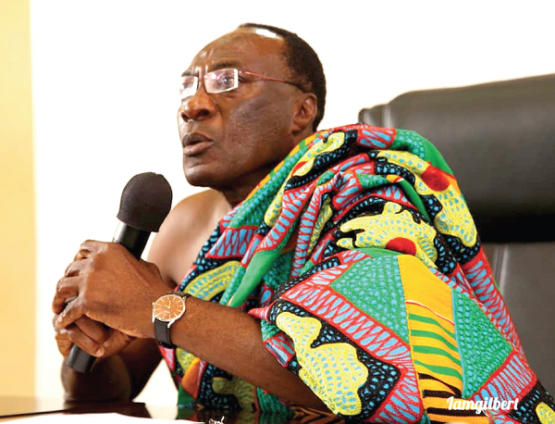
A Paramount Chief of the Anfoega Traditional Area, Togbe Tepre Hodo IV is lauding the Supreme Court’s ruling against chiefs engaging in partisan politics.
According to him, the ruling clarifies what chiefs can and cannot do when politicians visit their area.
“Basically, I think it was a terminal decision by the Supreme Court which ought to be commended,” he said in an interview on JoyNews’ The Probe on Sunday, June 4.
In a unanimous ruling this week, the Supreme Court established that any chief who publicly or covertly urges his subjects to support a specific political party, has violated Article 276(1) of the 1992 Constitution of the Republic of Ghana by engaging in "active party politics."
The verdict was rendered in response to a request from an LLM student requesting that the Apex Court use its original jurisdiction to clarify what is meant by active party politics by a Chief under Article 276 Clause 1.
According to him, the provision of the Constitution in Article 276 Clause 1 was ambiguous.
He added that for this reason, most chiefs were unable to ascertain what was constitutional or not.
But Togbe Hodo IV added that he could be confident that the recent decision from the Supreme Court will prompt the members of the various Houses of Chiefs to read the verdict and familiarise themselves with where to draw the line when dealing with politicians.
He also emphasised there is a difference between a chief endorsing the candidature of a politician and a chief lauding the policy of a government or a politician.
He then contended that the Supreme Court’s current interpretation of what chief participation in active politics means was very clear and void of ambiguity.
As the country prepares for elections, he emphasised the importance of intensifying education about the many circumstances that could come off as a chief taking part in active politics.
This, Togbe Hodo IV explained, will help chiefs become more aware and prudent.
The paramount chief further pointed out that the essence of the verdict is to guide and regulate the conduct of chiefs in order to avert unnecessary conflict.
He, therefore, advised that “chiefs, as leaders of the community, need to be guarded in what they say.”
Latest Stories
-
Young Positivist writes : Waste trafficking in Ghana
2 minutes -
JoySports Invitational Tournament 2026: A look back at a day of fitness, fierce competition and fun
3 minutes -
FoSCel urges Ghanaians to know their genotype
7 minutes -
Mahama honours Nkrumah’s role in founding Non-Aligned Movement
20 minutes -
Tanker drivers demand audit and elections, cite poor representation and toll increase
35 minutes -
Bayport Ghana reports strong financial and ESG performance in 2025
41 minutes -
IGP deploys reinforcement team to contain violence in New Winneba shooting incident
43 minutes -
Two dead, 6 injured in Accra-Kumasi Highway crash
53 minutes -
Birth, death registration are mandatory – Deputy Registrar tells Ghanaians
1 hour -
GoldBod defends $1.315bn forex generation, says transactions backed by GANRAP
1 hour -
Sherif Ghali steps down as CEO of Ghana Chamber of Young Entrepreneurs after 10 years
1 hour -
Signals Bureau case: ‘I had about 60 questions’ – Atta Akyea welcomes extra cross-examination day
1 hour -
Africa’s colonial ecological debt could exceed hundreds of trillions of dollars – Report
2 hours -
Ibrahim Sulemana joins Sassuolo on loan from Atalanta
2 hours -
Former UK Prime Minister Keir Starmer to stand down as MP to focus on world affairs
2 hours