

Audio By Carbonatix
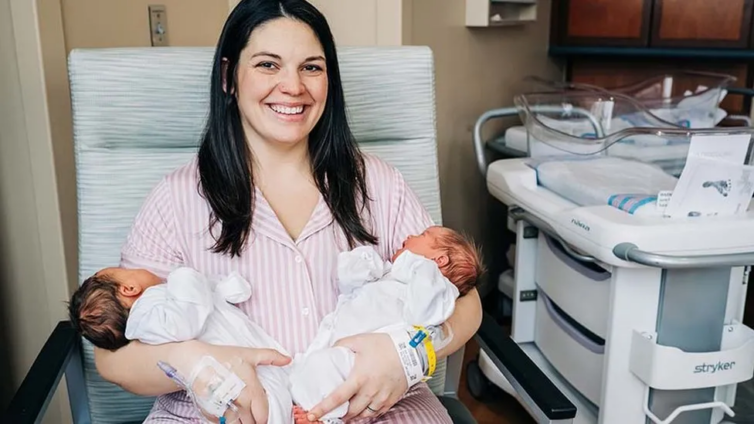
A US woman with a rare double uterus has given birth twice in two days - after a "one in a million" pregnancy and a total of 20 hours in labour.
Kelsey Hatcher, 32, delivered one daughter on Tuesday, and a second on Wednesday, at the University of Alabama at Birmingham (UAB) Hospital.
Announcing the arrival of her "miracle babies" on social media, Ms Hatcher hailed the medics as "incredible".
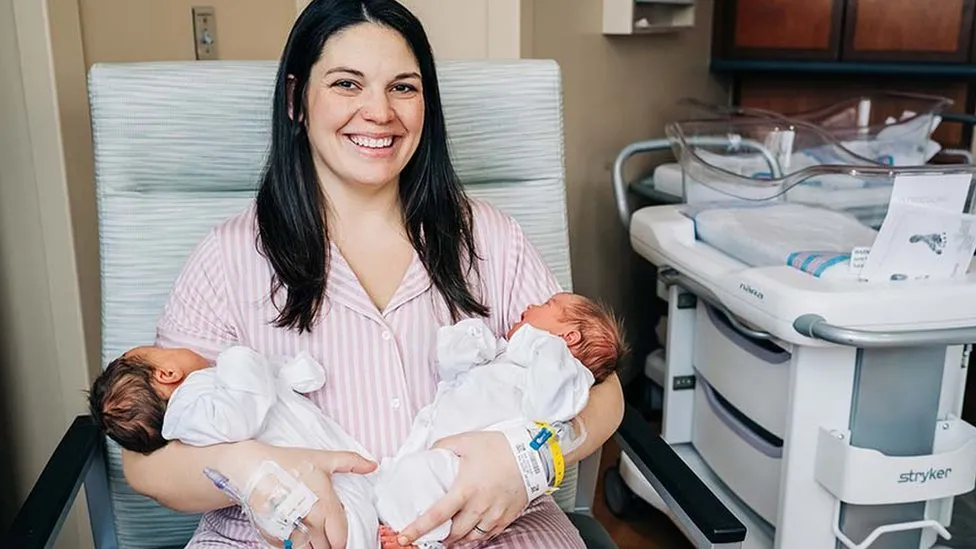
The girls are described as fraternal twins - with rare separate birthdays.
Hatcher said the family was now back at home and could "enjoy the holidays". She had previously expected a Christmas due date.
The mother was told at age 17 she had a double uterus (uterus didelphys) - which the UAB described as a rare congenital anomaly affecting 0.3% of women.
And the odds of becoming pregnant in both uteri - a dicavitary pregnancy - were even slimmer, at "one in a million", according to the UAB.
Reported cases worldwide are extremely rare. In 2019, a doctor in Bangladesh told the BBC a woman had given birth to twins almost a month after delivering a premature baby in her other uterus.
Ms Hatcher had three previous, healthy pregnancies. This time, she believed herself to be pregnant in only one uterus - until a routine ultrasound revealed there was also a baby in her second.
"I gasped... We just could not believe it," she recalled.
She went on to document her unusual journey on Instagram. One update at 38 weeks asked: "What the heck?! HOW have we made it this far?!"
UNIVERSITY OF ALABAMA AT BIRMINGHAM
The UAB described her pregnancy as routine. Prof Richard Davis, who co-managed the delivery, pointed out that each baby had enjoyed "extra space to grow and develop".
This was because each baby had a womb to itself, he said - unlike in a typical twin pregnancy.
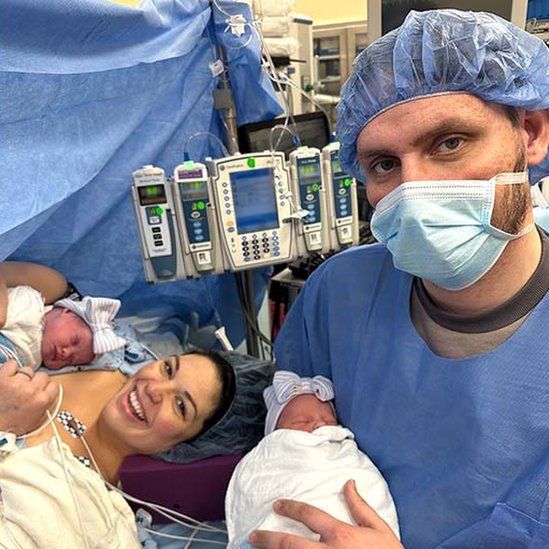
Ms Hatcher's labour was induced at 39 weeks and required double the monitoring and charting at the hospital - as well as double the staffing.
Her obstetrician described "a cheer from everyone in the room" when the first baby was delivered vaginally at about 19:45 local time on 19 December.
The second came by C-section more than 10 hours later, at about 06:10 the following morning.
Prof Davis said the girls could be called fraternal twins - a term used when each baby develops from a separate egg, each fertilised by a separate sperm.
"At the end of the day, it was two babies in one belly at the same time," he said. "They just had different apartments."
Latest Stories
-
2026 U20 WWC: 5 key Black Princesses players who will miss tournament
31 seconds -
Djokovic in tears during US Open first-round exit
5 minutes -
Yusuf Sulemana celebrates Gonja unity at Damba festival
6 minutes -
A Minister under watch: Zanetor’s burden of expectations
19 minutes -
Don’t make funding your starting point for green businesses – Entrepreneurs urged
25 minutes -
Skills gap in electric vehicles presents jobs opportunity for Ghanaian youth
32 minutes -
Mahama heads to Serbia for 65th anniversary of Non-Aligned Movement
37 minutes -
National Children’s Day 2026: Child Online Africa calls for child-led digital protection in Ghana
42 minutes -
Manasseh sets the record straight on Northshore Apparel GH; dispels 1D1F claim
43 minutes -
Supreme Court dismisses injunction bid seeking to halt Skytrain trial
47 minutes -
AU Chairperson reaffirms commitment to global African unity
56 minutes -
Air Pollution in Accra is not random; it is a burden carried by the poor
1 hour -
GEXIM Bank grows loan portfolio to GH¢1.56bn as equity hits GH¢2.1bn in 2025 – SIGA Report
1 hour -
Ghana Shippers’ Authority grows surplus by 272% as assets reach GH¢979.92m
1 hour -
Government designates 13 blocked-out areas for small-scale mining to curb illegal mining
1 hour