

Audio By Carbonatix
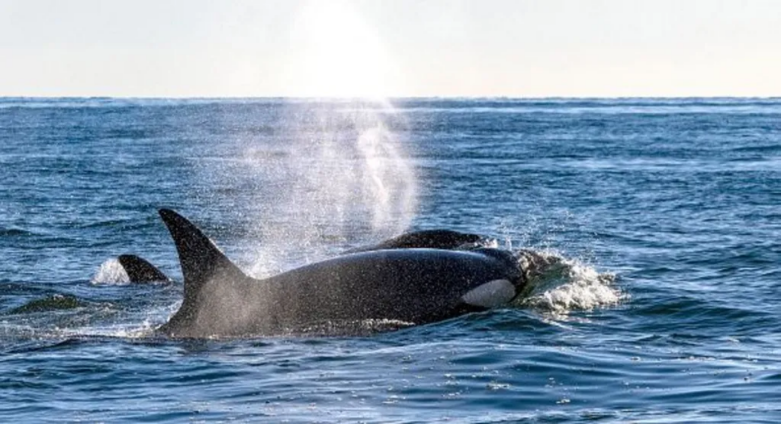
A sailing yacht has sunk in Moroccan waters in the Strait of Gibraltar after being rammed by an unknown number of orcas, Spain's maritime rescue services said.
Two people onboard the vessel, Alboran Cognac, were rescued by a passing oil tanker, after the incident at 0900 local time (0800 BST) on Sunday.
It is the latest in a series of orca rammings of vessels around the Strait of Gibraltar over the past four years.
Scientists are unsure about the exact causes of the behaviour but believe the highly intelligent mammals could be displaying "copycat" or "playful" behaviour.
Spain's maritime rescue service said the two passengers reported feeling sudden blows to the hull and rudder, causing water to seep into the vessel.
The couple alerted emergency services and were rescued by a nearby oil tanker which then took them to Gibraltar.
The yacht was left adrift and eventually sank.
Orca rammings in the Strait of Gibraltar - one of the busiest waterways in the world, with approximately 300 ships crossing daily - and off the Atlantic coast of Portugal and north-western Spain, have become increasingly common over the past four years.
Experts believe them to involve a subpopulation of about 15 orcas given the designation "Gladis".
The research group GTOA, which tracks the population of the Iberian orca sub-species, has documented nearly 700 interactions involving the species, since the attacks were first reported in May 2020.
Experts believe attacks first began after one or two orcas, which are also known as killer whales, started interacting with and damaging small sailing vessels that month.
One of the main theories that has circulated social media is that the orcas are seeking revenge for White Gladis - a killer whale supposedly hit by a boat.
That caught on when Alfredo López Fernandez, from research group GTOA, was quoted as saying a "traumatised orca" had launched the attacks.
But, according to animal behaviour experts, this might not be true.
"The idea of revenge is a great story, but there's no evidence for it," neuroscientist Lori Marino, president of the Whale Sanctuary Project previously told the BBC.
"There's never been a case of an orca harming a human being in the wild.
"If they really wanted to do damage and harm the people on the boat they could easily do that."
Instead, Lori told the BBC, it's more likely the apparent attacks "started out as play behaviour", and it's a case of copycat killer whales rather than aggression.
"We're talking about very intelligent beings, and we know that they are social learners," she says.
Scientists think the endangered mammals instead appear to be "playing" with the boats out of curiosity and copycat behaviour, rather than aggression.
Latest Stories
-
Catholic Bishops pressure gov’t to sign long-delayed mission schools agreement
13 minutes -
Cedi under fresh pressure as Christmas import demand drives dollar surge
28 minutes -
Ato Forson eyes first-week November for 2027 Budget, promises jobs and major infrastructure push
37 minutes -
SHS placement crisis deepens as Catholic Bishops demand probe into ‘protocol’ admissions
45 minutes -
SHS placement: Catholic Bishops demand probe into alleged payments for school places
1 hour -
Facts about Nigeria’s Dangote oil refinery Initial Public Offering
1 hour -
Trump says AI safety fears a ‘hoax’ as he rejects calls for greater safeguards
2 hours -
Oil climbs as Saudi pipeline outage, fresh attacks heighten supply concerns
2 hours -
Donald Trump Jr and Bettina Trump say Putin ally paid for some wedding festivities as a ‘gift’
2 hours -
EU is set to propose ban on social media and AI chatbots for under-15s
2 hours -
No SHS space shortage – GES says 800,000 places available for just over 600,000 students
2 hours -
Emmys 2026: The winners and nominees in full
3 hours -
African banks’ foreign subsidiary contributions increasing; Access Bank records fastest cross-border growth
3 hours -
Food prices in Ghana remain largely stable – AGRA report
3 hours -
Fiscal economy to remain firm despite execution risks – Databank Research
3 hours