

Audio By Carbonatix
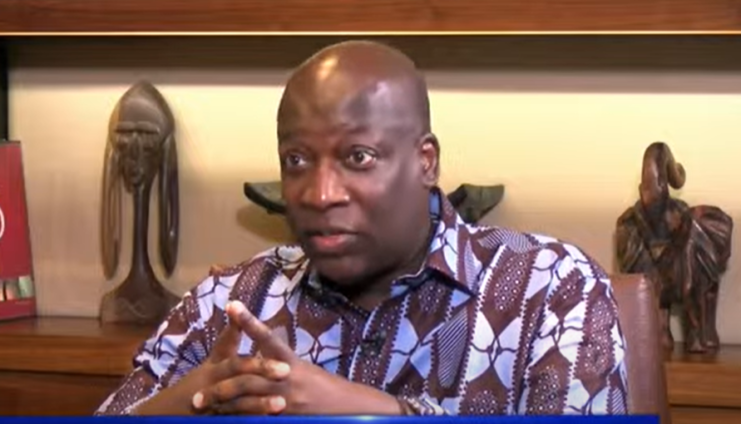
Former Executive Vice President of Unilever, Yaw Nsarkoh has shared his insights on whether the next Ghanaian government should join BRICS -the geopolitical, intergovernmental organisation comprising Brazil, Russia, India, China, South Africa, Iran, Egypt, Ethiopia, and the United Arab Emirates..
According to Nsarkoh, there are advantages to uniting smaller, fragmented entities to face global challenges, emphasising the relevance of BRICS in promoting a multi-polar world, which he believes is more beneficial for small countries like Ghana compared to a unipolar world.
"There is something to be gained in coming together, realising that we are small fragmented entities and you can't take on the world in that kind of way," Mr Nsarkoh stated.
"I think if you ask the question, between a unipolar world and a multi-polar world, which is better for small countries like us, it's not a big debate. It was very clear in our minds that multi-polarity is a better place to be. It gives you some flexibility if you know how to navigate it."
Mr Nsarkoh highlighted the importance of counter-powers emerging to challenge the main hegemonic power, noting that this is beneficial for smaller nations.
However, he also stressed the need for Ghana to have its own agenda when considering joining BRICS, pointing out the internal challenges faced by the pivotal BRICS countries themselves, such as Brazil's structural issues, Russia's political landscape, and the significant poverty in India.
"We need to have our own view about what we want from BRICS," Nsarkoh argued. "It's not just about jumping on board. I think the idea that you have people who introduce multi-polarity into the world so that their checks and balances are absolutely unassailable, in my view, that is necessary to have in the world. But if we just go and join BRICS and we do the same neoliberal short-termism and so forth that we are talking about, then absolutely nothing changes."
He criticised the lack of strategic thinking in Ghana, suggesting that the country often adopts models that may not be applicable to its current context.
He also highlighted the historical accumulation of capital through slavery and colonialism as models that may not work for Ghana today.
"If you go and take models where the massive accumulation of capital into those societies has been through slavery and colonialism, and you believe that it's going to work for you in 2024, you must first ask yourself the question, who are you going to colonise in 2024? Where are you going to source the slaves from?"
The former Executive of Unilever also discussed the importance of radical land reforms, stating that no country has achieved prosperity without such reforms unless it benefited from colonialism or slavery.
He bemoaned the complexities of land reform in Ghana, including the role of the state and chieftaincy.
“If we succeed, we will be the first in human history and I wonder why we will be the only ones. So that's a major issue. As soon as you touch on that - when I talk about this, people always get uncomfortable. If you are going to do significant land reforms, it raises the issue of the competence of the state and what is the role of chieftaincy in the modern republic.
“I don't say abolish chieftaincy but there are rogue features of chieftaincy. There are absolutely rogue features to the extent that sometimes you are not sure who really is in charge of this country," he added.
Latest Stories
-
Mining communities must be treated as development partners and economy shareholders – Sammy Gyamfi
5 minutes -
Nearly 9 metric tonnes gold refined locally this year – Sammy Gyamfi
6 minutes -
The world’s best countries for expats in 2026
10 minutes -
Social clubs must become engines of national development – Ace Anan Ankomah
11 minutes -
Harvard appoints former BoG Governor Ernest Addison as senior research fellow
13 minutes -
Sammy Gyamfi warns youth exclusion could threaten mining’s social licence
14 minutes -
Mining communities must not be left without social amenities – Sammy Gyamfi
18 minutes -
National Mining Dialogue 2026: We must remain independent in reporting on mining — GJA President
26 minutes -
Social licence must be reimagined as a development compact with the youth – Sammy Gyamfi
27 minutes -
Give indigenous landowners control to curb irresponsible mining – Dr Nana Kwao Adarkwa
35 minutes -
Interior Minister urges religious leaders to protect Ghana’s tradition of tolerance
37 minutes -
In Pictures: Dignitaries, stakeholders gather for National Mining Dialogue 2026
44 minutes -
BoG inaugurates Financial Advisory Council to drive non-interest banking in Ghana
46 minutes -
Mineral right is a privilege, not an absolute right – Minerals Commission
47 minutes -
Ablakwa seeks Russian support for Africa-led fight against Sahel extremism
59 minutes