

Audio By Carbonatix
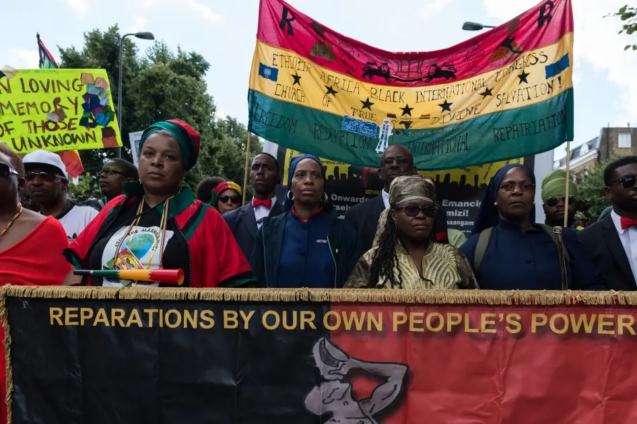
A former Unilever Executive Vice President, Yaw Nsarkoh, has cautioned African leaders against reducing the reparations debate to what he describes as an “escapist route” in the search for development financing.
Speaking on Joy News’ PM Express on Tuesday, he acknowledged the moral basis for reparative justice but warned against unrealistic expectations.
“The moral justification for that injury was done through the process; it’s unassailable,” the business executive and independent consultant said.
However, he urged a practical assessment of what reparations mean in today’s world.
“But then you must also place what we are trying to do in the real world,” he argued, questioning who exactly should benefit.
“To whom, as the return from reparations go, why shouldn’t it be given to the people in the diaspora, who, in a sense, were the most dislocated?”
He also challenged assumptions about Western economies' capacity to meet great financial demands.
“Are the economies that we are demanding this from, even in a position to pay those sorts of monies that we are talking about?” he asked.
According to him, the campaign lacks clarity, and he suggests alternative approaches beyond direct financial payments.
“There are different ways in which you can structure things so that you benefit from knowledge systems and so on.”
But he dismissed the idea that Africa should expect a windfall.
“But to merely, as one person said to me, sit down and think that there’s a box of money that is going to be handed over you so you build handed over to you, so that you build railways and so on. Is, in my view, in 2026 exceedingly utopian.”
When it was put to him that many African countries support the call because they believe there is “some cool cash” to be gained, Nsarkoh responded pointedly.
“Well, they should show us the route to that cool cash,” he said. “If we are not careful, this becomes an escapist route.”
He stressed that the reparations debate has deeper cultural and historical dimensions that risk being overshadowed by financial arguments.
“There are many elements of the discussion on repatriations that can lead to cultural identity, more solidarity amongst people of Africa and people of African descent, tracing exactly what happened, what binds us.”
He blamed weak historical storytelling for distorting the conversation.
“We have now allowed, because the media has not properly harnessed the resources of true historians, to tell the story.”
He warned against framing the issue as guilt politics. “We have allowed the discussion around this thing to be about guilt tripping people in the diaspora, saying, you sold us.”
“This is a minority of people who were involved in indigenous slavery and who did this.”
Nsarkoh argued that any meaningful reparations agenda must confront complexity rather than reduce centuries of trauma to a price tag.
“But if it becomes this neoliberal discussion about, how have you been putting the price tag?”
“You went through the humiliation of disruption; your people were captured in tens of thousands. Who is going to sit down and say that, if you give me $50 million for that, that then solves the issue?”
He called for a broader, more inclusive debate.
“So they are very complex dimensions, and the reparation discussion itself must open up, become much more democratic, be willing to be challenged and contested, and then the people of Africa must themselves articulate this is what we think is the way forward.”
Latest Stories
-
GRA assures Tullow of collaboration to settle $393m tax liability without disrupting its petroleum operations
15 minutes -
South Korea demands apology from Pyongyang for landmine blasts that injured three
19 minutes -
Carlos Queiroz not the sort of coach Black Stars need – Nii Lante Vanderpuye
49 minutes -
AFCON 2027Q: ‘Our Black Stars team is gone’ – Former Sports Minister
1 hour -
Prof. Prempeh calls for public review of draft constitutional reform bills
1 hour -
AFCON 2027Q: ‘I have never seen a poor performance from Black Stars like against Gambia’ – Nii Lante Vanderpuye
1 hour -
Nigeria set to launch National Digital Address System 9 years after Ghana showed the way
2 hours -
Policy rate decision takes time to reflect in lower lending rates – BoG
2 hours -
Western Regional Minister applauds Karpowership’s role in Ghana’s power sector
2 hours -
Playback: Road safety crises: Where are we getting it wrong?
2 hours -
Enterprise Life celebrates 25 years of protecting families and building trust
3 hours -
ICC London rules in favor of Ghana against Tullow over $400m tax charge
3 hours -
We are disappointed in ICC’s ruling over our corporate income tax assessment in Ghana – Tullow Oil
3 hours -
Cost of building inflation for August 2026 increases to 4.6% – GSS
3 hours -
Today’s front pages: Wednesday, September 30, 2026
3 hours