

Audio By Carbonatix
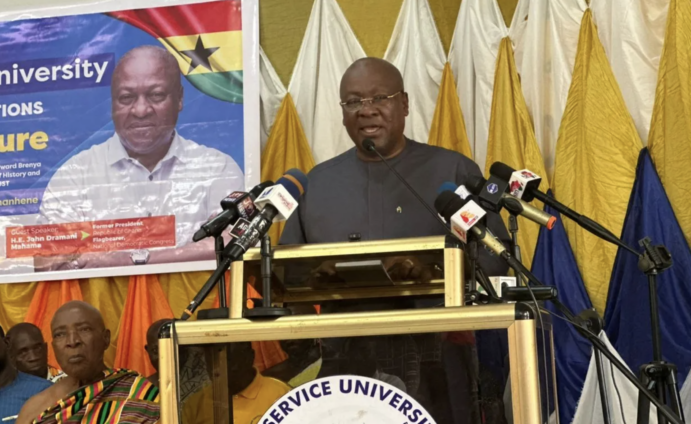
Former President John Dramani Mahama says he firmly believes that democracy is the surest path to sustained progress and development for Africa particularly Ghana.
“This belief has driven me into my active involvement in democratic pursuits and governance in various capacities for over three decades from the grassroots to the highest office of the land,” he said at a public lecture at the Christian Service University (CSU) in Kumasi.
The lecture, which was on the theme, “Sustainability of Democracy in Africa: The Ghanaian Experience” formed part of activities marking the 50th anniversary of CSU, which coincidentally received a Presidential Charter to become a full-fledged university this year.
Founded in 1974, the University has consistently upheld its mission to provide quality education grounded in Christian values over the years.
The former President, who was the guest speaker for the public lecture, said Ghana had come a long way after suffering several military takeovers since independence with the current republic being the longest sustained period of democratic governance in the history of Ghana.
He said many young Ghanaians saw democratic governance in Ghana as routine and therefore took it for granted because they were born into democracy.
According to him, some military governments made strides towards improving the country’s fortunes but overall, the experience under military regimes was clearly unpleasant.
“We have learnt that democracy is a better system of governance than unconstitutional and military rule.
And yet amid the current excruciating economic crisis, there have sometimes been loud expressions of desire by a frustrated section of our citizens for a return to military rule,” the former President submitted.
That some citizens, especially the younger ones yearning for a return to military rule, he said, was concerning but not surprising.
He said such calls, especially after all the gains made in entrenching democratic culture, called for a re-evaluation of what had gone wrong, adding that, an honest retrospection revealed that many felt that they had not benefited from or taken part in the democratic dividends.
“They do not see that democratic governance has met their aspirations and expectations nor do they feel that they are properly represented in decision-making,” he noted.
Former President Mahama, who is also the flagbearer of the NDC in the December 2024 elections, said Ghana’s acceptance of democracy was very strong within a sub-region that was prone to volatility and conflicts, saying that, the democratic consolidation in Africa had suffered setbacks with a disturbing relapse into the era of coup d’états.
By the mid-80s to the 1990s many African countries had begun to shift back towards democratic governance after military rule had often worsened the circumstances they were supposed to correct, Mr Mahama pointed out.
He indicated that Ghana had recorded some of the highest growth rates in the world in the last 30 years, but this democratic transition appears to have landed Ghana into a false sense of security and accomplishment.
“Economic mismanagement, corruption, and a host of other governance issues have returned, diminishing the hopes that many citizens have in government and state institutions,” he stated.
Professor Samuel Afrane, Vice Chancellor of CSU, said the university as part of its 50th anniversary thought it wise to organise two public lectures and invite the presidential candidates of the two major political parties to share their thoughts on the topic ahead of the December general elections.
“The objective of this university for this public lecture is to partner with all the political giants of this nation to conceptualise new ways of sustaining the democracy practised in Ghana and for that matter the whole of Africa,” the Vice Chancellor explained.
He said politicians in the country had divergent opinions on the sustainability of democracy, and as a university, they appreciated their role as a convergence point of diversity, talent and innovation.
It was for that reason that the University invited the former President to share his views on the topic to help the youth to appreciate the new ways to sustain the democracy being enjoyed in the country.
“It is my sincere hope that at the end of this lecture, all participants here and the nation at large will have developed an interest in the new ways of sustaining our democracy and how we can offer our talents, skills and energies to ensure the consolidation of our democracy as a shining example in the rest of the African Continent,” Prof Afrane observed.
Latest Stories
-
Dafeamekpor defends Ayine’s handling of Aksa case, faults past AGs
30 minutes -
Luv FM High School Debate: Afigyaman, OKESS seal Round of 16 spots in style
32 minutes -
Dafeamekpor urges Parliament to stay out of Aksa probe, backs expert-led inquiry
33 minutes -
The rise and rise of Azigi
40 minutes -
Is Angela List being targeted? Government must reconsider the Adamus revocation
43 minutes -
Bezos-backed consortium buys a third of Liverpool
43 minutes -
Galamsey is becoming a national survival issue – Annoh-Dompreh
59 minutes -
Beyond State Funding: NSA Inaugurates Deen-led team to power Ghana’s sports reset
1 hour -
Jason Arday death ‘tragedy on so many levels’ says PM Burnham
1 hour -
NPP has never used nolle prosequi to shield appointees – Baffour Awuah
1 hour -
A-G owes it a duty to the State even if we don’t trust him – Dr Bomfeh on AKSA bribery probe
1 hour -
A Plus dismisses claims poor English explains his limited role in Parliament
2 hours -
Unauthorised drone flights banned at Manhyia Palace
2 hours -
Aksa bribery scandal: Ghana’s probe must be pursued with speed – Dafeamekpor
2 hours -
Samson’s Take: When religion threatens peace, sanity must prevail
3 hours