

Audio By Carbonatix
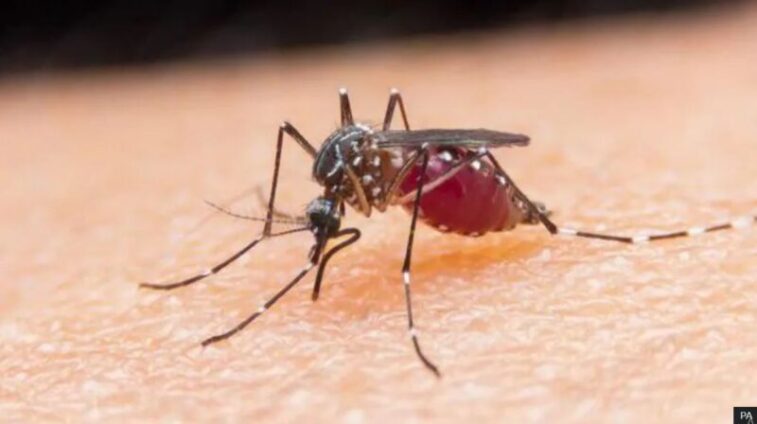
Scientists believe they have found a quirky way to fight mosquito-spread diseases such as dengue, yellow fever and Zika - by turning male insects deaf so they struggle to mate and breed.
Mosquitoes have sex while flying in mid-air and the males rely on hearing to chase down a female, based on her attractive wingbeats.
The researchers experimented, altering a genetic pathway that male mosquitoes use for this hearing. The result - they made no physical contact with females, even after three days in the same cage.
Female mosquitoes are the ones that spread diseases to people, so trying to prevent them from having babies would help reduce overall numbers.
The team from the University of California, Irvine studied Aedes aegypti mosquitoes, which spread viruses to around 400 million people a year.
They closely observed the insects' aerial mating habits - which can last between a few seconds to just under a minute - and then figured out how to disrupt them using genetics.
They targeted a protein called trpVa that appears to be essential for hearing.
In the mutated mosquitoes, neurons normally involved in detecting sound showed no response to the flight tones or wingbeats of potential mates.
The alluring noise fell on deaf ears.
In contrast, wild (non-mutant) males were quick to copulate, multiple times, and fertilised nearly all the females in their cage.
The researchers from the University of California, Santa Barbara, who have published their work in the journal PNAS, said the effect of the gene knock-out was "absolute", as mating by deaf males was entirely eliminated.
Dr Joerg Albert, from the University of Oldenburg in Germany, is an expert on mosquito mating and I asked him what he made of the research.
He said attacking sense of sound was a promising route for mosquito control, but it needed to be studied and managed.
"The study provides a first direct molecular test, which suggests that hearing is indeed not only important for mosquito reproduction but essential.
"Without the ability of males to hear - and acoustically chase - female mosquitoes might become extinct."
Another method being explored is releasing sterile males in areas where there are pockets of mosquito-spread diseases, he added.
Although mosquitoes can carry diseases, they are an important part of the food chain - as nourishment for fish, birds, bats and frogs, for example - and some are important pollinators.
Latest Stories
-
Daily Insight for CEOs: Making better decisions under pressure
40 seconds -
Weta rice farmers seek urgent support after floods destroy crops
1 minute -
Mahama commits GH¢200m in 2027 Budget to complete Police Hospital expansion
5 minutes -
Standard Chartered Bank delivers strong returns and sustainable shareholder value
16 minutes -
Akufo-Addo’s role in the artificial cedi stability is indisputable — Facts do not bend to political convenience
19 minutes -
Breaking Bad actor RJ Mitte dies aged 34
25 minutes -
Wontumi pleads not guilty in GH¢30m Exim Bank loan case
30 minutes -
Beyond the Flyer: Awareness without screening is not enough
37 minutes -
Bekwai MP donates GH¢100,000 to hospital for specialist equipment
44 minutes -
Van Vicker sues Lil Win for defamation, demands GH¢10m
50 minutes -
FIFA/ FIBA agency Pep Sports moves to admit Ghana’s 7-Foot Basketball talent to its Ultra-Modern Sports campus after MyJoyOnline report
52 minutes -
GAUA strike disrupts academic plans at University of Ghana as students, parents express frustration
57 minutes -
Dad’s Army/African Polistas crowned champions of 2026 Accra Polo Club Trustees’ Cup
1 hour -
Mahama approves Integrated Basic Education Model, with funding expected in 2027 under GETFund formula
1 hour -
Money-driven elections fuelling corruption – Haruna Iddrisu
1 hour