

Audio By Carbonatix
Despite the global recognition of Science, Technology, Engineering, Arts and Mathematics (STEAM) education, Ghana’s education system has yet to fully embrace models that effectively integrate STEAM competencies into practical projects. An initiative by Benjamin Ansah, a Ph.D. Art Education student at the Kwame Nkrumah University of Science and Technology (KNUST), is set to change this narrative.
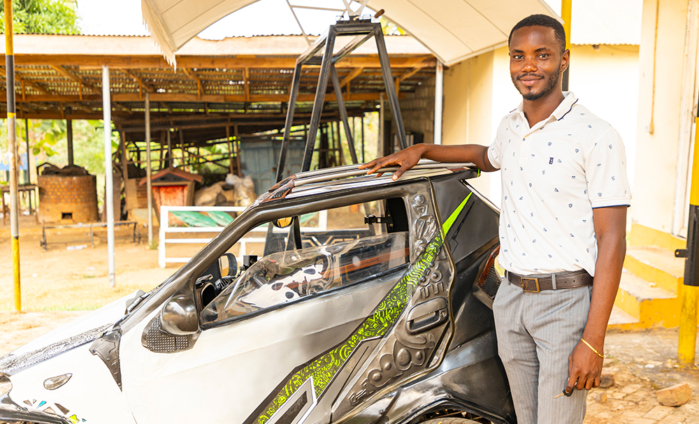
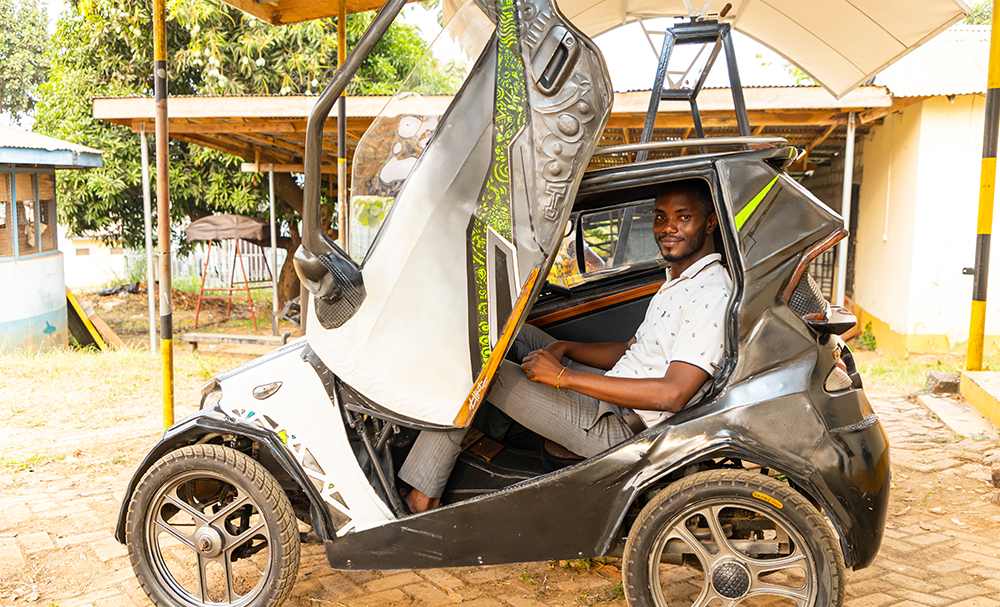
Benjamin has constructed a cycle car as part of his project titled “STEAM in Ghanaian Higher Education: Modelling STEAM-Related Competencies of Students Through Cycle Car Technology.”
Mr. Ansah describes his project as a conceptual movement aimed at fostering interdisciplinary education in Ghana. According to him, the vehicle embodies the essence of STEAM by incorporating elements from various disciplines, such as mechanical and electrical engineering and material science.
“Every discipline here in KNUST depicts itself in this vehicle: from the mechanical to the electrical and materials. If we want to have an inclusive education, we can use this vehicle for an example. That was the motive for the vehicle in the first place, aside from tackling the student mobility system. The main concept was to showcase the educational aspect – that it is possible for these disciplines to come together to create something like this,” Ansah explained.
This innovative approach highlights the practicality of STEAM education and also addresses a key challenge in Ghanaian universities: student mobility. Ansah elaborated on the advantages of the cycle car over traditional modes of transport, such as bicycles or motorbikes.
“In terms of the weather, when it’s raining, there is cover. It is well secured,” he said.
Mr. Ansah’s supervisor, Dr. Kafui Kwasi Agyeman, emphasised the project’s broader implications for Ghana’s educational system. He described it as a critique of the country’s predominantly linear educational structure and advocated for a more collaborative approach to problem-solving.
“We are supposed to tease our educational system. We have a linear form of education. There should be a convergence where different people come together, think together, and capitalise on individual strengths to solve problems. This approach is better than having one person tackle a problem individually,” Dr. Agyeman stated.
He further highlighted the importance of multidisciplinary collaboration in addressing complex challenges. “When people with different backgrounds come together, complex problems are solved,” he added.
Dr. Agyeman attributed Ansah’s ability to undertake this ambitious project to his diverse training background. “This guy is able to do this because he has multidisciplinary training. His father is an engineer, and he had some training under him in a multi-material disciplinary system. He also went through a system where he engaged in a lot of woodwork, bringing different competencies on board. That’s how it’s able to happen,” he explained.
The work was supervised by Professor Harry Barton Essel, Dr Kafui Kwesi Agyeman, and Dr Frank Kwabena Afriyie Nyarko.
Latest Stories
-
David Selassie Anthony declares bid for NDC Deputy National Organiser
31 minutes -
Amin Adam proposes 13 measures to strengthen Ghana’s debt transparency and market confidence
53 minutes -
Mahama announces $2bn annual investment to accelerate industrialisation
58 minutes -
Amin Adam urges monthly disclosure of Sinking Fund as Ghana prepares for DDEP repayments
1 hour -
Stronger banks will fuel business growth and jobs – ADB MD
1 hour -
Galamsey: ‘Rivers that fed our grandparents now run the colour of chocolate milk’ – Sam Jonah
1 hour -
We have been scammed by NDC, government is only doing PR – Abanga Fuseini
1 hour -
Republic Bank–JoyNews Habitat Fair opens in Ho today
1 hour -
BoG pledges stability to attract investment, urges stronger Africa–Asia partnerships
1 hour -
Amin Adam warns treasury bill dependence could expose Ghana to refinancing risks
1 hour -
Ghana better placed to withstand commodity price shocks – IMF
1 hour -
GAPTE intensifies efforts to increase bus availability for Aayalolo contra-flow
1 hour -
Amin Adam warns cedi depreciation could reverse Ghana’s debt relief gains
1 hour -
Fiscal discipline crucial for pension fund investments – Finance Minister
1 hour -
BoG Governor rallies IMF to back Africa’s digital sovereignty
2 hours