

Audio By Carbonatix
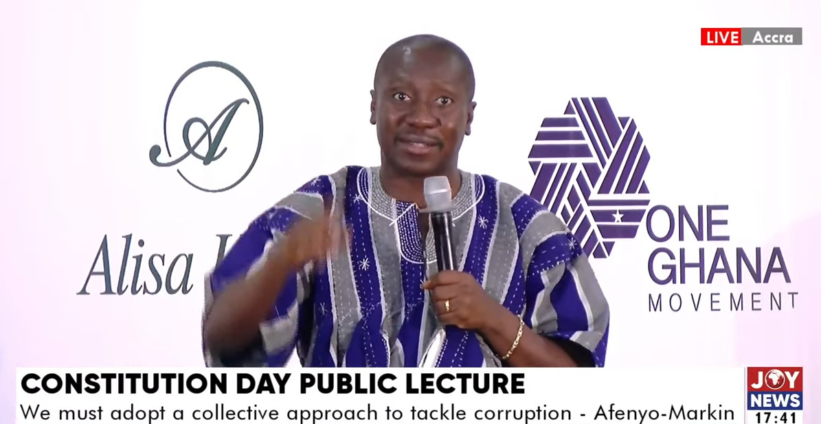
Minority Leader, Alexander Afenyo-Markin, has called for a collective approach in addressing corruption, urging Ghanaians to broaden their perspective on the issue rather than limiting it to politicians alone.
Speaking at the Constitution Day Public Lecture on Friday, February 28, he questioned the need to blame only politicians for corruption.
"Do we often narrow the issue of corruption and limit it to the political class, or perhaps we have to broaden it and look at it as part of the general life of all of us as a people?" he quizzed.
He explained that corruption is often influenced by cultural and societal expectations, which sometimes push leaders into unethical decisions.
“As part of our culture, don’t we make ourselves vulnerable to what we call corruption? Our cultural lifestyle and how we relate to ourselves makes the leader very vulnerable, and in trying to meet those expectations, if you don’t have the resources, you may end up acting wrongly.”
Mr Afenyo-Markin further highlighted that tackling corruption requires a joint effort from citizens, businesses, civil society, and the media, rather than just placing the burden on government officials.
“It is not enough to talk about corruption, we must look at a collective approach in how to deal with it. We cannot lay blame on one side, we have to be very collective and tackle it head-on.”
He also encouraged civil society to play a more active role in holding leaders accountable, noting that public scrutiny could serve as a deterrent.
“I encourage discussions by civil society all aimed at cracking the whip on the political class. If somebody knows that on the radio, people will be talking about his lifestyle, he will be careful when he gets into office.”
He concluded by emphasising that corruption is not just a government problem but a societal issue that requires all stakeholders to take responsibility.
"The laws are just not enough, it is our collective will. And in the process as citizens we must never give up because giving up will mean leading us to a failed state, that cannot help us as a nation. Let us continue to crack the whip, let us continue to be hard on the political class but at the same time other actors in that chain of corruption, because if you leave the other actors and focus on the political class, dealing with the canker will still remain a big headache on our heads as a country," he concluded.
Latest Stories
-
Ghana’s economy grows by 7.4% in July 2026
6 minutes -
NDC member challenges Dennis Yeboah Twumasi’s eligibility for Bono Regional Secretary elections
16 minutes -
Popular Nigerian gospel singer Toluwanisings dies
26 minutes -
Spio-Garbrah proposes debt swaps to fund reparative justice in Africa and Caribbean
33 minutes -
Alban Bagbin calls for governance reforms and coordinated action to address Africa’s debt crisis
36 minutes -
AAK Academy Ghana trains 22 chocolate and confectionery companies in production techniques
38 minutes -
Adwumawura Programme trains second cohort of young entrepreneurs in Bono East
39 minutes -
Destroying Jimi River for gold could cost us our lives – Asantehene
46 minutes -
Sammy Gyamfi didn’t say BoG has ceded its forex role to us – GoldBod
2 hours -
High Court sets November 4 for ruling on Wontumi’s bail application
2 hours -
Tetteh Kwetey files nomination for NDC Greater Accra Regional Chairmanship
2 hours -
Korle Bu appeals for more doctors, nurses as A&E Centre struggles under pressure
2 hours -
AFCON 2027Q: ‘I’m optimistic Black Stars can turn things around’ – Agyemang-Badu
2 hours -
Digital innovation could widen Africa’s inequalities if people are left out – Sam Jonah
2 hours -
Galamsey is an economic, health and moral problem – Sam Jonah
2 hours