

Audio By Carbonatix
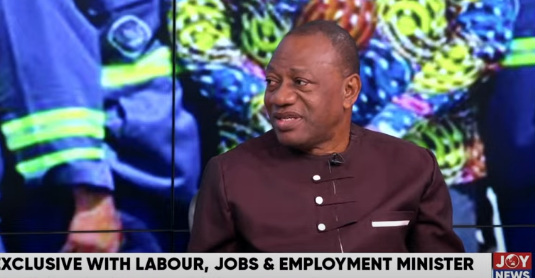
Minister for Labour, Jobs, and Employment, Dr Rashid Pelpuo, has warned that strike actions could severely disrupt national productivity and urged workers to exhaust all avenues of negotiation before resorting to industrial actions.
Speaking on the Joy News AM Show, Dr Pelpuo addressed a recent situation at Dr Hilla Limann Technical University, where staff were preparing to strike without informing the Ministry.
“Yesterday [Tuesday], I received a message informing me that Dr Hilla Limann University staff were preparing to go on strike. However, I was unaware of the reasons behind their decision,” Dr Pelpuo explained.
“After looking into the matter, I discovered that the issue stemmed from a disagreement between the staff and the university management,” he said.
While acknowledging the right of workers to protest, Dr Pelpuo emphasised that strikes often have far-reaching consequences.
“The reality is, when workers go on strike, it’s not just the workers or management who suffer, it’s the broader public. Strikes disrupt not only the workplace but the entire economy,” he said.
“It is important for workers to engage with the Ministry before taking such drastic measures, as we can help mediate and find solutions,” he added.
The Minister also stressed that strike action should always be a last resort.
“There are laws in place that govern the relationship between employers and employees. It’s essential that workers pursue every avenue of negotiation before considering a strike,” Dr Pelpuo stated. "Negotiation should be given every chance to succeed, and only after exhausting all options should strike action be taken."
Dr Pelpuo further outlined the broader impacts of strikes on the economy. “When workers go on strike, production halts, and entire sectors of the economy are affected. For example, if students are involved, their education is disrupted, which impacts families across the country,” he noted.
He urged all workers, employers, and the government to prioritise dialogue and negotiation over strike actions.
“We strongly encourage workers and employers to engage fully in discussions before considering strike action, as strikes can have long-term consequences that damage national productivity and stability,” he concluded.
Latest Stories
-
Fuel prices set to rise again from Sept 1; petrol could hit GH¢16.21 – COPEC
1 hour -
REGSEC restricts Akwasidae celebrations in Denkyira amid security concerns
1 hour -
Eric Adjei distributes free fertiliser to farmers in Jaman North
1 hour -
Akufo-Addo urges NPP factions to unite behind Bawumia for 2028 victory
2 hours -
NDC mourns Western Regional Elections Director Papa Assan
2 hours -
Minerals Commission warns against fake job recruitment schemes
2 hours -
10 recruits dismissed for defying phone ban – Interior Minister
2 hours -
IEAG commends GoldBod, BoG for improving forex stability
2 hours -
Bawumia donates GH¢50,000 to St Jude Catholic Church at Weija
2 hours -
Mahama calls for faster mobilisation of AU Peace Fund resources
2 hours -
Improved roads bring new vehicle options to Tumu-Bolga, Tumu-Tamale, Tumu-Wa routes
2 hours -
Cedi records 7.9% depreciation against US dollar in first half of 2026
3 hours -
GIS launches operation on anti-human trafficking and exploitative street begging
3 hours -
Awutu-Senya District Assembly organises clean-up ahead of Awubia Festival
3 hours -
Vice President Opoku-Agyemang receives Democracy Cup
3 hours