

Audio By Carbonatix
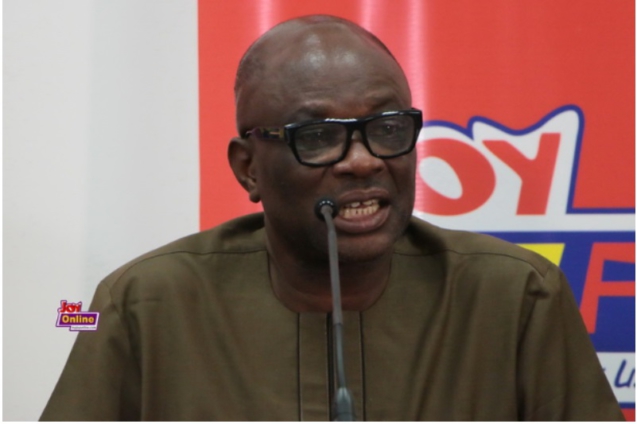
President of the Ghana Union of Traders’ Associations (GUTA), Dr. Joseph Obeng, is urging the government to take urgent steps to sustain the recent gains made by the cedi.
He is warning that failure to do so will derail recovery efforts and dampen hopes of easing inflation and interest rates.
“This gain will come to nothing if we are not able to sustain it,” he said on PM Express on JoyNews.
“It’s very important that we now talk about the predictability and sustainability of these gains.”
Dr. Obeng said members of the trading community are hesitant to reduce prices despite the cedi’s recent appreciation because they’ve been down this road before.
“The trading community have been asking me… ‘Are you sure this is going to be sustained?’” he said. “They are saying, are you not rushing to come and tell us to transfer the gains of the cedi and all that?”
For him, the answer lies in strong and consistent economic management.
“Whatever thing we have to do, if government puts prudent mechanisms and the Bank of Ghana has put very stringent controls on the forex, we have to be able to maintain it,” he stressed.
He explained that sustaining the cedi’s performance will have a ripple effect across other key economic indicators.
“This is what is going to push the other indicators that make businesses thrive — the rate of inflation, and then the interest rate,” he said.
“This is going to significantly bring inflation down and also affect interest rates positively.”
Dr. Obeng believes that real productivity gains are possible if the cedi remains stable.
“If you can use the stability of the currency to enhance productivity, that will make us competitive,” he noted.
“That will enable us be able to turn the produce of our industry into be highly competitive one. Then, of course, we are on the threshold to recovery.”
Host Evans Mensah pressed him on when Ghanaians would see lower prices at the market level.
But Dr. Obeng explained that hesitation is rooted in past disappointments.
“It’s because of what has happened in the past. When the cedi appreciates, they see the gain, and it is not sustained,” he said.
He called on all stakeholders, particularly policymakers and financial regulators, to act swiftly and decisively.
“What brought us here is very necessary,” he said. “And then how are we taking advantage of the gains that we’ve made and sustaining them? That’s very important.”
For Dr. Obeng's message for government is clear: “We’re on the threshold of recovery — don’t blow it.”
Latest Stories
-
If CJ needs ethics law to know SOE comments were wrong, he may not be worthy of office – Arthur Kennedy
36 minutes -
Stop touring state agencies and focus on the Judiciary’s problems – Arthur Kennedy to CJ
41 minutes -
Apologise and don’t do it again – Arthur Kennedy to Chief Justice over SOE comments
47 minutes -
Chief Justice remains committed to judicial independence, justice and equality – Judicial Service
1 hour -
Ghana concludes evacuation of citizens from South Africa; total returnees reach 1,900 – Ablakwa
2 hours -
Africa must define its own green transition path – Prof Fatima Denton
2 hours -
WASSCE 2026: English Language performance falls to 62.4% – WAEC
2 hours -
WASSCE 2026: Social Studies records sharp rebound as Maths, Science also improve
3 hours -
2026 WASSCE entry rises by 11% as 512,862 candidates sit exams
3 hours -
WASSCE 2026: English Language performance falls to 62.4% – WAEC
3 hours -
WAEC cancels 2026 WASSCE results of 8,295 candidates over examination irregularities
3 hours -
WAEC releases provisional 2026 WASSCE results for 512,862 candidates
4 hours -
CJ’s remarks on SOEs were made in good faith, not to undermine judicial independence – Judicial Service
7 hours -
Bright Future Alliance pays courtesy call on Akufo-Addo, invites him to African Leaders of Influence Lectureship Series
7 hours -
This is an attempt to break the Minority caucus – Patricia Appiagyei on alleged GH¢70k payment
7 hours