

Audio By Carbonatix
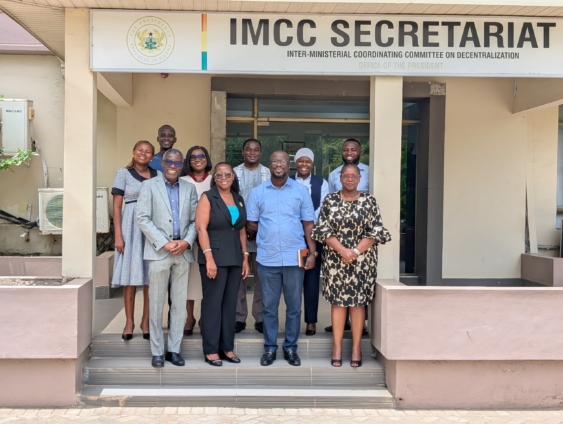
The Executive Secretary of the Inter-Ministerial Coordinating Committee (IMCC) on Decentralisation, Dr. Gameli Kewuribe Hoedoafia, welcomed a high-powered delegation from the National Development Planning Commission (NDPC) for a strategic dialogue at the IMCC Secretariat in Accra.
The meeting, themed “Mainstreaming Decentralisation Reforms into the Planning Guidelines,” brought together top technical experts and decision-makers from both institutions.
Leading the NDPC team was its Acting Director General, Dr. Audery Smock Amoah, who was joined by key staff, including Dr. Felix Addo-Yobo, Director of the Development Policy Division, and Dr. Sandra Kesse-Amankwa, Acting Head of the Plan Coordinating Division.
On the part of the IMCC, several core team members contributed to the discussions, including Dr. George Laryea (Director of Policy & Research Division), Tracy Cudjoe Edumadze (Finance), and Louis Ntem Adzato (Director of Administration).
In his welcome address, Dr. Hoedoafia emphasized the IMCC’s commitment to embedding decentralisation not just as a policy requirement, but as a working reality that enhances service delivery at the sub-national level.
He stressed that aligning decentralisation with national development plans is key to ensuring that every Ghanaian, no matter where they live, benefits from good governance and effective public services.
Dr. Amoah, on her part, reiterated the NDPC’s readiness to work closely with the IMCC to ensure that the 2026–2029 Medium-Term National Development Policy Framework (MTNDPF) reflects decentralisation more prominently, either as a standalone development area or a cross-cutting theme. “It’s time to close the gap between national policy and local impact,” she noted.
The team explored a range of practical options, including issuing clear directives to Ministries, Departments, and Agencies (MDAs) to prioritise decentralised service delivery in their planning and budgeting, as well as strengthening the role of Metropolitan, Municipal, and District Assemblies (MMDAs) in the implementation of national development policy at the local level.
There was a shared understanding that these reforms would not only improve coordination across governance levels but also enhance ownership, accountability, and results.
The meeting ended on a high note with a commitment to undertake further technical consultations and the development of a joint roadmap to mainstream decentralisation in all future national and local planning efforts.
Latest Stories
-
Freda Kingful Abraham Cudjoe: The visionary founder building a creative legacy through Impakers Creative Hub
3 minutes -
Tanker drivers suspend strike after BOST commits to fix Kumasi depot challenges
6 minutes -
Photos: Stonebwoy’s BHIM Festival at OVO Arena Wembley, London
14 minutes -
BoG identifies $4.8bn annual SME financing gap, pushes digital data-driven lending
28 minutes -
Labone bank robbery suspect remanded
32 minutes -
NTC launches 2026 Ghana Teacher Prize to celebrate outstanding educators
33 minutes -
Hanan Abdul-Hamid cannot be forced to face trial without lawyer — Dame
42 minutes -
MTTD to make Accra model city for safe riding – ACP Dr Samuel Sasu Mensah
42 minutes -
NPP Upper West eyes 2028 comeback; dismisses vote-buying allegations in regional executive elections
48 minutes -
Minaata Moomin defeats Nancy Dery in NPP Upper West Regional Women’s Organiser election
50 minutes -
Constituency Games will take Mahama’s ‘Reset Ghana sports agenda’ to every community – Samson Deen
50 minutes -
Russian Foreign Minister Lavrov praises Kwame Nkrumah’s legacy during meeting with Ablakwa
51 minutes -
Bleoo 2G alumni hand over Beatrice Lokko Memorial Eco Park
54 minutes -
‘I will not be available’ – Godfred Dame rejects vacation hearing in Hanan trial
55 minutes -
27-year-old spiritualist arrested over alleged attempt to use 11-year-old girl for ritual
1 hour