

Audio By Carbonatix
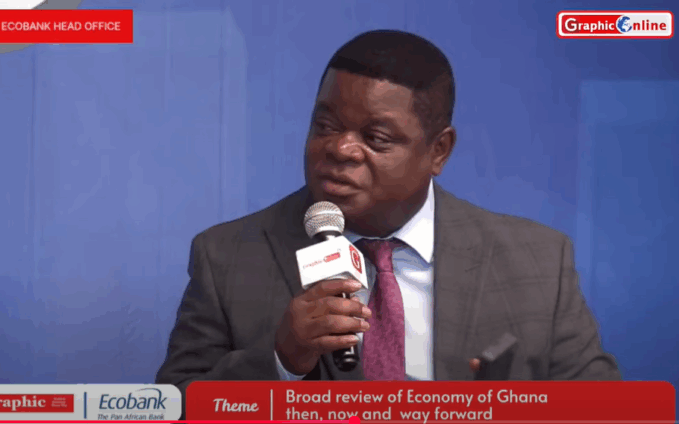
The Director of the Institute for Statistical, Social and Economic Research (ISSER), Prof. Peter Quartey says Ghana’s current tax system encourages evasion to enrich a few people.
He blamed the situation on the imposition of high taxes on businesses and individuals in an attempt to achieve targets.
Speaking at the Graphic Ecobank Economic Forum, Prof. Quartey cautioned that tax handles must not only be seen as means of achieving target, but must be a tool for behavioral correction and effective revenue collection.
Citing Ghana’s VAT system as an example, he pointed out that the computation of the consumption levy has compounded the tax burdening of businesses and consumers.
“Our tax levels are too high, in my view. Our VAT is 21% plus. Some are even straight levies that you cannot claim input tax, and what have you. But look at our competitors. On average, some are paying 15%, 18%, and we are charging over 21%. So what you are doing is that you are encouraging people to evade”, he cautioned.
Prof. Quartey observed that the situation has created an environment that fuels conspiracy and corruption between state officials responsible for tax collections, and businesses required to pay taxes.
“When your tax is too high, it calls for tax evasion. So you are enriching customs officials, you are enriching businessmen, and the government is struggling for money”, he stressed.
According to him, the development is made worse due to the fact that Ghana’s economy is largely informal, making it difficult to trace and punish tax evaders.
“We have an informal economy. Over 80% of our economy is informal. We have not devised a proper mechanism for taxing the informal sector”.
This, he said has resulted in a situation where a few workers in the formal economy are targeted and overburdened with taxes.
“All we do is the 20%. Why should we focus so much on the 20% and over tax them and leave the 80%?, he quizzed.
Proffering some solutions, Prof. Quartey called f or a serious examination of the VAT system and engage broadly to bring the informal sector into the tax bracket.
“We need to look at this critically. Otherwise, we would not be making a lot of inroads in terms of tax revenue mobilisation, and that is why we keep borrowing. Because we are not raising enough revenue”.
He cautioned that increasing taxes will not necessarily lead to a corresponding increase in tax to GDP ratio.
“Tax to GDP at best, 14%, when some are doing 18, 20, 23% within Africa. So it tells you there is a lot of risk inherent to risk”.
He added that one way to get the public to voluntarily pay taxes is to judiciously use revenue collection in the wellbeing of the public.
“Maybe later we'll talk about even how efficiently we even use the revenue, because it's not just about raising the revenue, but how well you use the revenue to advance your cause”.
The forum, held at the Ecobank Head Office under the theme “A broad review of the economy of Ghana: Then, now, and the way forward,” also featured remarks from Presidential Advisor on the Economy, Seth Terkper, and PwC Ghana’s Tax Partner, Abeku Gyan-Quansah. Participants explored issues of monetary policy, taxation and fiscal discipline, with a focus on repositioning Ghana’s economy for long-term growth.
Latest Stories
-
2026 U-20 WWC: ‘Not all wishes come true’ – Gyan inspires Black Princesses after elimination
3 minutes -
‘I am not a magician’ – Zdravko Logarušić on Nations FC exit from Africa
16 minutes -
Three nights. 28 titles. Ultimate history made
27 minutes -
Ghanaian delegates at IYF 2026 could become bridges for stronger Russia ties – John Aggrey
31 minutes -
Nigeria: Over 30 dead, 50 hospitalised after consuming alcoholic substance in Ondo State
33 minutes -
UK lawmakers demand new law to address AI threat to human rights
42 minutes -
WAFU B U-17 Girls Cup: Black Maidens depart Accra for tournament in Yamoussokro
43 minutes -
Sweden’s center-left bloc narrowly ahead as election remains too close to call
53 minutes -
GPL 2026/27: ‘We won ugly’ – Kotoko head coach unimpressed after Lions victory
56 minutes -
7 out of 10 human trafficking cases in Ghana never reach prosecution — JoyNews Research
1 hour -
Music, football to converge at Music Meets Football Summit 2026 in Lusaka
1 hour -
Putin invites young global leaders to partner with Russia in shaping future world order
1 hour -
Putin calls for ‘just world’, says every nation must be free to choose its own path
1 hour -
IFY 2026 food festival to serve 20,000 meals showcasing global cuisines in Russia
2 hours -
Ghana has a Domestic Violence Act: But can a victim afford to use it?
2 hours