

Audio By Carbonatix
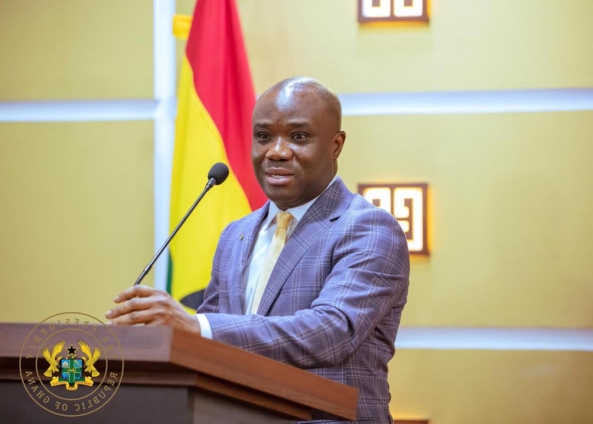
Felix Kwakye Ofosu, the Minister for Government Communications, has announced a significant boost to the Ghanaian economy, revealing that more than US$3 billion has been funnelled into the country within four months of the strategic Gold Board initiative.
“In the last four months, over $3 billion has entered our economy in addition to the expected inflow,” he stated during an interview on GTV.
This influx has been attributed to a targeted policy that requires all small-scale miners to sell their gold to the Gold Board, ensuring that the proceeds benefit the formal economy.
READ ALSO: Stop blaming us for galamsey; you hired them – Chinese Ambassador fires back at Ghanaians
Mr. Kwakye Ofosu explained that this innovative system allows the Gold Board to purchase gold in cedis, export it for dollars, and then reinvest the foreign exchange earnings back into local markets.
“This ensures that the dollars generated are allocated to vital sectors of the economy,” he stated.
A portion of the foreign currency is retained by the Bank of Ghana to bolster national reserves, while others are injected into the forex market and used to meet international obligations.
Previously, small-scale miners often exported their gold through informal channels, meaning the foreign exchange generated was not accounted for within the formal economy.
“Gold was leaving the country without being properly recorded, and the proceeds were not centralised for fair distribution,” he explained.
Mr. Kwakye Ofosu contrasted the current administration's approach with that of previous governments.
“They had eight years to stabilize the cedi but left us with unprecedented depreciation,” he remarked, highlighting that in 2022, the cedi lost approximately 54% of its value, making it one of the worst-performing currencies globally at that time.
“The Gold Board arrangement is here to stay and is not just a temporary fix,” he assured. “The President has indicated that, eventually, the cedi will stabilise within a defined range, avoiding the extreme fluctuations that have caused hardship for Ghanaians.”
When faced with assertions that similar solutions were available during the previous administration, he challenged the effectiveness of those measures, stating, “If they had viable strategies, they should have worked during their eight years in office.”
As the government continues to implement these initiatives, the positive impacts on Ghana's economy and the stabilisation of the cedi are expected to take centre stage in discussions about the country’s financial future.
Latest Stories
-
Court orders police to file disclosures in Labone robbery case
47 seconds -
Central Regional Minister lauds Gomoa Central Assembly for effective utilisation of Common Fund
7 minutes -
What must gov’ts do to make food systems drive job creation in Africa? – Fareeda Mustapha asks Rwanda’s Kagame
11 minutes -
Gender Minister calls for equitable gender roles to support girls’ development
12 minutes -
Prioritise rural businesses in Women’s Bank – NETRIGHT urges gov’t
18 minutes -
Guinea backs Morocco’s Sahara autonomy plan as ‘sole solution’ to dispute
21 minutes -
NDPC, Youth Empowerment Ministry collaborate to mainstream youth into National Development Planning
23 minutes -
Mahama calls for rebranding of Ghanaian football
29 minutes -
Emeritus Prof John Bright Kobla Aheto, Esq
32 minutes -
GTA CEO honoured at Africa Brain Bank Summit and Awards
35 minutes -
CHRAJ urges stakeholder collaboration, intensified public campaign
40 minutes -
$350m project to end Weija Dam flooding to commence this year
45 minutes -
24-Hour Economy’s job creation push yet to gather speed – Nii Moi Thompson
50 minutes -
Why I rejected political offers that could have made me billionaire – Omotola Jalade
1 hour -
Singer Davido sternly warns those trying to move like him
1 hour