

Audio By Carbonatix
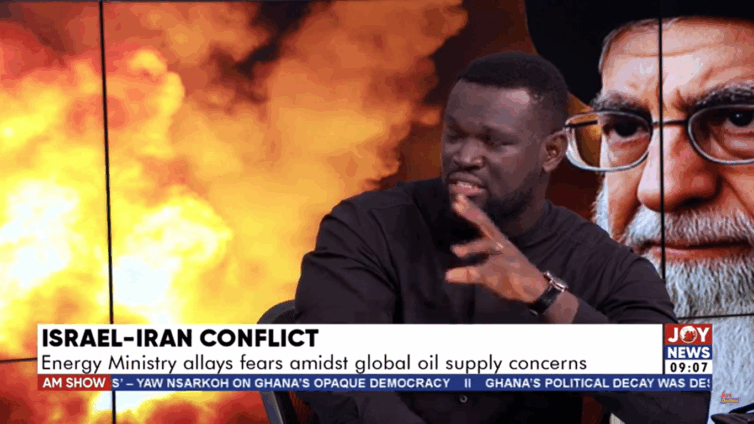
African and International Relations Analyst, Nana Yaw Mireku, has expressed confidence that Ghana’s diplomatic relations with countries in the Middle East will remain intact despite ongoing regional tensions.
Speaking on the JoyNews AM Show on Tuesday, June 24, Mireku dismissed fears that Ghana’s diplomatic arrangements in the Middle East could be significantly affected.
“I don’t think it’s going to affect our diplomatic arrangements,” he stated. “In my opinion, I don’t think so because it was a response to what was happening in Tehran.”
Mireku drew comparisons with previous flashpoints in the region, citing the example of Qatar.
During heightened tensions, Qatar was forced to close its airspace as a precautionary measure, disrupting flights and movement temporarily.
However, once the hostilities subsided, the country swiftly returned to operational normalcy.
“If we take Qatar, within a moment that Iran was seeking to strike Qatar, Qatar closed up its airspace which directed all airplanes coming to Qatar. But right after the hostilities and everything was normalised, the country has come back to normalcy,” he explained.
According to Mireku, the temporary suspension or downgrading of diplomatic activities in times of crisis is not uncommon, especially in volatile regions.
However, he emphasised that these pauses are typically short-lived and dependent on the pace of de-escalation.
“What it means is that, once there is cessation of hostilities in Iran and Tel Aviv and things begin to take their rightful shape, most of these embassies will begin to work,” Mireku said.
He added “And what it means is that the diplomatic connections Ghana has in the Middle East will begin to function normally, but it will take a number of days for us to see how events turn out.”
Ghana, like many nations with embassies and missions in the Middle East, maintains a delicate balance in the region—focused on cooperation in areas such as energy, trade, labour, and security.
While some embassies may limit activities for safety reasons during conflict, Mireku stressed that this should not be interpreted as a breakdown in relations.
Mr Mireku asserted that the current hostilities in the region do not pose a long-term threat to Ghana’s foreign policy posture.
“So, I don’t think it’s going to affect our diplomatic arrangements,” he concluded.
Latest Stories
-
National Chief Imam remains Ghana’s strongest symbol of interfaith harmony – Mahama Ayariga
13 minutes -
Gov’t to upgrade all rural telephony networks to 4G capability – Sam George
30 minutes -
‘We’ve never seen a CJ in our judiciary system who is everywhere like MTN’ – Janet Nabla
31 minutes -
Lawyers, prosecutors fume over abandoned 26-year-old Upper West High court project
36 minutes -
At least two dead in blast at Bolivia military barracks
1 hour -
Tate brothers officially indicted with trafficking and sex crimes in Romania
1 hour -
US envoys arrive in Moscow ahead of Ukraine talks
1 hour -
Health Minister to brief media on Free Primary Healthcare programme on Monday
1 hour -
‘It was inappropriate to make that comparison’ – Dr Pumpuni Asante on CJ’s SOE comment
2 hours -
Photos: Final-day shopping continues at Joy FM Back-to-School Discount Fair
2 hours -
Darkey and Frimpong set up J30 Accra boys’ doubles final
2 hours -
When war takes more than territory: The human cost of conflict
2 hours -
Review SHS placement policy to give more BECE candidates access – Kwesi Kwarteng
2 hours -
Tano South Municipal Assembly moves to curb road carnage with speed ramps
2 hours -
Duvor Klu, Gakpo win J30 Accra girls’ doubles title
2 hours