

Audio By Carbonatix
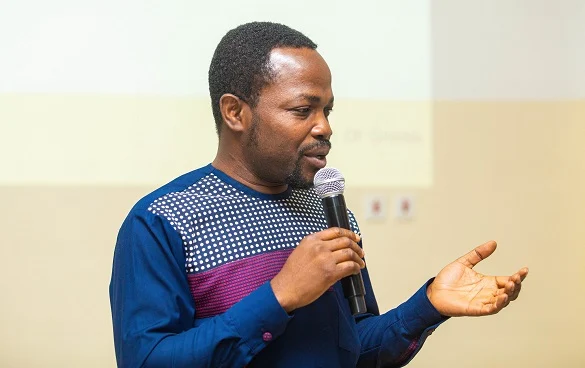
Prof. Fred Dzanku, a development economist, has praised the Mahama administration for steering Ghana’s economy in a positive direction during its first year in office, but stopped short of giving a definitive assessment, warning that structural challenges remain unaddressed.
Prof. Dzanku, Associate Professor at the Institute of Statistical, Social and Economic Research (ISSER), University of Ghana, made the remarks on Newsfile the day after President Mahama’s 2026 State of the Nation Address, speaking in his professional capacity.
Asked to assign a score to the government’s economic performance, he declined, noting that key macroeconomic indicators were moving in the right direction.
“If we are looking at macroeconomic stability — your exchange rate, your inflation, your fiscal space — they are pointing in the right direction. So far, we are going in the right direction. Let’s sustain it over a long period of time,” he said.
The government has framed 2025 as a year of stabilisation. A February 23, 2026, press release from the Ministry of Finance highlighted a budget deficit narrowed to 1.0 per cent of GDP, below the 2.8 per cent target, alongside a primary balance surplus of 2.6 per cent of GDP.
Inflation fell to 3.8 per cent in January 2026, marking the 13th consecutive month of decline and the lowest level since Ghana’s CPI was rebased in 2021.
The Bank of Ghana has also cut interest rates cumulatively by 12.5 percentage points since July 2025.
Despite these gains, Prof. Dzanku expressed caution, pointing to structural issues that could undermine sustained growth.
“Ghana has spent an average of 36 per cent of government revenue on interest payments over the past decade — against a sub-Saharan average of 8 per cent,” he said. He also noted that government capital investment has dropped from around 27 per cent of GDP in 2015 to about 10 per cent today, while GDP per capita growth has been volatile, averaging just 2.3 per cent over the decade — far below the 4–6 per cent needed for meaningful structural transformation.
“I want to be optimistic because everybody wants things to go well,” Prof. Dzanku said. “But because of where we’ve been and where we came to, I adopt a wait-and-see attitude.”
Latest Stories
-
Conflicts among care providers linked to maternal, neonatal deaths – Expert
2 hours -
GIS marks 10th TIME conference, champions improved teaching practices
2 hours -
BRICS Or Balance? What Ghana’s bid really means
2 hours -
GPRTU wants full TRAFFITECH-GH implementation to start in 2027
2 hours -
Mahama announces plans to import electric wheelchairs for PWDs
3 hours -
KGL U17 Colts 2026: Western beat Prempeh Elite Academy to set up final final with Greater Accra Region
3 hours -
Late Solanke strike salvages 10-man Spurs draw at Man United
3 hours -
Gender Ministry to monitor welfare of Nana Akua Addo’s children amid domestic violence case
3 hours -
Benedict Okyere Yeboah: Ghana’s football problem goes beyond sacking a coach
3 hours -
GPL 2026/27: Darkwah Wiafe’s winner sees All Blacks beat Kotoko
3 hours -
ITF World Tour : Patel Wins Boys’ Singles Final at J100 Accra
4 hours -
Ghana must pursue BRICS partnership if it brings economic benefits – Kpebu
4 hours -
Success and Wright Claims J100 Accra Girls’ Doubles Championship
4 hours -
ITF J100: America’s Wright wins J100 Accra Girls’ Singles Title
4 hours -
Expedition hopes to find aviator Amelia Earhart’s plane on remote island
4 hours