

Audio By Carbonatix
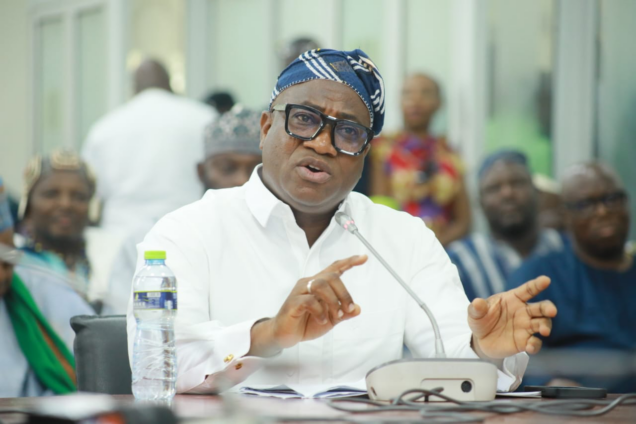
Dr. Ibrahim Murtala Muhammed, Minister of Environment, Science and Technology, has stated that Ghana’s proposed ban on plastics will be a gradual process to ensure a smooth transition to sustainable alternatives.
Dr. Muhammed emphasised that an immediate ban could have adverse effects, as viable options must be easily accessible.
The Minister said this at the Environmental Sustainability Summit organised by the Business and Financial Times in Accra.
The event was on the theme: “Ending Plastic Waste in Ghana: A Sustainable Future for all.”
The event featured a high-level panel discussion, and impactful case studies on climate financing, green energy transitions, circular economies and, corporate sustainability practices.
The Minister said, “You do not just ban plastics overnight, because you are dealing with people’s livelihoods and habits.”
He said as a country “We must first provide affordable and practical alternatives before enforcing restrictions.”
Ghana generates between 840,000 and 1.1 million tonnes of plastic waste annually with over 50 per cent uncollected and only 9 per cent recycled.
Dr Muhammed said that reckless disposal of waste clogged drains, polluted water bodies, and posed severe health risk, costing the economy $6 billion yearly which is 11 per cent of Gross Domestic Products (GDP).
He said Ghana was currently studying successful circular economies on the African continent, notably Rwanda and Kenya where plastic bans were implemented alongside robust recycling systems.
He revealed that the government circular economic strategy would prioritise taxes and regulations, promote local alternatives and extend producer responsibility.
The Minister called for a change in habits from Ghanaians, citing real-life situations where traders resisting reusable containers due to convenience.
Dr. Godwin Acquaye, the Chief Executive Officer for Business and Financial Times, highlighted the impact of plastics notably remnants of plastics being found in the reproductive organs of human beings.
“So, there was research done outside the country, and they saw microplastics in the testicles of those who were examined. So reproductive organs and fluids have plastics in them. So, the questions are that what children are we giving birth to?, “he said.
He urged the government to remain committed to the circular plastics roadmap and other international commitments such as the one advocated by the Global Plastic Action.
He called for an effective collaboration between state institutions and the private sector to promote Ghana’s circular economic initiatives.
Latest Stories
-
Meko Bono 2026: Vice President pledges agricultural revival as Atebubu hosts grand homecoming
1 hour -
Russian skydiver Sergey Boytcov sets world record with 11,551-metre stratosphere jump
1 hour -
Ablakwa-led committee submits five reports to Mahama ahead of 2027 AU chairmanship
1 hour -
Africa not seeking Western cash in reparations campaign – Ablakwa
1 hour -
Production decline, reserve depletion threaten Ghana’s upstream sector – Jinapor
2 hours -
Surveyors caution against treating compensation disputes as professional misconduct
2 hours -
Mahama calls for AU dialogue on migration after South Africa xenophobic tensions
2 hours -
I haven’t experienced any envy in the gospel music industry — Ohemaa Mercy
3 hours -
Prayer does not solve everything — Ohemaa Mercy
3 hours -
New PURC office symbolises stronger consumer protection – Dr Jinapor
4 hours -
Rev. Wengam re-elected Assemblies of God, Ghana General Superintendent
4 hours -
Less than 20km of clearing left to connect Accra-Kumasi Expressway to Kumasi – Agbodza
4 hours -
US judge strikes down policy suspending immigrant visa processing for 75 nations
4 hours -
MCEs collecting fees from galamseyers are facilitating illegality – Ken Ashigbey
4 hours -
Developer LMI Holdings commits to completing first 700 Saglemi housing units
5 hours