

Audio By Carbonatix
BBC News and three leading news agencies have expressed desperate concern for journalists in Gaza, who they say are increasingly unable to feed themselves and their families.
Those reporting the conflict from Gaza now face starvation and "the same dire circumstances as those they are covering," a joint statement from BBC News, Agence France-Presse (AFP), Associated Press (AP) and Reuters said.
"For many months, these independent journalists have been the world's eyes and ears on the ground in Gaza", it reads.
International news outlets rely on local reporters within Gaza, as Israel does not allow foreign media, including BBC News, to send journalists into the territory.
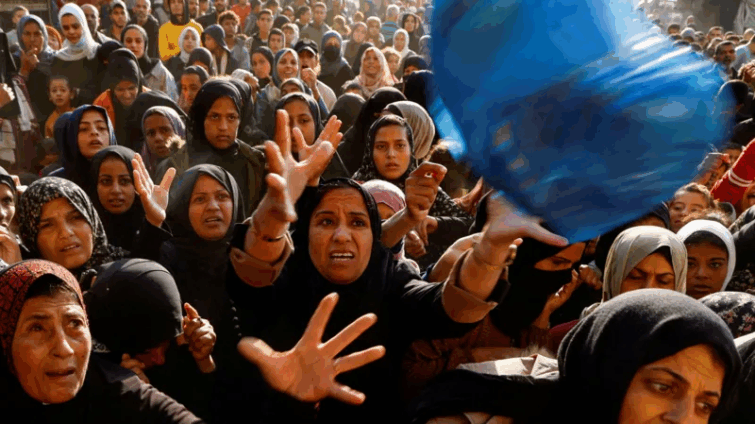
It comes as more than 100 international aid organisations and human rights groups have warned of mass starvation in Gaza.
The full statement reads: "We are desperately concerned for our journalists in Gaza, who are increasingly unable to feed themselves and their families.
"For many months, these independent journalists have been the world's eyes and ears on the ground in Gaza. They are now facing the same dire circumstances as those they are covering.
"Journalists endure many deprivations and hardships in warzones. We are deeply alarmed that the threat of starvation is now one of them.
"We once again urge the Israeli authorities to allow journalists in and out of Gaza. It is essential that adequate food supplies reach the people there."
In a separate joint statement, Médecins Sans Frontières (MSF), Save the Children and Oxfam, said their colleagues and the people they serve were "wasting away".
But Israel, which controls the entry of supplies into Gaza, has accused the charities of "serving the propaganda of Hamas".
Since Sunday, 45 Palestinians have died as a result of malnutrition, according to Gaza's Hamas-run health ministry.
Israel prevented aid deliveries to Gaza in early March following a two-month ceasefire.
The blockade was partially lifted after nearly two months, but food and medicine shortages have worsened.
Israel, along with the US, helped to establish a controversial new aid system run by the Gaza Humanitarian Foundation (GHF).
Hundreds of killings have been recorded in the vicinity of GHF's aid sites since they began operating eight weeks ago.
The World Health Organization has said that a quarter of Gaza's population is facing famine-like conditions, according to its assessments.
On Wednesday, its director Tedros Adhanom Ghebreyesus said: "I don't know what you would call it other than mass starvation, and it's man-made.
"And that's very clear, this is because of the blockade."
Latest Stories
-
Mahama calls for responsive healthcare regulation to improve patient safety
17 minutes -
IERPP accuses GoldBod of breaching transparency law, says quarterly trading reports removed from website
21 minutes -
Future of Energy Conference: Africa cannot industrialise in the dark – ECOWAS Bank President
22 minutes -
Help comes to Alajo as DirectAid brings relief items to flood victims
42 minutes -
“Somebody created the loss” – Haruna Mohammed backs Minority’s call for GoldBod probe
43 minutes -
Hope for agroecological farmers: Scientific Research supports urine-based weed management as safer alternative to glyphosate
44 minutes -
Israeli Film Festival returns to Accra with free screenings to boost cultural exchange
44 minutes -
SONABEL considers opening Bagré Dam spillway on Friday amid rising water levels
47 minutes -
Ghana Maritime Authority, Humanity First commission 4 boreholes in Wa to end water scarcity and keep children in class
57 minutes -
In Photos: Day Two of ‘SYPALA 2026’ focuses on governance, economic freedom and youth leadership
1 hour -
Wontumi withdraws from NPP chairmanship race, urges support for Bawumia
2 hours -
UCC-IEPA, CEGRAD launches free digital skills programme to empower 1,000 women in education
2 hours -
NPP dismisses extortion allegation against Afenyo-Markin, says focus remains on GoldBod losses
2 hours -
Guinness Ghana DJ Awards 2026 set for December 4 as ‘All Out’ era begins
2 hours -
GhIE inducts 183 engineers, calls for stronger action on galamsey and infrastructure
2 hours