

Audio By Carbonatix
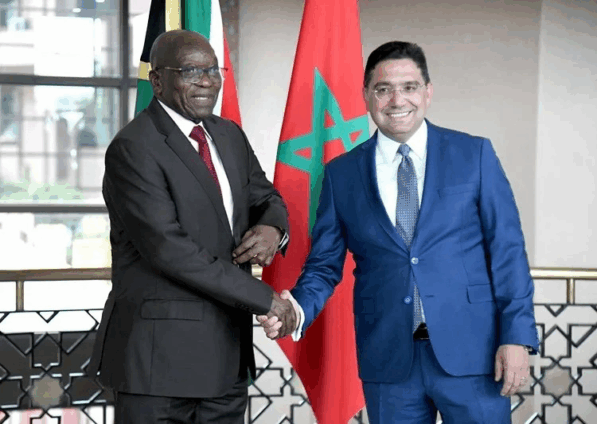
Former South African President Jacob Zuma, now leader of the opposition Umkhonto we Sizwe (MK) party, visited Morocco on July 15, 2025, where he met with Foreign Minister Nasser Bourita and other officials.
During the visit, Zuma openly endorsed Morocco’s autonomy plan for the Sahara, a move that unsettled Pretoria and exposed internal rifts within South Africa’s foreign policy stance.
His declaration in support of Morocco’s proposal particularly rattled the Department of International Relations and Cooperation (DIRCO). Instead of addressing the substance of Zuma’s remarks, DIRCO focused on protocol, questioning the use of South Africa’s national flag during the meeting.
Analysts say this response revealed a deeper unease: a government confronted by the symbolic dissent of a former president and anti-apartheid icon who now offers an alternative vision on the Sahara issue.
The episode highlighted Pretoria’s growing isolation on the matter and underscored the fact that South Africa’s hostility toward Morocco is not unanimously shared within the country.
Zuma’s visit demonstrated that South Africa’s political, intellectual, and social voices can hold positions distinct from the ruling party’s line.
Sources close to the visit indicated it was carefully coordinated with the involvement of diplomatic missions from both countries.
The South African Embassy in Rabat even requested that Zuma be accorded full protocol courtesies, including the display of the national flag—something Zuma himself reportedly insisted on.
The uproar over symbols, therefore, appears more as an attempt to deflect attention than a substantive concern.
Pretoria’s reaction also raised questions about its tolerance for political pluralism, a cornerstone of South Africa’s democracy.
The MK party, though newly established, is represented in Parliament and enjoys growing support.
For its part, Morocco has emphasised that it takes no position in South Africa’s internal politics but fully respects the diversity of opinions within the country.
Zuma’s endorsement was neither improvised nor symbolic. The MK party has announced a press conference in response to DIRCO’s statement, confirming that the position reflects a considered view on a key African issue.
Morocco, meanwhile, continues to engage with all political forces in South Africa. In October 2024, Rabat hosted an ANC delegation led by Obed Bapela, underscoring its commitment to dialogue across the political spectrum.
On the broader Sahara question, Rabat’s position remains rooted in historical and legal legitimacy, gaining steady support across the continent.
Today, more than two-thirds of African states either explicitly back Morocco’s sovereignty over the Sahara or adopt a constructive stance.
Ultimately, Morocco reiterated its respect for the South African people and expressed readiness for open, pragmatic dialogue with Pretoria—one that moves beyond Cold War-era ideological divisions and focuses on stability, sovereignty, and African unity.
Latest Stories
-
Chef Abbys: Feeding 50,000 people, putting food security on Ghana’s agenda
17 minutes -
Ho set to host Republic Bank–JoyNews Habitat Fair as multiple firms prepare to showcase housing solutions
25 minutes -
NPP demands public inquiry into alleged $600,000 World Cup visa fraud, wants Sports Minister, GTA CEO summoned
32 minutes -
I want my brand to be bigger than just music – Yaw Wazinga
36 minutes -
Houthi missile attack on Yemeni presidential palace kills two, minister says
36 minutes -
I hoped to win an award; I worked hard – 2026 Best Graduating Law Student
46 minutes -
Fraudsters increasingly target bank customers instead of banking systems – Fraud detection expert
47 minutes -
44 teacher sexual abuse cases tracked since 2015; school heads feature in 40% of recent cases — JoyNews Research
49 minutes -
Unchecked imports and the Middle East crisis threaten Ghana’s fragile food inflation anchor
1 hour -
Ecobank Junior Saver Big Pitch to reward 10 winners with GH¢2,000 each
1 hour -
AMA demolishes unauthorised pigsty obstructing Agbogbloshie waste evacuation exercise
1 hour -
I was filled with disbelief – Akosua Achia Sarpong Esq. shares her first reaction
1 hour -
Snake Village: A look at Volta Region’s hidden snake village and its tourism potential (Video)
1 hour -
Election Watch Ghana calls for constitutional reforms to strengthen Electoral Commission independence
1 hour -
NACOC, Postal and Courier Services Regulatory Commission intensify efforts to curb drug trafficking
1 hour