


Audio By Carbonatix
Ecobank Ghana continued its position as the biggest bank in Ghana in 2024 with a market share of 14.3%, according to the 2025 Ghana Banking Sector Survey by PwC.
It was followed by GCB Bank with a market share of 13.0% in 2024, from 10.9% in 2023.
According to the report, the expansion of the two banks highlights the high level of trust these institutions enjoy among retail and corporate clients.
Their success in deposit mobilisation can be attributed to a variety of strategic initiatives. These included leveraging an extensive physical branch network, each operating more than 250 outlets nationwide, to improve accessibility in both the urban and rural areas.
Additionally, their sustained investment in digital banking infrastructure significantly enhanced convenience for clients, particularly the younger, tech-oriented demographic. Their rollout of targeted savings and investment products further attracted clients such as SMEs and salaried professionals seeking flexible and secure financial solutions.
Standard Bank and Absa consolidated their standings as the third and fourth largest banks by total deposits, expanding their combined deposit base by GH₵6.9 billion.
In the mid-tier category, banks such as Zenith Bank, Consolidated Bank Ghana and First Atlantic Bank remained steady in the 6th, 8th, and 10th positions, respectively.
Access Bank Ghana rose from ninth to seventh place, while GT Bank improved its standing from 11th to 9th.
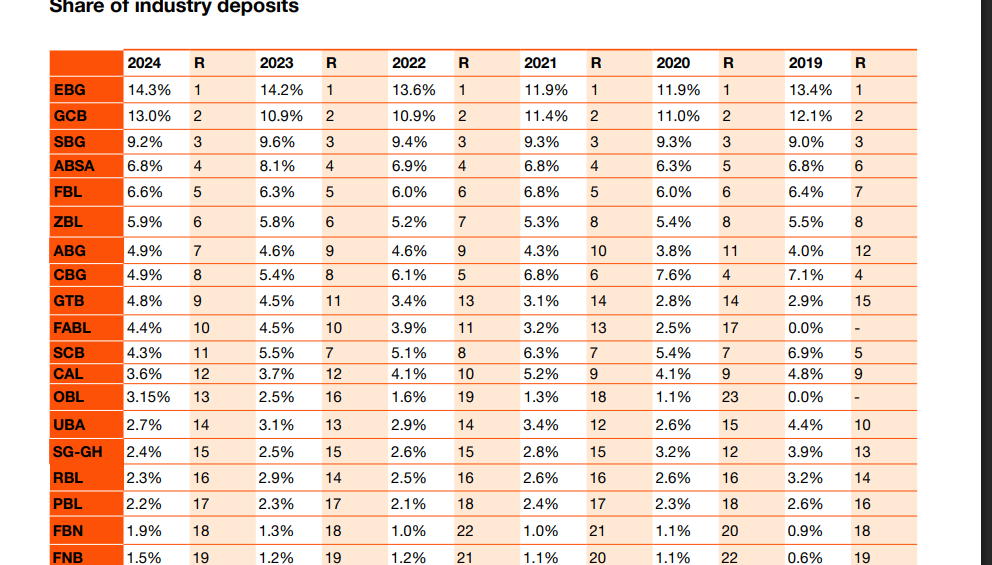

Conversely, Standard Chartered Bank dropped from 7th to 11th, suggesting competitive or operational headwinds.
Overall, the ten leading banks captured over 50% of the industry’s total deposits, affirming their influence in shaping sector dynamics.
Across deposit types, there was broad-based growth: current accounts surged by 37.4%, savings accounts rose by 44.2%, and both certificates of deposit and call deposits showed marked increases.
Deposits from other banks also increased sharply by nearly 50%, indicating a rise in interbank confidence and activities to support the new cost to deposit ratio requirements.
Notably, time and fixed deposits declined by 6.2%, likely driven by changing interest rate expectations and a growing preference for more flexible financial instruments.
Latest Stories
-
Government dismissed my drug trafficking warning, then tried to arrest me – Ntim Fordjour
5 seconds -
Day Two: 3rd Republic Bank-JoyNews Habitat Fair Clinic underway at Junction Mall
6 seconds -
NACOC addressing inherited gaps in fight against drug trafficking – Deputy Director-General
13 minutes -
Taekwondo goes to school as GTF launches five-region youth campaign
16 minutes -
The issues Mourinho is struggling to fix at Real Madrid
22 minutes -
Hundreds throng EducationUSA College Fair in Kumasi in pursuit of abroad studies
25 minutes -
Drug bust: NACOC should be part of port inspection team – Twum-Barimah
28 minutes -
Ward appointed Liverpool’s sporting director
28 minutes -
This isn’t the first cocaine bust; NPP must stop the politicisation – NACOC deputy boss
32 minutes -
Drug bust case: Only Customs officers, MPS officials in scanning room – NACOC
2 hours -
I don’t mind being insulted; I have a crocodile skin – President Mahama
2 hours -
Samson’s Take: Verify the badge – and verify the story
2 hours -
President Mahama explains why Ghana must rethink regulation of TikTok, other new media platforms
2 hours -
Rule of law must be protected – GBA condemns EOCO action against Baffour Awuah
4 hours -
950,000 barrels of Sankofa crude head to TOR as GNPC deepens domestic refining
4 hours