

Audio By Carbonatix
Counsel for the former National Signals Bureau (NSB) chief, Kwabena Adu Boahen, in the high-profile GHS49 million theft and money laundering trial, has strongly criticised the Attorney General’s decision to drop charges against one of the accused persons.
The move, which has seen Ms Mildred Donkor discharged as the third accused and repositioned as a prosecution witness, has sparked heated legal debate and raised questions about prosecutorial consistency in one of Ghana’s largest financial crime cases.
Background: The GHS49 Million Scandal
The case, which has gripped the nation in the last few months, centres on allegations that Kwabena Adu Boahen, his wife Angela Adjei-Boateng, and their company, Advantage Solutions Ltd., orchestrated a sophisticated scheme resulting in the theft and laundering of over GHS49 million (approximately $4 million).
Mildred Donkor, an accountant, was previously charged alongside the couple, accused of playing a pivotal role in the alleged money laundering activities.
AG’s Sudden Withdrawal: “What Has Changed?”
The Attorney General’s office, in a filing on October 16, 2025, formally withdrew all charges against Ms Donkor, paving the way for her to testify on behalf of the state.
The High Court, presided over by Justice Afia Serwah Asare-Botwe, accepted the withdrawal and discharged Ms Donkor in Friday’s sitting.
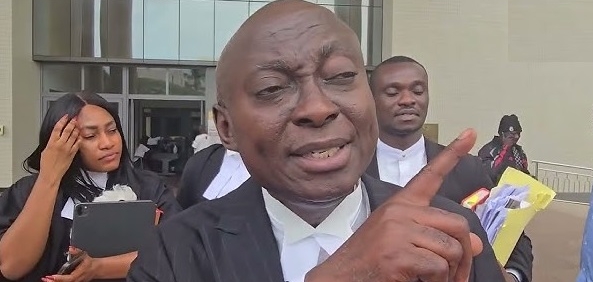
Speaking to reporters outside the courthouse, lead defence counsel Samuel Atta Akyea described the development as “one of the most interesting and dramatic moments” of the case.
“For the first time I am hearing that somebody has been withdrawn as an accused person and is being made a witness… I could tell you that it is one of the interesting developments and dramatic moments in this whole thing because an accused person has become a prosecution witness,” he remarked.
Atta Akyea was especially critical of the Attorney General’s reversal, noting that Ms Donkor had been implicated in the original charge sheet, which was personally signed off by the AG and presented to the court.
The charge sheet publicly accused her of laundering millions of cedis in concert with the first and second accused.
“The AG has published to the whole world that the third accused is into money laundering activities with the first and second accused. So what has changed? Guess who signed it? The AG signed it before the court and the charge sheet says so. So what has changed for the AG to have a huge somersault that the one that I have accused to be involved in money laundering should come and testify against the people she was charged with?” Mr Atta Akyea queried.
Concerns Over Prosecution Tactics
The move, Mr Atta Akyea argued, suggests “indecent haste” on the part of the prosecution, raising suspicions that the state is eager to bolster what has become a complex, high-stakes case by securing insider testimony at the expense of prosecutorial integrity.
“It is too early to talk about it, but for me it leaves much to be desired,” he said, cautioning that such a tactic could undermine public trust in the justice system.
Legal experts note that while it is not uncommon for prosecutors to offer immunity or discharge certain accused persons in exchange for testimony, such decisions are typically accompanied by detailed justifications—especially in cases involving large sums and public officials.
Pending Appeal Clouds Trial
In addition to his objections over Ms Donkor’s discharge, Mr Atta Akyea also took issue with the court’s decision to proceed with the substantive trial despite a pending appeal over the prosecution’s alleged failure to disclose key evidence to the defence.
Ghana’s criminal procedure law requires prosecutors to make full disclosure to enable fair trial rights enshrined in Article 19 of the 1992 Constitution.
Mr Atta Akyea described the court’s approach as “an aberration of justice”, stating that the refusal to pause proceedings deprives his client of crucial information necessary for a robust defence.
Wider Implications for Financial Crime Prosecutions
The GHS49 million case is being closely watched by anti-corruption advocates and the financial sector, as Ghana continues to battle rising incidents of white-collar crime.
According to Transparency International’s 2024 Corruption Perceptions Index, Ghana ranks 70th out of 180 countries, with public confidence in anti-graft enforcement seen as mixed.
As the trial resumes, all eyes will be on the prosecution’s next moves and the impact of Ms Donkor’s testimony.
For now, Atta Akyea’s sharp critique has placed the Attorney General’s strategy—and the broader integrity of high-profile prosecutions—firmly under the spotlight.
Latest Stories
-
Government has improved sanitation in one-and-a-half years — Salaga South MP
3 hours -
Nkwanta North Assembly to appear before Parliament over DACF sanitation spending
3 hours -
Mourinho prints out ‘red card’ incidents after Real lose derby
3 hours -
Atletico beat 10-man Real in feisty Madrid derby
4 hours -
Twelve Tribes of Israel Ghana to mark 40 years with anniversary celebration
4 hours -
GPL 2026/27: Hearts held by Bechem as Kotoko, Samartex share spoils
4 hours -
My Story (Kwaku Antwi-Boasiako)
5 hours -
We expect growth rate to re-accelerate in second-half of 2026 – IC Insights
5 hours -
The ungodliness and unrighteousness underlying the National Cathedral mess!
5 hours -
T-bills auction: Government fails to achieve target; yield on 91-day-bill remains unchanged
5 hours -
It’s Ghana’s shame to denigrate Nkrumah when the whole world honours him as African of the Century – Asiedu Nketiah
5 hours -
No other nationalist can compare to Nkrumah – Asiedu Nketiah
5 hours -
Collateral Registry: Foreign banks accounted for GH¢19.9bn of secured credit in quarter 2, 2026
5 hours -
This government should expect scrutiny – Asiedu Nketiah
6 hours -
Two-year-old girl dies in domestic fire at Cantonments
6 hours