

Audio By Carbonatix
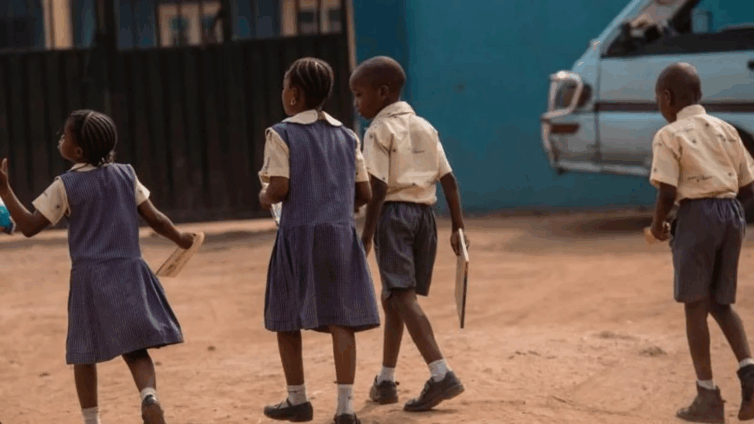
The Nigerian government has announced it is cancelling a controversial policy that mandated the use of indigenous languages for teaching in the earliest years of schooling instead of English.
Education Minister Tunji Alausa said the programme, introduced just three years ago, had failed to deliver and was being scrapped with immediate effect.
Instead, English will be reinstated as the medium of instruction from pre-primary levels through to university.
The now-defunct programme was launched by former Education Minister Adamu Adamu, who had argued that children learnt more effectively in their mother tongue.
At the time, Adamu argued that pupils grasped concepts more readily when taught in "their own mother tongue" - a view supported by numerous UN studies on early childhood education.
Nigeria's education system is facing serious problems, including poor-quality teaching, inadequate resources, low teacher pay, and numerous strikes.
Although 85% of children attend primary school, fewer than half complete secondary education.
Some 10 million children are out of school in Nigeria, more than in any other country, according to the UN.
Announcing the reversal of the language policy in the capital, Abuja, Dr Alausa pointed to poor academic results from those areas which had adopted mother-tongue teaching.
He cited data from the West African Examinations Council (WAEC), the National Examinations Council (NECO), and the Joint Admissions and Matriculation Board (JAMB).
"We have seen a mass failure rate in WAEC, NECO, and JAMB in certain geo-political zones of the country, and those are the ones that adopted this mother tongue in an over-subscribed manner," the minister stated.
The abrupt cancellation of the policy has drawn a mixed response from education specialists, analysts and parents.
Some have hailed the government's decision, agreeing that the implementation was problematic and contributed to falling standards.
Others, however, believe the policy was abandoned prematurely. They argue that such a significant shift requires substantial investment in teacher training, the development of textbooks and learning materials, and a longer timeframe before it can be fairly judged and begin to bear fruit.
Education expert Dr Aliyu Tilde praised the reversal, saying Nigeria isn't ready for such a move.
"Does Nigeria have trained teachers to teach in the dozens of indigenous languages in the country? The answer is no. Also, the major exams like WAEC, JAMB are all in English and not in the mother tongue languages.
"I think what's needed to improve the quality of our schools is bringing in qualified teachers,” he told the BBC.
A mother who has two children in early education schools, Hajara Musa, said she supported the reversal as it would help young children to learn English at an early age.
"English is a global language that is used everywhere, and I feel these kids should start using it from the start of their schooling instead of waiting for when they are older,” she told the BBC.
However, social affairs analyst Habu Dauda disagreed.
“I think it was scrapped prematurely instead of giving it more time. Three years is too little to judge a big shift such as this - the government ought to have added more investment," he said.
The debate highlights the ongoing challenge in Nigeria of balancing the promotion of its rich linguistic heritage with the practical demands of a national curriculum and a globalised economy where English proficiency is dominant.
Latest Stories
-
Reality Zone with Vicky Wireko: International Day of the Girl, shaping today’s girl for tomorrow’s future – ZONTA Clubs lead the way
5 minutes -
Global health must be led by countries, not designed for them – Mintah Akandoh
1 hour -
Mahama honoured at 2026 World Health Summit in Berlin for global health leadership
1 hour -
Breast cancer is not a death sentence – Besease Kontire Obaapanin, Magmina Foundation lead awareness campaign
1 hour -
EcoBank invests in digital education of 4 Garisson School to mark 40 years in Africa
2 hours -
AGI urges investment in skills and raw materials to strengthen local manufacturing
2 hours -
GPL 2026/27: ‘We have to rectify our mistakes’ – Boadu reacts to Aduana FC defeat
2 hours -
No disability access, no building permit – KMA declares
2 hours -
Asantehene to lead environmental restoration effort at Jimi Land Reclamation Site
2 hours -
Poor Ghanaians are being jailed because they cannot afford justice – Crime Check Foundation
2 hours -
No conflict in appointing Emelia Agbenyo as Deputy EC Chair – NDC
2 hours -
87-year-old man jailed 20 years for defiling 9-year-old girl at Ofankor
2 hours -
Sankofa Gold targets 70kg output after 9-month shutdown
2 hours -
Tamale, Bolgatanga had just one Legal Aid lawyer between them – Kwesimintsim MP
2 hours -
PAC orders eviction of former irrigation company MD from official residence
2 hours