

Audio By Carbonatix
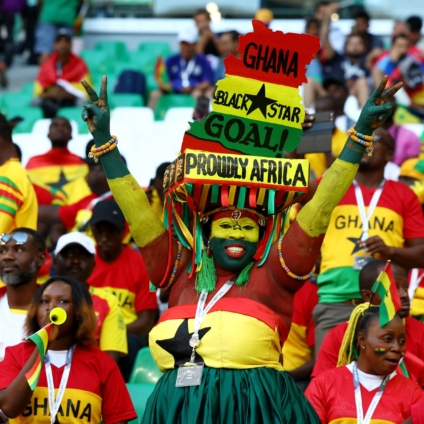
“Your fans will bring colours, style, and passion to the greatest FIFA World Cup ever in 2026 in Canada, Mexico, and the United States.”
That was FIFA President Gianni Infantino, speaking in October 2025, moments after Ghana secured qualification for the expanded 48-team World Cup.
Two months later, African fans are asking a simple question: How?
How do we bring colour, style, and passion when the price of entry alone wipes out months of income?
The cheapest World Cup ticket costs $140, while the average minimum monthly wage across the nine African countries represented at the tournament stands at $163 -- with Ghanaians earning the least.
Read that again.
Ghana’s lowest-priced ticket for its first match against Panama is more than three times the monthly minimum wage of any ordinary Ghanaian.
The West African country’s minimum monthly wage stands at just $45.29, according to data from the Ministry of Employment and Labour Relations.
Meanwhile, the cheapest ticket available for Ghana’s World Cup opener against Panama is $140. That single ticket alone costs an arm and a leg. Against England, the lowest ticket rises to $220, nearly five times what an ordinary Ghanaian earns in a month.
Fans might be passionate about the Black Stars, but this is no longer about football passion. It is about survival. How does a fan choose between food, rent, transport, and a World Cup ticket?
"I am happy we [Ghana] have qualified, but I think the price [of the ticket] is outrageous for the ordinary Ghanaian," a football fan says.
It was on BBC Focus on Africa on Friday, December 12, a few hours after FIFA released the ticket prices on its website.
"It appears there's a disconnect between FIFA and the Global South when it comes to the economic realities in Ghana and other parts of the continent."
Those were my words on the programme.
"The ordinary fan has been priced out of what is supposed to be a celebration of national teams," I added.
"We know those who will be going. They would be a few. I would rather sit behind my TV and watch," another fan resigned his fate.
While some fans have thrown their hands in the air in despair, others joined the global call for a reduction of the prices, which is more than 100% the price many paid during the last World Cup in Qatar 2022.
During that competition, despite the country spending an estimated $220 billion on infrastructure, fans and journalists benefited from compact venues, efficient transport, and relatively manageable ticket costs.
From close-range coverage, it was one of the most accessible World Cups ever staged.
North America is different. Distances are vast. Costs are layered. And tickets? The first gate are unforgiving.
"I think FIFA has to reduce the prices. Most of us, our money is not enough to even think of watching any match in the stadium after seeing the ticket prices," a fan says.
"I think something should be done about it. We are pleading with the government to intervene for Ghanaians because it's too high. The price is too high," another adds
"They are too expensive. Around GHC 5,000 (about $400)? I don't think any ordinary Ghanaian can afford that," he decried.
The reaction of Ghanaians and many fans in Africa and beyond is not misplaced.
These World Cup ticket prices suggest Africa was not considered by FIFA during the planning period.
It's a tournament for the masses; but this a tournament for the elite, it's a tournament for the billionaires, it's a tournament for the corporate travellers.
As stated earlier, the minimum required to buy a ticket for Ghana's opening match against Panama is more than the monthly salary of some Ghanaians. That's indeed a betrayal of the sport FIFA says it's accessible to all.
The 2026 World Cup is shaping up to be the most expensive in history; not just because it spans three countries, but because its pricing model assumes incomes that simply do not exist across much of Africa.
There's a staggering imbalance between ticket costs and the financial realities of millions of African football fans.
In the three countries the World Cup will be staged: United States, Canada, and Mexico, there is a vast stronger wage floors.
In Canada for instance, monthly minimum wages range from roughly $1,805 to $2,286, depending on province per Playroll.
In the United States, the federal minimum translates to about $1,255 per month depending on the state you're domiciled, with many states significantly higher according to Playroll and Visual Capitalist.
Even Mexico, the lowest-paid of the host nations, has an estimated monthly minimum wage ranging from $263 to $386, depending on the region, according to data from Deel.
For fans in these countries, ticket prices are painful but proportionate. For African fans, they are annihilating.
The disposable income of many people from the Global South is completely different from that of North America and Europe. What may be considered disposable income per their minimum wage may take someone from Africa three or four months to raise that kind of money.
For instance, South Africa, often perceived as one of the continent’s stronger economies, would need quadruple of their current monthly earnings to watch Bafana Bafana against Mexico. With a minimum monthly wage of $278, as cited by LegalWise, RemotePass, and VCA Consulting, the figures remain staggering.
A Category 3 ticket for South Africa’s match against Mexico costs a jaw-dropping $1,020, while the most expensive option reaches $2,355. Even the so-called ‘cheapest’ option is nearly four times the monthly minimum wage.
For matches against either Denmark, North Macedonia or Czech or the Republic of Ireland, Or Korea, Category 3 tickets drop to $140, but even that represents half a month’s income.
Egypt’s minimum monthly wage is estimated at $147, based on prevailing exchange rates.
Ticket prices for Egypt’s matches range from $140 at the lowest to $500 at the top end.
In practical terms, an Egyptian fan earning the minimum wage would need to spend almost an entire month’s salary just to secure the cheapest ticket -- before flights, visas, accommodation, or food are even considered.
That’s not disposable income. It's a full month of living expenses.
For Senegal, the numbers are even more unforgiving. The country’s minimum wage is approximately $105 per month, according to Rivermate and fatunetwork.net. However, the cheapest ticket for Senegal’s matches sits at $140, while high-profile fixtures against France or Norway climb to $220 and beyond.
FIFA is asking a Senegalese fan to give up more than a month’s salary for one game. That is not participation — that is exclusion.
In Algeria, where the minimum monthly wage is $143 (Algeriainvest), ticket prices range from $140 to $265, depending on the opponent.
On paper, the lowest ticket appears ‘affordable’ — until one realises it consumes almost an entire month’s earnings. Matches against global giants like Argentina push the cheapest option to $265, nearly two months’ salary.
Tunisia’s situation mirrors that of Egypt. With a minimum wage of $147 per month (Trovit), the lowest ticket prices for Tunisia’s games are $140, rising to $180 and beyond. For a Tunisian fan, attending one World Cup match would mean sacrificing nearly everything earned in a month.
The numbers don’t lie. This pricing assumes a level of income that simply does not exist for most Africans.
Côte d’Ivoire presents a similarly sobering picture. With a minimum wage of $132 per month (Rippling.com), ticket prices range from $140 to $220 for matches against Ecuador, Germany, and Curaçao. Even the cheapest ticket exceeds a month’s earnings for many Ivorians.
This is where the idea of the ‘ordinary fan’ completely collapses. Only the wealthy, or those sponsored by institutions, stand a chance.
Morocco, despite having one of the continent’s higher minimum wages at $305 per month (Espace Paie), still struggles under the weight of ticket pricing. Category 3 tickets range from $180 to $265, while premium options climb to $700.
For a Moroccan fan, attending one match could consume nearly an entire month’s salary -- and sometimes more.
Higher income does not equal affordability. Context matters, and FIFA ignores it.
Cape Verde rounds out the list with a minimum monthly wage of $170, according to publicly available data. Ticket prices for Cape Verde’s matches range from $140 to $180. Even at the lowest end, a fan must part with nearly a full month’s income.
For a small island nation, this is devastating. Football is one of the few global stages Cape Verde has -- and its fans are locked out.
Taken together, these figures tell a single, undeniable story. Across all nine African countries represented at the 2026 World Cup, the cheapest available tickets routinely consume one to four months of minimum wages.
When flights, accommodation, visas, feeding, and internal transport are added, costs I personally experienced when I paid $2,461 for a summer flight to Oregon in 2022 for the World Athletics Championships, the idea of African fans filling the stands collapses entirely.
It gets worse when some football fans, especially from Algeria, Côte d’Ivoire, Cabo Verde, and Senegal are forced to post a visa bond of up to $15,000 before travelling to the United States for the 2026 FIFA World Cup, following the new measures introduced by the U.S. Department of State.
Though the other countries are not in this category of a visa bond, the travel restrictions apply to all countries that have qualified for the World Cup from Africa.
FIFA speaks of inclusion, but the numbers, the actions of the host, especially the USA tell a different story. For Africa’s ordinary fan, the 2026 World Cup is not just expensive - it is unreachable.
The world football governing body has strategically thrown Africa and Africans out of the World Cup because many of us cannot afford it.
The inequity is glaring. Fans in England, Ghana's group opponent, have estimated monthly minimum wage of about $2,578, based on National Living Wage calculations (Playroll – https://www.playroll.com). That's 57 times more than what Ghanaians earn.
In the Netherlands, Tunisia's group mate, a minimum wage is approximately $2,504. Egypt's opponent, Belgium has around $2,127, France at $1,851, and Germany at $1,775 — all figures drawn from Playroll’s global wage estimates and European Commission data.
For a minimum-wage worker in England, a $140 Category 3 World Cup ticket represents less than 6% of monthly income.
Even a $220 ticket is uncomfortable, but survivable. It does not erase rent, food, or transport for the month.
One might expect greater parity when Africa is compared to CONMEBOL, where football culture is equally intense and economies are often fragile.
Even here, Africa falls behind.
Uruguay has a minimum wage of about $543 per month. Ecuador sits at $470, Colombia at $389, Paraguay at $355, Brazil at $286, and Argentina at $224 (Deel – https://www.deel.com).
These figures are not high. But they still double, triple, and in some cases quintuple the minimum wages of several African qualifiers.
It's not FIFA’s fault that the Africa continent has an anaemic economy, but a body that says its competition is a celebration of universality; a gathering where nations converge in the spirit of sport, this edition threatens to redefine that principle.
If nothing is done, the 2026 World Cup will be remembered not for the games or the goals, but for the absence of Africa’s fans in the stands. It risks becoming a spectacle where only the wealthy can participate.
Even fans with a better economic environment compared to Africa say “This is a monumental betrayal of the tradition of the World Cup, ignoring the contribution of supporters to the spectacle,” said Football Supporters Europe (FSE).
They called on the Football Association to challenge FIFA over the pricing, which the FSA described as “scandalous” and a “laughable insult” to the average fan.
English fans earn approximately 57 times more than Ghanaians. Belgian fans earn about 15 times more than Egyptians. Dutch fans earn around 17 times more than Tunisians. And Senegal’s opponent, France, has fans who are roughly 17 times better off than Senegalese supporters in terms of monthly income.
Fans of these countries may fill the stands, creating a partisan atmosphere which could suffocate their opponents to death.
The gulf in standards of living is not marginal.
It is worlds apart.
Across Asia, the pattern repeats. In Australia, minimum wages translate to around $2,461 per month (Playroll). South Korea sits at $1,437, Saudi Arabia at $1,066.
Even Qatar, often criticised for labour conditions, has a minimum wage of roughly $274 (Deel).
At the lower end, Uzbekistan stands at about $90, one of the few countries globally comparable to Africa’s lowest earners (Playroll).
Yet most Asian qualifiers still earn several times what African minimum-wage workers do — and FIFA’s ticket pricing does not adjust for this disparity.
The data vary for some countries as they do not have standard minimum wage. For some, it is done a regional basis and even that they are better off than many Africans.
Then there's the hidden costs FIFA does not price in. Tickets are only the first gate.
With the World Cup taking place in peak summer, airfare inflation alone pushes the total cost beyond imagination for most Africans.
Accommodation in cities like Los Angeles, Dallas, New York, and Toronto during summer is unforgiving. Add transport and feeding, and attending even one match becomes an elite experience.
The conversation is urgent because time is short. Flights must be booked, accommodations reserved, and visas processed.
Ultimately, the story of Africa and the 2026 World Cup is one of exclusion by circumstance. The footballing talent is undeniable; the passion is abundant; the cultural contribution is unmatched.
For African supporters, the countdown to the 2026 World Cup is not just a matter of excitement — it is a race against financial impossibility, a stark reminder that passion alone does not buy a ticket to history.
And unless FIFA reassesses the economic realities confronting millions of ordinary Africans, the 2026 edition may come and go with African voices missing from the stands, silenced not by lack of love for the game, but by the stark inequities of pricing, wages, and opportunity.
And as the numbers show, this is not about sentiment.
It is about structure.
It is about wages.
It is about who FIFA believes the World Cup is really for.
Latest Stories
-
JoyNews’ Jacqueline Ansomah Yeboah selected for UK Media Excellence for Emerging Technology Fellowship
10 minutes -
Mental Health Alliance urges government to operationalise Mental Health Fund
25 minutes -
Ghana–Holy See agreement heads to Parliament after Cabinet approval
29 minutes -
Luv FM Corporate Games 2026: Kumasi Central Prisons, Amanfiman Bank win big amid fun
40 minutes -
WAFU B U17: Ghana top Group A after win over Togo
1 hour -
Ho Central Mosque reopens amid unresolved leadership dispute that led to closure
2 hours -
Minority caucus questions GH¢16.4m in Ablakwa’s SA evacuation spending, demands independent audit
3 hours -
Gender Ministry meets Nana Akua Addo’s husband over domestic violence after hospital discharge
3 hours -
UG Vice-Chancellor urges swift operationalisation of National Research Fund
4 hours -
Pope Leo to have surgery after lump found in lung
4 hours -
Joseph Cudjoe writes: Ghana must break free from the dangerous mindset that natural resources are the foundation for wealth
4 hours -
Children among 109 dead after boat capsizes off Djibouti, UN says
4 hours -
OmniBSIC Bank’s 11th health walk promotes fitness and business growth
4 hours -
2026 World Maritime Day: Danish Embassy organises “The Gulf of Guinea Speaks”
5 hours -
New Economy will tackle unemployment and restore hope – Ato Forson
5 hours