

Audio By Carbonatix
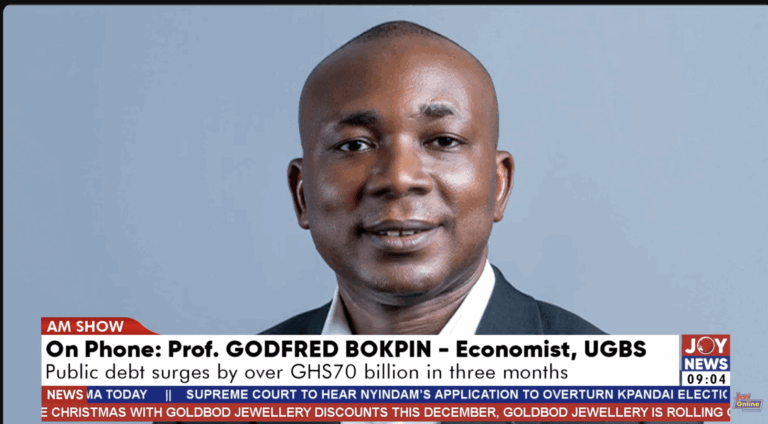
Professor Godfred Bokpin,an Economist and University of Ghana Business School (UGBS) lecturer, has played down concerns over Ghana’s recent rise in public debt, insisting the country is no longer classified as being at high risk of debt distress.
Speaking on Joy FM’s AM Show, Prof Bokpin urged Ghanaians to focus on the broader debt sustainability outlook rather than short-term fluctuations driven largely by currency movements. “I don’t think it presents a bigger concern here. Let’s not major on the minor,” he said, citing the International Monetary Fund’s (IMF) latest debt sustainability analysis.
According to him, the IMF’s October 2025 assessment shows Ghana has exited the high-risk debt distress category and is now considered a moderate debt risk country.
“If you look at the October debt sustainability analysis that the IMF released, Ghana has exited the high-risk of debt distress category. We are now considered a moderate debt risk country, given our economic fundamentals,” Prof Bokpin explained.
His comments come against the backdrop of fresh data from the Bank of Ghana, tracked by JoyNews Research, showing that Ghana’s public debt stock rose by GH¢71.6 billion in the third quarter of 2025. The increase has been largely attributed to the sharp depreciation of the cedi against the US dollar during the period. Total public debt has now climbed to GH¢684.6 billion, with projections suggesting it could exceed GH¢700 billion by the end of the year if exchange rate pressures persist.
Prof Bokpin acknowledged the rise in debt but argued that the increase should be properly contextualised. He noted that Ghana officially entered the high-risk debt distress category in 2014, prompting the government at the time to seek IMF support. “That was the reason President Mahama, on August 6, 2014, went to the IMF for the 16th IMF-supported programme,” he recalled.
He added that although Ghana exited that IMF programme in April 2019, debt sustainability was not fully restored, describing it as one of the key shortcomings of the programme. “We exited that programme without being able to restore debt sustainability. That was a major drawback,” he said.
The economist stressed that while some level of borrowing remains necessary to meet refinancing obligations and support economic recovery, the focus should be on sustainability rather than headline debt figures. He argued that recent debt increases, driven mainly by exchange rate effects, do not necessarily signal a return to crisis conditions.
Ghana is currently implementing IMF-backed reforms aimed at stabilising the economy, restoring confidence, and placing public debt on a sustainable path, amid ongoing challenges from currency volatility and global economic pressures.
Latest Stories
-
No conflict in appointing Emelia Agbenyo as Deputy EC Chair – NDC
22 seconds -
87-year-old man jailed 20 years for defiling 9-year-old girl at Ofankor
3 minutes -
Sankofa Gold targets 70kg output after 9-month shutdown
5 minutes -
Tamale, Bolgatanga had just one Legal Aid lawyer between them – Kwesimintsim MP
13 minutes -
PAC orders eviction of former irrigation company MD from official residence
16 minutes -
Legal Aid Commission has offices in only 45 of Ghana’s 261 districts, needs 180 more staff
18 minutes -
Challenging Heights welcomes Ghana’s Tier 1 ranking, calls for more anti-trafficking funding
38 minutes -
Cedi extends depreciation against dollar; going for GH¢12.10 at forex bureaus
40 minutes -
ECG cannot keep lending electricity for free
42 minutes -
No trader will be evicted from Aboabo Market after redevelopment – Mahama Ayariga assures traders
49 minutes -
GAUA to communicate decision on strike suspension after Tuesday
54 minutes -
Moody’s upgrades Ghana’s credit ratings to B3, but changes outlook to stable
59 minutes -
‘I want to raise well-rounded individuals, not just men’ – Kate Addo on parenting boys
1 hour -
Yaa Konadu Agyeman’s ‘Exceptionally Yours’ is the perfect romance read for the holiday season
1 hour -
‘You have to man up’ – Kobby Kyei on the hidden cost of silence for Ghana’s boys
1 hour