

Audio By Carbonatix
Government is taking decisive steps to reset Ghana’s agribusiness sector with the validation of a Draft National Agribusiness and Agro-Processing Policy aimed at promoting inclusive growth, investment, and commercial farming.
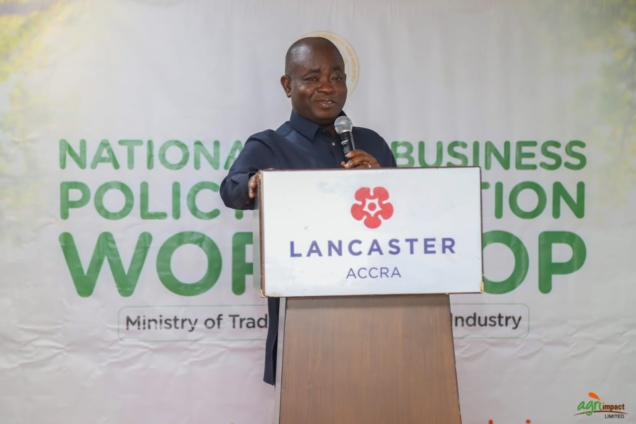
Speaking at the National Agribusiness Policy Validation Workshop in Accra on Friday, 19th December, 2025, the Deputy Minister for Trade, Agribusiness and Industry, Sampson Ahi underscored government’s commitment to shifting Ghana’s agricultural sector from subsistence practices to a business-driven, value-oriented agribusiness ecosystem.
According to him, the policy is intended to provide clear direction for agribusiness development by focusing on the commercial aspects of farming, trade, and agro-processing, stressing that agriculture must go beyond production to address value addition, markets, and sustainability.
Mr. Ahi urged stakeholders to expedite actions towards finalising the policy, noting that government was keen on completing the process within the shortest possible time.
He said, although the initial expectation was to have the policy ready for Cabinet consideration before the end of the year, he would push for it to be presented at the first Cabinet meeting in 2026 if timelines were not met.
The Deputy Minister called on all participants to give their best during the validation process to ensure the development of a strong, coherent, and results-oriented agribusiness policy.
He emphasised the need for collaboration among technical experts, policymakers, and private sector players to produce a policy that is practical, implementable, and capable of delivering tangible outcomes, noting that the government’s objective is to stimulate economic growth through agribusiness-led industrialisation.
Also addressing participants, the Chief Executive Officer of Agri-Impact Group, Mr. Daniel Acquaye, recounted the extensive stakeholder engagement process that began in July 2025, including national and regional dialogues across Ashanti, Bono, Bono East, Northern, Volta, and Oti regions.
He explained that the policy development process brought together industry players, development partners, academia, policy experts, agribusiness processors, and farmer groups, allowing grassroots voices to shape the policy framework.
Mr. Acquaye outlined key questions guiding the validation process, including whether the policy would provide clear direction, address systemic challenges such as post-harvest losses, unlock investment opportunities, promote inclusivity, and drive transformative change rather than marginal improvements.
He praised the Ministry, particularly the Sector Minister, Elizabeth Ofosu-Adjare and the Deputy Minister, for their hands-on leadership and commitment to ensuring the policy is completed within a reasonable timeframe.
Earlier, in a welcome address, the Director for Agribusiness at the Ministry of Trade, Agribusiness and Industry, Mr. Kwame Oppong-Ntim, explained the Ministry found it critical to develop a single, comprehensive policy framework to guide agribusiness and agro-processing activities nationwide.
Mr. Oppong-Ntim revealed that the draft policy was developed through extensive national and regional consultations involving both public and private sector stakeholders. He noted that the validation workshop was convened to ensure that all regional and national priorities had been adequately captured in the document.
“The essence of this validation is to scrutinise the draft policy and provide the necessary feedback to make it comprehensive and robust enough to stand the test of time,” he said.
The workshop brought together key stakeholders from the public and private sectors, development partners, industry associations, and policy experts. Activities included presentations on the draft policy’s objectives and key highlights, breakout group discussions across thematic areas, and plenary sessions to consolidate stakeholder inputs.
The validation exercise is expected to mark the final phase before the policy undergoes expert review and submission for Cabinet consideration, paving the way for a more coordinated, inclusive, and investment-driven agribusiness sector in Ghana.
Latest Stories
-
NACOC boss calls for practical cross-border action against drug trafficking
12 minutes -
Ghana calls for stronger regional cooperation to combat drug trafficking
25 minutes -
Ablakwa presents bicycles to 100 North Tongu day students
26 minutes -
Ablakwa supports 2,269 North Tongu SHS students with essential items
27 minutes -
Dr Bawumia expresses sympathy with farmers over their inability to sell their produce even at reduced prices
42 minutes -
Constitutional review: Govt must keep discussions open – Dr Tandoh
49 minutes -
GPL 2026/27: David Gyamfi hat-trick fires Ashantigold to historic first victory
50 minutes -
Ericsson celebrates 150 years of global innovation, 30 years of partnership and digital transformation in Ghana
1 hour -
Ghana’s Ambassador to Serbia hosts African ambassadors’ September meeting in Belgrade
2 hours -
Ghana closer to terrorism threat than ever before – WACCE
2 hours -
Gov’t must focus on quality everywhere, not categorisation of public schools – Ben Boakye
2 hours -
Tanko Computer backs comprehensive review of 1992 Constitution
2 hours -
2026 SHS placement crisis was caused by changes to established model – Former Dept. GES Director
2 hours -
GMet forecasts thunderstorms, rain across parts of Ghana tonight
2 hours -
GETFund to allocate GH¢250m to expand Category A SHS infrastructure
2 hours