

Audio By Carbonatix
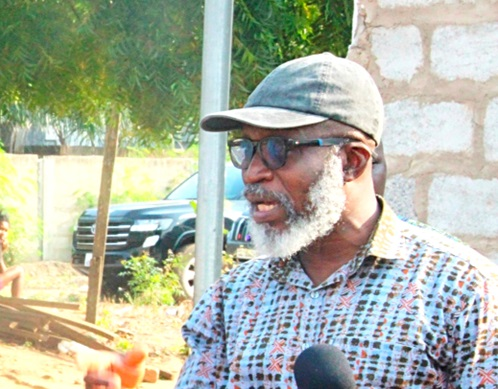
The Director-General of the Ghana Atomic Energy Commission (GAEC), Professor Samuel Boakye Dampare, has raised alarm over illegal developments around the National Radioactive Waste Management Centre, warning that human settlements close to the facility pose serious risks to public safety.
Professor Dampare explained that the Centre, which stored radioactive materials used by hospitals and industries, was a highly controlled zone.
“We manage these sources because they are dangerous. People shouldn’t get close to them, but they don’t care,” he said.
Professor Dampare said this in an interview with the Daily Graphic during an inspection tour of e-waste recycling and related facilities at GAEC last Thursday (January 8), led by the Minister of Lands and Natural Resources, Emmanuel Armah Kofi Buah, who is also the acting Minister of Environment, Science and Technology (MEST).
Nightmare
The problem, Professor Dampare, explained, escalated when individuals and developers began constructing structures near the National Radioactive Waste Management Centre.
“Assuming people are exposed to radioactive materials, the government would have to find money to treat them. And if we have built structures here and an accident occurs, evacuating people would be a nightmare,” he said.
He further stressed that areas housing radioactive sources were considered security zones, and as such were supposed to have constant military presence to prevent unauthorised access.
“These are not ordinary sites. They require security 24/7, but unfortunately, this has not always been the case,” the GAEC boss explained.
The National Radioactive Waste Management Centre, he added, played a critical role in the country’s health care and industrial sectors. Hospitals, for instance, use radioactive sources for diagnostic and treatment purposes, after which the materials are returned to the Centre for safe storage and management.
Professor Dampare lamented that urban development around sensitive sites often took precedence over safety considerations.
“The focus is on buildings and infrastructure, and this attitude is defeating the country. People should understand the danger they are placing themselves in,” he said.
Determination
For his part, the Minister of Lands and Natural Resources, Emmanuel Armah Kofi Buah, reiterated the government’s determination to protect strategic state lands within the GAEC area.
He described some areas as restricted zones due to national security concerns and the presence of toxic materials
“These lands are not for us alone.
This generation will pass and others will come.
We cannot behave as if our responsibility is to finish everything simply because we are here,” he said.
Mr Buah added that earlier leaders, including Osagyefo Dr Kwame Nkrumah, deliberately preserved areas such as the GAEC enclave to safeguard Ghana’s future, and warned that the government would not tolerate encroachment.
“They are ‘no-go’ areas. Anyone who enters does so at their own risk.
The Government will do everything to protect these lands in the long-term interest of Ghana,” he cautioned.
Latest Stories
-
Tiger Woods gets five-year driving ban after reckless driving plea
5 minutes -
South African airline behind daring stadium stunt cancels next flyby
14 minutes -
PURC urges ECG to address outages, metering delays
25 minutes -
Police engage traders over alleged harassment, extortion on Aflao-Accra highway
35 minutes -
Uber shuts operations in Nigeria and Uganda with immediate effect
46 minutes -
Netherlands moves billions in gold to London in ‘crisis preparedness’ move
56 minutes -
Legal vacation does not halt urgent court cases – Chief Justice
1 hour -
Keta residents react with mixed feelings to fresh fuel price hike
1 hour -
Managing Director on GH¢150,000 bail over five dud cheques
1 hour -
BOSTenergies reports strong 2025 performance, pays first-ever dividend to government
2 hours -
Carlos Queiroz reappointed as Black Stars head coach
2 hours -
Gov’t targets TVET transformation with US$300m World Bank facility
2 hours -
Flying into Ghana with more than 2 phones may face commercial import charges – GRA
2 hours -
Education Ministry warns private schools against use of unapproved textbooks
2 hours -
Travelers with multiple new devices returning to Ghana to pay additional charges – Customs Commissioner
3 hours