

Audio By Carbonatix
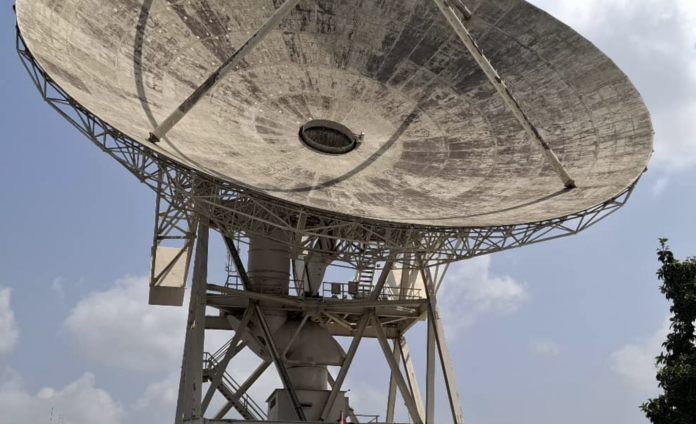
The Ghana Atomic Energy Commission (GAEC) has expressed concerns over the illegal acquisition of lands surrounding the Ghana Radio Astronomy Observatory (GRAO) at Kuntunse, Ga West Municipality, Greater Accra Region.
The land, acquired over 40 years ago to support satellite observation, data collection, research, and training in Space Sciences, has been taken over by private developers, which is now impacting the efficiency of the facility.
Addressing a news conference following a tour of the Observatory on Tuesday, the management of the GRAO raised alarm over ongoing construction near the facility, warning that the observatory could become “useless” if those activities continued.
The management explained that settlements and household devices, such as microwaves, were interfering with radio signals, hampering satellite observations beyond 10 minutes.
Launched in 2017, GRAO plays a crucial role in global space science, offering a platform for scientists to study the universe.
It supports Ghana’s participation in space research, fostering the development of scientists and engineers.
Ghana’s National Space Science Policy, launched in 2024, aims to leverage space technology for national development, security, and sustainability.
During a visit to the Observatory on Tuesday afternoon, the Ghana News Agency observed that numerous buildings had been constructed around the facility, with some located as close as 50 meters from the satellite dish.
Military officers were stationed at the site, providing security while contractors worked diligently to construct a fence around the remaining buffer zones of the facility.
Obrempong Toku Dum (VIII), Project Manager of the Via Sat Station (Real Time Earth Station), revealed that in 1979, an Executive Instrument facilitated the procurement of 163 hectares of land for the Radio Astronomy Observatory.
However, he noted that the land had been reduced to about 30 hectares over the past four decades, which now threatened the future viability of the facility.
“We want to create awareness about the importance of this facility. Ghana’s closeness to the equator presents an opportunity for us to attract investment into this facility,” Obrempong Dum VIII said.
Dr Joseph Bremang Tandoh, Director, Ghana Space Science Technology Institute, said the Radio Astronomy Observatory was a vital national asset crucial for the successful implementation of Ghana’s Space Science Policy.
He appealed to authorities and the public to support efforts to protect the facility from further encroachment and safeguard the investments channelled into it.
“Through this facility, a lot of Ghanaians have been trained in data science and other professions, and this inspires the next generation to pursue science. We have to protect it,” he said.
Latest Stories
-
Teachers’ Strike: Haruna Iddrisu questions paper-based processing of promoted teachers’ data
9 minutes -
Teachers’ strike: GES targets Monday deadline to submit promotion data to Controller
17 minutes -
Inflation to average 11.3% in 2027 – Fitch Solutions
48 minutes -
I didn’t campaign for NDC to come and do this nonsense – Kpebu on EOCO
49 minutes -
Fitch Solutions maintains its policy rate forecast of 14% by December 2026
56 minutes -
Diaspora Nasara Caucus congratulates Mohammed Ali Suraj, new NPP executives
3 hours -
Dr Antwi-Boasiako’s cybersecurity book showcased at UN crime prevention congress
3 hours -
We will empower the grassroots and protect every vote – NPP’s 1st Vice Chair Kojo Bamba
3 hours -
I do not see myself as better than anyone – NPP’s 1st Vice Chair Kojo Bamba
3 hours -
Police blur the line between invitations and arrests – Reindorf Twumasi Ankrah
4 hours -
Turning invitations into arrests is making citizens reluctant to assist police – Twumasi Ankrah
4 hours -
The Traffitech-GH SMS spot-fine system: The good, the sad, and the funny – Bright Simons writes
5 hours -
Hawa Koomson pledges experienced and mature leadership of NPP women’s wing
6 hours -
Young woman found dead at Kasoa Peace Town
6 hours -
Playback: The Law examined lawful arrest in Ghana
7 hours