

Audio By Carbonatix
Rethinking Credit: Why Conventional AI Fails Africa’s Financial Reality
For decades, modern banking systems have been built on a narrow definition of financial identity. You are considered “bankable” if you have a payslip, a formal employer, a credit history, collateral, and a verifiable address. This logic works reasonably well in highly formalised economies, but it collapses almost entirely when applied to Africa’s economic reality. According to the World Bank, over 57 per cent of adults in Sub-Saharan Africa remain unbanked, and even among those with accounts, a large proportion operate outside formal credit systems (World Bank, 2022). This means more than half of Africa’s productive population is invisible to traditional banking intelligence.
Yet invisibility does not mean inactivity. Africa’s informal economy contributes between 55 and 65 per cent of total employment and up to 40 per cent of GDP in many countries (International Labour Organisation, 2018). Market women, transport operators, artisans, smallholder farmers, street vendors, cross-border traders, and home-based manufacturers form the backbone of daily economic life. They move cash daily. They rotate capital weekly. They reinvest profits continuously. But because their transactions are not structured like corporate accounts, banks treat them as “high risk.”
This is where conventional Artificial Intelligence reproduces injustice.
AI systems used in banking are trained on historical financial data. They learn from existing credit bureau records, past loan performance, bank account activity, and salary patterns. The problem is simple but profound: the dataset itself is biased. If only formally employed people appear in the training data, the algorithm will conclude that formal employment is equivalent to creditworthiness. Informal traders become statistically invisible. The model does not see their daily turnover, their community trust, or their trading discipline. It only sees “missing data,” and in AI logic, missing data equals risk.
This is not a technical error.
It is a structural failure.
AI does not understand why a tomato seller in Makola Market rotates capital every three days.
AI does not know why a fish trader in Elmina never defaults within her susu group.
AI cannot interpret why a farmer repays loans after harvest cycles rather than monthly.
The result is what economists now call algorithmic financial exclusion. The very technology meant to democratize access to finance ends up reinforcing the same elite structures that have historically controlled capital.
This is why Africa does not need “better AI.”
Africa needs a better intelligence architecture.
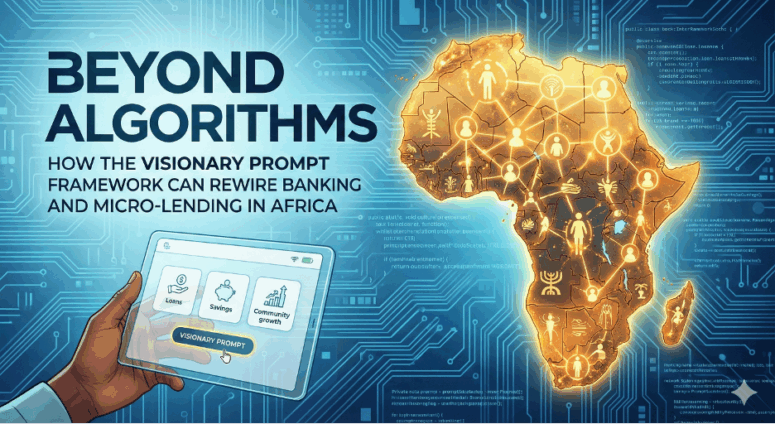
The Visionary Prompt Framework (VPF) was created to solve this exact problem. VPF is not just another algorithm. It is a multi-intelligence orchestration system. It recognises that economic behaviour is not purely numerical. It is social. Cultural. Seasonal. Psychological. Historical. Communal. VPF integrates multiple intelligence chambers into a single decision-making operating system.
For banking and micro-lending, these chambers become critical.
Human Intelligence interprets intention, context, and behavioural patterns.
Artificial Intelligence processes transactional data at scale.
Indigenous and Ancestral Intelligence reads community trust systems.
Natural Intelligence understands seasonal cash flow rhythms.
Systems Intelligence sees markets as ecosystems, not individuals.
Unknown and Unknowable Intelligence explores patterns that have not yet been documented.
This is what normal AI cannot do.
It sees transactions.
VPF sees economic life.
To understand why this matters, consider how most African credit currently works. Informal lending systems already exist. In Ghana, susu groups rotate capital weekly. In Nigeria, Ajo systems mobilise community savings. In South Africa, stokvels manage billions of rand annually. These systems operate on trust, reputation, and social enforcement, not credit scores. Default rates in many community groups are often lower than in formal microfinance portfolios, yet banks ignore them because they do not fit into spreadsheet logic.
VPF treats these systems as financial intelligence networks.
Not folklore.
Not charity.
Not “informal.”
But functional banking systems existed long before colonial institutions.
Conventional AI cannot interpret these networks because:
It does not know social hierarchies.
It cannot model reputation.
It cannot read moral obligation.
It cannot understand shame, honour, or community standing.
VPF can.
By integrating Indigenous and Ancestral Intelligence, VPF reads:
Who is trusted in the market
Who settles disputes
Who mentors apprentices
Who mobilises group savings
Who enforces repayment socially
These are credit signals.
Powerful ones.
Now add Natural Intelligence. Agricultural finance depends on seasons, not calendar months. Cash flows rise after harvest and decline during planting. Normal AI expects monthly salary payments. Farmers do not earn a monthly salary. They earn seasonally. When AI flags a farmer as “irregular,” it is actually misreading a natural system. VPF corrects this by aligning repayment models with rainfall cycles, planting seasons, and commodity price fluctuations.
This is why VPF is revolutionary for the banking industry.
It does not ask:
“Does this person fit our data model?”
It asks:
“What system does this person belong to?”
“How does money flow in this ecosystem?”
“What patterns govern this market?”
“What social contracts enforce repayment?”
This shift changes everything.
Banks stop lending to individuals and start lending to economic systems.
Microfinance stops chasing repayment and starts designing context-aware products.
Central banks stop regulating balance sheets and start regulating financial ecosystems.
This is the future of banking intelligence.
Not bigger algorithms.
Deeper understanding.
And this is only the beginning.
How the Visionary Prompt Framework Reads Financial Intelligence Beyond Data
Modern banking systems have been built on a flawed assumption: that financial behaviour can be fully understood through numbers alone. Balances, inflows, outflows, credit scores, repayment histories, and collateral valuations form the core data inputs banks use to make lending decisions. While these metrics are useful, they are incomplete. They capture only formal economic footprints, not the lived financial reality of most Africans. This is where the Visionary Prompt Framework (VPF) fundamentally departs from conventional Artificial Intelligence models.
VPF operates on the understanding that money does not move randomly. It flows through social systems, cultural practices, seasonal cycles, and trust networks that shape economic behaviour. To capture this reality, VPF integrates multiple intelligence chambers simultaneously, allowing financial institutions to read patterns of life rather than isolated transactions.
Human Intelligence within VPF interprets intent and behaviour. A bank officer using VPF does not just see a withdrawal. They see why the withdrawal happened. Was it school fees? Was it a funeral contribution? Was it inventory restocking? Context matters. In African societies, financial decisions are rarely individual. They are collective. Family obligations, community ceremonies, rotating savings groups, and business cycles drive spending behaviour. Normal AI sees “irregular activity.” VPF sees structured social spending.
Artificial Intelligence within VPF still plays a role, but as a processor, not the decision-maker. It clusters transactions, identifies velocity, detects seasonality, and maps cash flow rhythms. But its outputs are interpreted through other chambers, not blindly trusted. This prevents algorithmic bias from becoming institutional policy.
The Indigenous and Ancestral Intelligence Chamber is where VPF becomes transformative. Long before banks existed, African societies developed sophisticated financial systems. Susu in Ghana, ajo in Nigeria, stokvels in South Africa, and tontines across Francophone Africa mobilise billions annually. Studies show that rotating savings and credit associations serve over 40 per cent of low-income households in Sub-Saharan Africa (Banerjee & Duflo, 2019). These systems rely on social trust, reputation, and communal enforcement, not contracts. Defaulting is not just financial failure. It is a social dishonour.
Normal AI cannot model shame.
It cannot quantify reputation.
It cannot measure community standing.
VPF can.
By integrating community data, social leadership patterns, conflict-resolution histories, and market reputation, VPF constructs social credit profiles that are far more predictive than conventional scores. A trader who has never defaulted in her susu group for ten years is a lower risk than a salaried worker with a high credit score and no social accountability. Traditional AI cannot see this. VPF does.
Natural Intelligence adds another critical layer. Economic behaviour in Africa is deeply seasonal. Farmers earn after harvest. Fisherfolk earn based on migration cycles. Traders earn during festive seasons. School fees spike in September. Funeral contributions rise unpredictably. Normal AI expects monthly salary flows. When it sees irregular deposits, it flags risk. VPF corrects this by aligning financial analysis with ecological rhythms. Rainfall data, planting seasons, fishing cycles, and commodity price fluctuations are integrated into lending models. A farmer who earns twice a year is not at risk. They are natural.
Systems Intelligence then connects these patterns into ecosystems. Instead of evaluating a borrower in isolation, VPF evaluates networks. Who supplies them? Who buys from them? Who lends to them informally? Who vouches for them? This allows banks to understand economic interdependence. A tomato seller’s risk is not just her behaviour. It is the stability of the entire market chain. When transport costs rise, her margins fall. VPF sees this. Normal AI does not.
The Unknown and Unknowable Intelligence Chamber enables VPF to explore patterns that have not yet been documented. This is where discovery happens. New forms of micro-enterprise. New digital trading behaviours. New informal credit systems are emerging through mobile money. Normal AI cannot predict what it has never seen. VPF is designed to explore, not just predict.
This multi-intelligence architecture transforms how financial institutions operate. Banks no longer rely solely on static scores. They begin to understand financial ecosystems. Microfinance institutions stop chasing repayment through pressure and instead design products aligned with cash flow rhythms. Central banks move from regulating balance sheets to regulating financial behaviour systems.
The implications are massive.
According to the African Development Bank, SMEs contribute over 80 per cent of employment in Africa but receive less than 20 per cent of formal bank credit (AfDB, 2021). This is not because SMEs are unproductive. It is because banks cannot read them. VPF changes that.
In integrating:
Market transaction velocity
Supply chain behaviour
Community reputation systems
Seasonal income patterns
Cultural saving habits
VPF builds deep financial intelligence where AI alone sees chaos.
This is not charity.
This is precision finance.
Banks using VPF can design:
Harvest-based repayment schedules
Market-cycle loan products
Group-guaranteed credit systems
Women-centred enterprise financing
Youth startup micro-capital programs
All based on how money truly moves in African societies.
This is how financial inclusion becomes intelligent, not just digital.
This is how Africa leapfrogs from:
Paper banking → mobile banking → intelligent banking
And now, we move from theory to proof.
Five Scenarios Where VPF Outperforms Normal AI in Banking and Micro-Lending
The true test of any intelligence system is not its theory but its performance in real-world complexity. African financial systems are among the most complex in the world because they operate simultaneously across formal and informal sectors. Conventional Artificial Intelligence struggles in such environments because it depends on structured datasets, historical records, and rigid risk models. The Visionary Prompt Framework, VPF, was built for exactly this type of complexity. It integrates multiple intelligences to read economic life as a living system. The following five scenarios clearly demonstrate where VPF succeeds and where normal AI fails.
Scenario One: Credit Scoring for Informal Traders
In most African cities, informal traders dominate retail markets. In Ghana’s Makola, Kejetia, and Agbogbloshie markets, thousands of traders rotate cash daily, often without a single formal bank transaction. According to the International Finance Corporation, over 70 per cent of micro-businesses in Sub-Saharan Africa operate entirely informally (IFC, 2022). Conventional AI credit models fail here because they rely on payslips, bank statements, and credit bureau data. When these are absent, the system flags the trader as high risk by default.
VPF interprets this reality differently. Through its Indigenous and Ancestral Intelligence Chamber, it reads long-standing market reputation systems. Who is known to pay suppliers on time? Who is trusted to hold group savings? Who resolves disputes? These are credit signals invisible to AI.
Artificial Intelligence within VPF still processes mobile money flows, transaction frequency, and average daily turnover. But those signals are interpreted through Human and Systems Intelligence. The model recognises that a tomato trader who turns over capital every three days has stronger liquidity than a salaried worker paid monthly. Natural Intelligence then integrates market seasonality, recognising that sales peak during festive periods and decline during lean seasons.
Normal AI asks,
“Where is your payslip?”
VPF asks,
“How does your market breathe?”
This difference allows banks to approve loans for traders previously labelled “unbankable” with lower default risk than formal borrowers.
Scenario Two: Micro-Lending in Rural Communities
Rural Africa is where conventional banking models collapse most dramatically. Data is sparse. Branches are far. Incomes are irregular. According to the World Bank, nearly 65 per cent of rural adults in Africa have no access to formal credit (World Bank, 2022). AI systems flag these areas as high risk simply because data is limited.
VPF solves this by integrating community intelligence. Through Indigenous Intelligence, it maps traditional savings groups, cooperative societies, and clan leadership structures. These groups already enforce repayment through social contracts. VPF treats these systems as existing credit infrastructure.
Natural Intelligence then aligns lending with agricultural seasons. A maize farmer does not earn a monthly salary. They earn after harvest. VPF designs repayment schedules that mirror rainfall cycles and commodity price trends. When drought hits, VPF dynamically adjusts its risk models. AI alone cannot do this because it does not understand ecological causality.
Systems Intelligence evaluates the entire rural ecosystem. Who buys the produce? Who transports it? What price fluctuations look like. This allows lenders to assess systemic risk rather than individual risk.
Normal AI sees chaos.
VPF sees structure.
This approach allows microfinance institutions to lend at scale in rural areas with higher repayment rates than urban portfolios.
Scenario Three: Loan Default Prediction
Conventional AI treats default as a binary failure. Missed payment equals bad borrower. But in African contexts, default is often systemic, not moral. Market fires, floods, commodity price crashes, political unrest, and health emergencies disrupt income flows. AI does not understand this. It labels borrowers “high risk” and blacklists them permanently.
VPF distinguishes between:
Intentional default
Systemic shock
Temporary liquidity stress
Cultural financial obligations
Human Intelligence interprets context. Was the borrower sick? Was there a funeral obligation? Did floods destroy crops? Natural Intelligence integrates climate data. Systems Intelligence evaluates market disruptions. Indigenous Intelligence reads social reputation. Unknown Intelligence explores emerging risk patterns.
This allows VPF to build forgiveness algorithms. Borrowers affected by external shocks are supported, not punished. This increases long-term repayment rates and customer loyalty.
Banks using VPF shift from:
Punitive finance → resilient finance
They stop asking,
“Why did you fail?”
They ask,
“What system failed you?”
Scenario Four: Women-Led Enterprise Financing
Women dominate Africa’s informal economy. According to UN Women, over 58 per cent of informal traders are women (UN Women, 2021). Yet they receive disproportionately less formal credit. AI penalises women for interrupted income histories due to childbirth, caregiving, or household responsibilities.
VPF corrects this bias.
Human Intelligence recognizes caregiving cycles. Indigenous Intelligence understands the savings structures of women's groups. Systems Intelligence reads supply chains dominated by women traders. Natural Intelligence aligns repayment with domestic economic rhythms.
VPF identifies women who:
Run multiple micro-enterprises
Mentor apprentices
Lead savings groups
Manage household economies
These become positive credit signals. Normal AI cannot see this. VPF can.
This enables banks to design women-centred financial products with higher repayment rates than in male-dominated portfolios, as confirmed by global microfinance performance data (CGAP, 2020).
Scenario Five: SME Financing and Trade Credit
Small and medium enterprises form the backbone of African economies, accounting for over 80 per cent of employment (AfDB, 2021). Yet they receive less than 20 per cent of bank credit. Normal AI demands audited accounts, collateral, and long credit histories. Most SMEs cannot provide these.
VPF reads SMEs as supply chain nodes. Systems Intelligence maps their buyers, suppliers, inventory velocity, and transaction frequency. Artificial Intelligence analyses sales patterns. Indigenous Intelligence reads business reputation. Human Intelligence interprets management discipline.
This allows banks to issue:
Invoice-backed credit
Supplier-guaranteed loans
Velocity-based working capital
Trust-indexed trade finance
Instead of asking for land titles, VPF asks:
“How fast does your business breathe?”
This unlocks financing for thousands of SMEs previously excluded.
Conclusion: Why VPF Represents Africa’s Financial Intelligence Future
The evidence is clear. Conventional AI reproduces exclusion because it is blind to context. It does not understand culture, seasons, trust, or social structure. It treats Africa as a data desert when in fact it is an intelligence rainforest.
VPF changes the rules.
It does not replace AI.
It completes it.
In integrating multiple intelligences, VPF allows banks, microfinance institutions, fintechs, and central banks to finally read African economic reality accurately. This is not about charity. It is about precision. Risk pricing improves. Default reduces. Inclusion scales.
Africa does not need:
More branches
More apps
More algorithms
Africa needs:
Deeper intelligence. And that is what VPF delivers.
******
Dr David King Boison is a Maritime and Port Expert, pioneering AI strategist, educator, and creator of the Visionary Prompt Framework (VPF), driving Africa’s transformation in the Fourth and Fifth Industrial Revolutions. Author of The Ghana AI Prompt Bible, The Nigeria AI Prompt Bible, and advanced guides on AI in finance and procurement, He champions practical, accessible AI adoption. As head of the AiAfrica Training Project, he has trained over 2.3 million people across 15 countries toward his target of 11 million by 2028. He urges leaders to embrace prompt engineering and intelligence orchestration as the next frontier of competitiveness. He can be contacted via email at kingdavboison@gmail.com, on cell phone: +233 20 769 6296; or you can visit https://aiafriqca.com/
Latest Stories
-
Putin warns West that Russia is ready to use every weapon to protect Kaliningrad
1 hour -
Mobile Money Fintech LTD, UMB train hairdressers and beauticians
3 hours -
OpenAI fires workers for mishandling ‘sensitive information’
3 hours -
What’s gone wrong at Nike? How the world’s sportswear giant lost its mojo
4 hours -
Carney pitches oil pipeline as a response to US-Canada trade war
4 hours -
Badenoch welcomes expanded grooming gangs inquiry
4 hours -
GACL MD sues Samuel Buabeng over alleged Facebook defamation
4 hours -
Asylum votes show people want help, says Kemi Badenoch
4 hours -
Christa Pike in critical condition after surviving two lethal injections, lawyer says
4 hours -
Kemi Badenoch backs face covering ban at protest
5 hours -
Man City not ‘above the rules’, says No 10 after backlash to Burnham remarks
5 hours -
Real Madrid submit ‘substantial’ dossier in Barca payments case
5 hours -
Messi completes purchase of second Spanish club
5 hours -
Government must engage horticulturists on tomato crisis – GhIH
5 hours -
King Promise’s ‘Can’t Tame Us’ becomes official Chelsea anthem
5 hours