

Audio By Carbonatix
President John Mahama has announced that the government’s ban on the export of non-ferrous scrap is expected to boost Ghana’s processed metal exports by between "$250 million and $300 million annually", describing the move as a decisive step toward strengthening the country’s industrial base.
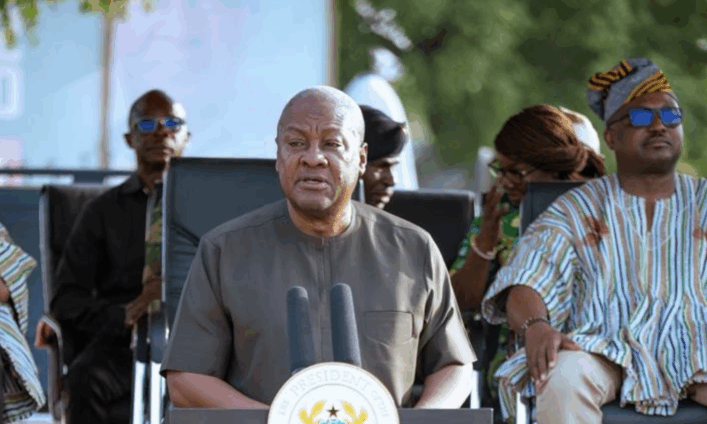
Speaking at the commissioning of the B5 Plus Limited Steel Manufacturing Plant at Prampram on Friday, February 20, the President said the policy is designed to secure raw materials for local manufacturers and accelerate value addition in the metals industry.
He explained that Ghana generates substantial volumes of scrap metal each year through construction, demolition, vehicle imports and other industrial activities. However, for years, a significant portion of that scrap has been exported in its raw form.
“Industrial capacity requires raw material security. By restricting non-ferrous scrap exports, the government ensures local processors have priority access to raw material for their production,” he said.
According to him, the policy will not only increase processed metal exports but also create between 5,000 and 10,000 new jobs across the value chain.
President Mahama added that the move would further enhance domestic revenue mobilisation through value-added tax, corporate taxes and pay-as-you-earn contributions.
He commended B5 Plus Group for its tax compliance, noting that the company is among the Ghana Revenue Authority’s most reliable taxpayers.
"They've paid more than $300 million in taxes and are looking to exceed $500 million very soon."
While acknowledging concerns raised by the company over frequent audits, he suggested that regulatory oversight must be balanced and predictable.
The President said the broader objective is to move Ghana up the value chain by exporting finished and semi-finished products rather than raw scrap materials.
Linking the policy to the government’s “Big Push” infrastructure agenda, he said massive investments in roads, highways, railway modernisation, bridges, interchanges, energy transmission lines, affordable housing and industrial parks will require a strong and reliable supply of iron and steel.
"Africa is projected to require over $100 billion annually in infrastructure development. West Africa alone faces significant infrastructure deficits.
"If Ghana develops a strong steel base, we not only build our own roads and bridges, we will also supply steel to the whole sub-region. This is how infrastructure becomes industrial strategy. The 24-hour economy program is particularly relevant to energy-intensive industries such as steel manufacturing," President Mahama added.
Latest Stories
-
OFFICIAL: Vinicius will miss El Clásico, suspended four games
2 minutes -
Prayer vigil held after four arson attack murders
9 minutes -
GRA fully recovers $154k legacy debt owed by foreign entities between 2022 and 2024
11 minutes -
Kwesi Pratt Jr warns bus preachers are adding to passengers’ stress with accident prophecies
12 minutes -
MTN Ghana to spend $1.1bn in 3 years, build 500 new sites as MoMo hits 44% Growth
14 minutes -
I have no regrets joining Assemblies of God – Mahama
14 minutes -
Starlink restrictions in Ukraine war linked to political situation, Zelensky aide says
17 minutes -
Furniture boost for Techiman North schools as MP donates to 20 institutions
17 minutes -
Assemblies of God to loan 10,000-seater dome for Ghana@70 celebrations
18 minutes -
Government to audit 2,016 community network sites – Communications Minister
18 minutes -
Heritage Series notes: BoG promises more inclusive cedi with improved sizes, tactile features
35 minutes -
‘We want answers’ – Family seeks probe into 14-year-old’s death 12 days after starting SHS
46 minutes -
No preacher has the right to impose beliefs on bus passengers – Kwesi Pratt Jr backs preaching ban
50 minutes -
Africa Maritime Security Forum opens in Accra with call for stronger continental cooperation
50 minutes -
Techiman North MP fulfills promise with new CHPS Compound in Kokoago
1 hour