

Audio By Carbonatix
The International Monetary Fund (IMF) has cautioned central banks against leaving inflation to “spiral out of control” amidst uncertainty surrounding the Middle East war.
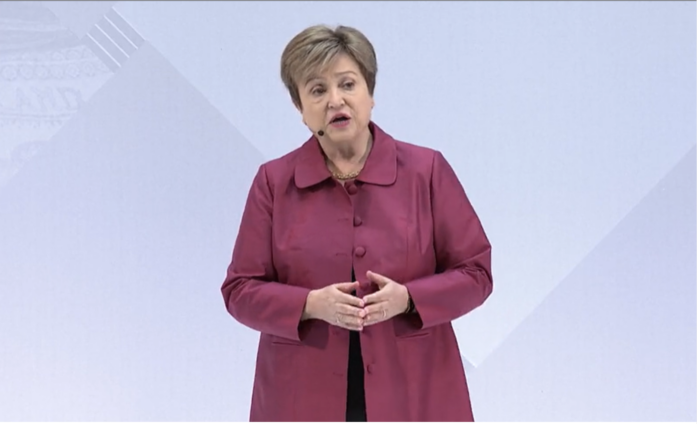
Kristalina Georgieva, the IMF Managing Director, gave the caution in a curtain-raiser speech ahead of the Fund’s joint Spring Meetings with the World Bank Group, slated for next week in Washington.
She cited transportation networks and trade flow disruptions through shortages of refined products as effects of the war.
The IMF Chief noted that the Middle East war had delivered a large, global and asymmetric supply shock that threatened to derail a world economy that was otherwise on course for an upward growth revision.
She said the transport disruptions caused by the conflict had pushed at least 45 million additional people into food insecurity, taking the total number of people facing hunger globally to over 360 million.
The world could experience further shocks through three main channels – price, impact and supply shortages – igniting a costly inflation process and financial conditions.
“We have been here before in the ’70s and earlier this decade,” she said.
For central banks, Ms Georgieva’s guidance was for them not to “unnecessarily” tighten monetary policy, but remain committed to price stability, urging them to stand ready to move firmly when rate hikes in inflation expectations showed signs of becoming unstable.
“Now, if inflation expectations threaten to break anchor and ignite a costly inflation spiral, then central banks should step in firmly with rate hikes,” she said, adding that the Spring Meetings would focus on how best to weather the shock and ease the pain on economies and people.
On fiscal policy, the IMF Managing Director noted that most countries had appropriately avoided broad-based tax cuts and untargeted energy subsidies, urging governments to keep fiscal support targeted and temporary.
She called for a balance between monetary and fiscal policies, indicating that with benchmark yield curves already rising and debt service costs climbing, deficit-financed stimulus at this juncture would increase the burden on monetary policy.
Ms Georgieva encouraged rebuilding of the fiscal space and urged all countries to reject export controls, price controls, and other go-it-alone measures that risked amplifying global disruption rather than containing it.
“Policymakers can help in multiple ways, and certainly they must be careful not to make things worse. So here I appeal to all countries to reject go-it-alone actions – export controls, price controls, and so on – that can further upset global conditions: don’t pour gasoline on the fire,” she added.
The Fund, in the near-term, expected demand for balance-of-payments support arising from the war’s spillovers to rise to somewhere between US$20 billion and US$50 billion, with the lower end of that range prevailing if the ceasefire was reached, she said.
She reminded policymakers that while external shocks were beyond any country’s control, the strength and agility of domestic fundamentals and institutions remained within their authority – and represented the surest defence when the next crisis arrived.
Ms Georgieva urged governments not to lose sight of longer-term structural imperatives around technology, demographics, geopolitics, trade, and climate even as they navigated the immediate turbulence.
The Spring Meetings would focus on helping countries find a path forward through what she called the “fog of uncertainty,” and appealed for lasting peace in the Middle East and across the world.
Latest Stories
-
Power restoration fault suspected in Kumasi Central Market fire
4 hours -
The 7-foot giant of Ngleshie Amanfro: Seven-foot Ghanaian Ephraim Saawa dreams of joining the national basketball team
5 hours -
Government promises support for Kumasi Central Market fire victims
5 hours -
Vibes The Movie: Big Ghun’s Ghanaian film earns five nominations at 2026 REFFA
5 hours -
MamaCare CEO warns unresolved conflicts among health workers could undermine maternal and neonatal care
6 hours -
Health professionals urged to translate medical knowledge into practice to save mothers
6 hours -
Conflicts among care providers linked to maternal, neonatal deaths – Expert
7 hours -
GIS marks 10th TIME conference, champions improved teaching practices
7 hours -
BRICS Or Balance? What Ghana’s bid really means
8 hours -
GPRTU wants full TRAFFITECH-GH implementation to start in 2027
8 hours -
Mahama announces plans to import electric wheelchairs for PWDs
8 hours -
KGL U17 Colts 2026: Western beat Prempeh Elite Academy to set up final final with Greater Accra Region
8 hours -
Late Solanke strike salvages 10-man Spurs draw at Man United
9 hours -
Gender Ministry to monitor welfare of Nana Akua Addo’s children amid domestic violence case
9 hours -
Benedict Okyere Yeboah: Ghana’s football problem goes beyond sacking a coach
9 hours