

Audio By Carbonatix
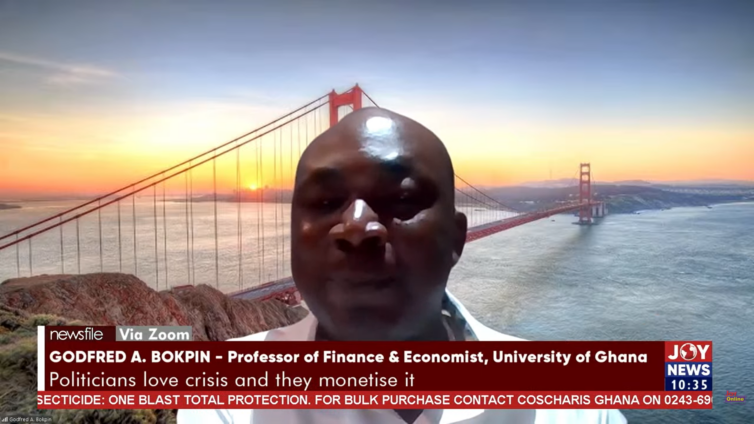
Economist and Professor of Finance has warned that persistent inefficiencies in the Electricity Company of Ghana (ECG) and other state-owned enterprises could push Ghana back to the International Monetary Fund (IMF) for another financial intervention.
Speaking on JoyNews' Newsfile on Saturday, Prof Bokpin said Ghana cannot afford to return to what he described as “business as usual” after years of fiscal pressure caused by inefficiencies within state-owned enterprises.
“So if we go back to business as usual, it is just a matter of time and we have to resort to the IMF and the World Bank for another level of intervention,” he cautioned.
He said Ghana has lost between 2.5% and 3.2% of its Gross Domestic Product (GDP) over the past 15 to 20 years due to inefficiencies in state-owned enterprises, including ECG and the Ghana Cocoa Board (COCOBOD).
“Over the last 15 to 20 years, between 2.5% to almost 3.2% of our GDP is lost to the inefficiencies of state-owned enterprises alone, including ECG and then COCOBOD and the rest of them,” he said.
Prof Bokpin said the energy sector continues to place significant pressure on Ghana’s fiscal space because government has to make additional allocations to cover sector shortfalls.
He noted that these extra-budgetary allocations can sometimes exceed the combined budgetary allocations of the Ministries of Health, Food and Agriculture, and Education.
“If you look at the fiscal space that the energy sector alone takes, the extra-budgetary allocation that we have to make to cover the energy sector shortfall sometimes exceeds the combined budgetary allocation to the ministries of Health, Food and Agriculture, and Education,” he said.
He stressed that reducing losses across generation, transmission and distribution would require significant investment.
“There is no way we can reduce the level of losses from generation, transmission to distribution without a certain level of investment,” he said.
According to him, government must therefore carefully consider how the investment gap will be financed without diverting scarce public resources from other critical sectors.
Prof Bokpin said the IMF-supported programme has improved transparency within the energy sector, particularly regarding the scale of losses and financial flows.
“What we should rather be seeing now as the effect of the IMF-supported programme is that there's a lot of transparency today in terms of even the extent of the losses going forward and the progress that we have made,” he said.
He also pointed to the cash waterfall mechanism as an area where some progress has been made.
“Today, the cash waterfall mechanism is working to some extent,” he said.
“You can credit that to the IMF programme because we know what was happening with the cash waterfall mechanism before.”
Reforms needed to prevent another IMF intervention
Prof Bokpin said the government must use the current reform process to address the structural problems within ECG and other state-owned enterprises rather than repeatedly providing financial support to cover their inefficiencies.
He called for broader consultation and greater disclosure of the proposed reforms.
“There has to be a broader consultation. There has to be greater disclosure of what kind of private-sector participation we are talking about,” he said.
He warned that returning to the old approach could worsen Ghana’s fiscal pressures and eventually force the country to seek another external intervention.
Prof Bokpin therefore urged policymakers to pursue reforms that improve ECG’s efficiency, reduce losses and lessen the company’s dependence on government financial support.
Latest Stories
-
GJA accepts Mahama’s request to organise national forum on hate speech
16 minutes -
Democratizing the judiciary: Why Judges in Ghana should engage “We the People” through social media platforms.
19 minutes -
Bond market: Turnover increases by 47% to GH¢4.07bn
31 minutes -
DVLA prepares electronic queue system to reduce congestion
37 minutes -
Hearts of Oak coach Kapor raises alarm over poor pitches in Ghana football
48 minutes -
Dorimon Traditional Council endorses policy to formalise female chieftaincy
51 minutes -
DVLA expands from 33 to 63 offices after opening 30 new service centres across Ghana
52 minutes -
State Housing Company offers 195 homes with a 5% discount; prices start at GH¢950,000
55 minutes -
Learn Deutsch opens German language examination centre in Accra
56 minutes -
Decline in external buffers complicates foreign exchange outlook – IC Insights
56 minutes -
Ghanaian filmmakers urged to tell local stories and take them to the world
1 hour -
Educated but unable to communicate? The missing link in Ghana’s University education
1 hour -
Informant demanded $20 million from NACOC for information on major drug consignment – Muntaka
1 hour -
Gov’t introduces mental health and drug tests for security recruits amid suicide concerns – Interior Minister
1 hour -
DVLA generates GH¢27.14m from dealer plates between January and September 2026
1 hour