

Audio By Carbonatix
A youth climate advocate is calling on policymakers to strengthen engagement with grassroots communities in designing and implementing climate policies, warning that many interventions fail because they do not reflect local realities.
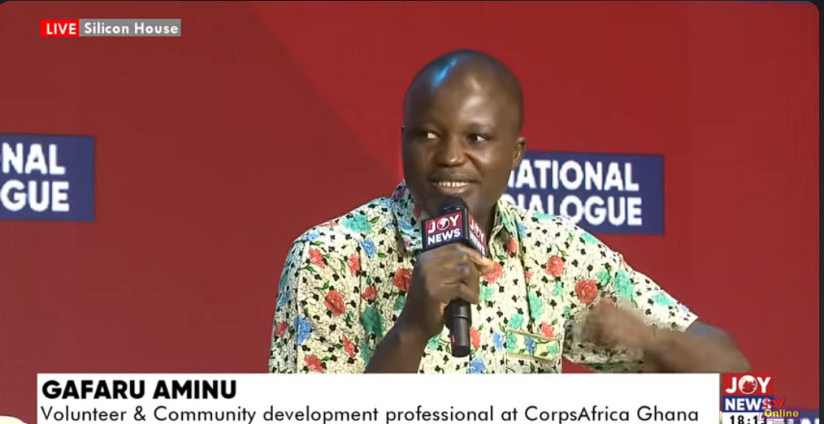
Gafaru Aminu, a volunteer and community development professional with CorpsAfrica Ghana, said climate action will be more effective if communities are placed at the centre of decision-making and implementation.
Speaking during a JoyNews National Dialogue on “Ghana’s Youth and Climate Change,”he said policymakers often design climate interventions that overlook lived experiences at the community level, creating gaps that weaken impact.
“If given the opportunity to meet a policymaker today, the message would be very simple: come back to us at the grassroots level. We need you, we need one another. When making policies, we don’t want to see gaps. We want the realities of communities to reflect in those policies,” he said.
He also urged government and development actors to rethink climate financing strategies, arguing that over-reliance on large global funding mechanisms risks overlooking local capacities and solutions already emerging within communities.
He cited a community-led initiative he supported as a volunteer, where 17 households mobilised about GH¢35,000 in cash and in-kind contributions within six months to implement a local climate adaptation project.
“To tell you that a 17-household community has raised GH¢35,000 within six months for a project, it shows the strength we are not paying attention to,” he noted.
He explained that when communities are empowered and given the right capacity, they can generate internal resources to address climate vulnerabilities without depending solely on external funding.
“Sometimes we focus too much on big global climate finance, but we have not even begun to explore the internal strengths within our communities,” he added.
Gafaru Aminu stressed that strengthening community-led adaptation strategies can significantly reduce climate vulnerability, especially in hard-hit areas, if properly supported by policy and technical guidance.
He concluded that meaningful climate action must be rooted in trust, participation, and shared responsibility between policymakers and local communities.
Latest Stories
-
Ghana prepares to reopen diplomatic mission in Ireland
27 seconds -
Mahama woos US investors for Ghana’s power, technology and industrial sectors
1 minute -
New College of Education in Tuobodom to end teacher training struggles in Bono East – Regional Minister
7 minutes -
Education Ministry proposes 2% GETFund emergency fund for crisis-affected schools
7 minutes -
BoG to intensify public education on authenticating new Heritage Series banknotes
18 minutes -
NAIMOS arrests 12 illegal miners in Osino; destroy mining equipment
25 minutes -
Ghana to retain cotton banknotes under new Heritage Series – BoG
27 minutes -
Lebanese Community awards scholarships to eight Ghana School of Law students
29 minutes -
NPP’s path to victory lies in unity – Boakye Antwi
34 minutes -
Divers recover a total of 52 bodies from capsized ferry in Indonesia after a dayslong search
44 minutes -
UNESCO urges Ghanaian journalists to mine archives for richer reporting
45 minutes -
Educational accountants hold workshop on financial discipline to avert PAC sanctions
49 minutes -
Devtraco Group launches Lotus residential development
56 minutes -
3rd JoyNews-Republic Bank Habitat Clinic kicks off at Junction Mall, Nungua
57 minutes -
KMA cracks down on unapproved transport fares; engages 24 unions ahead of Christmas
59 minutes