

Audio By Carbonatix
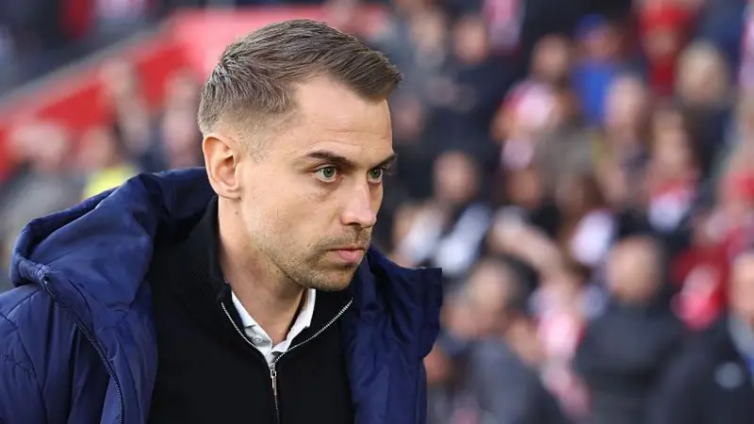
Southampton's spying on rival clubs was authorised by head coach Tonda Eckert and was a "contrived and determined plan from the top down", an independent disciplinary commission ruled.
The commission also said it was "deplorable" of the club to have used junior staff members to "conduct the clandestine observation".
Saints were expelled from the Championship play-offs after admitting to observing opponents' training sessions and have been deducted four points for the 2026-27 Championship season.
Written reasons explaining the commission's finding have now been published by the English Football League.
Eckert, the club's 33-year-old German rookie boss who only took charge in mid-season, is said to have "accepted that he had specifically authorised the observations". Such spying "seriously violated" the integrity of the competition, the commission said in an explanation of why it applied such a serious sanction.
In addition to the expulsion and point penalty, a reprimand was also imposed on Southampton. That was not merely because spying was taking place, but because "junior members of staff were put under pressure" to be involved, the commission stated.
The whole matter only arose after a junior member of staff was spotted secretly watching Middlesbrough at their training ground.
Southampton admitted spying on three rivals' training sessions – Oxford United and Ipswich Town earlier in the season, and then Middlesbrough before the first leg of the play-off semi-finals.
Their expulsion from the play-offs meant Middlesbrough - who they beat in the semi-final – were reinstated. They will meet Hull City in Saturday's final, for a place in the Premier League.
Southampton, who initially denied any video was captured or analysed before acknowledging that was not the case, were unsuccessful in an appeal against their removal from the play-offs.
They are said to have "placed reliance" on a previous sanction handed down to Leeds United, who received a £200,000 fine for spying on opponents in 2019, but the commission pointed out that happened before the introduction of the regulations Southampton breached.
'Contrived and determined from the top down'
The first determination is perhaps the most damning. It indicated a pattern of behaviour.
The independent disciplinary commission said: "We have concluded that there was, on the part of the respondent [Southampton], a contrived and determined plan from the top down to gain a competitive advantage in competitions of real significance by deliberate attendance at opposition training grounds for the purpose of obtaining tactical and selection information.
"It involved far more than innocent activity and a particularly deplorable approach in its use of junior members of staff to conduct the clandestine observations at the direction of senior personnel.
"There was transmission and internal dissemination and analysis of footage and observations."
Southampton made submissions which they said proved that the information had not altered the team selection, nor had it resulted in a sporting advantage, as shown by the poor first-half performance at Middlesbrough. This was rejected.
Eckert 'specifically authorised' spying
The most damning section for the Southampton head coach comes in the second determination of the judgment.
This states that the Germans not only knew about the spying but also had given their blessing.
Eckert was shown to have approved spying on Oxford to discover their formation after they had just changed manager.
In the case of Middlesbrough, he wanted to find out about the availability of a certain player - presumably Hayden Hackney, who had been out injured for several weeks.
The commission said: "Mr Eckert accepted that he had specifically authorised the observations to obtain information about formation (in the Oxford incident) and about the availability of a key player (in the Middlesbrough incident).
"Such information could only be sought in order to factor it into strategy, [and] whether the information confirms a strategy, is disregarded as unreliable or leads to a change of strategy does not, in our view alter the wrong which is committed when such information is sought.
"It is inherent in having information which your opponent would wish to keep private that you have a sporting advantage."
Latest Stories
-
Aggrieved teachers demand payment of unpaid four-year legacy arrears
11 minutes -
Skipping breakfast bad for your health?
25 minutes -
Kpeshie Lagoon reclamation linked to first-ever flooding at Tse Addo – ISD
32 minutes -
GRA announces major policy proposal under Modified Taxation Scheme initiative
47 minutes -
TCL sues Samsung for false advertising over ‘Mini LED’ televisions
55 minutes -
US embassy child abuse images suspect flown from UK before police interview
1 hour -
Payment dispute led to murder of Dr Jesse Amuah and wife at Asylum Down – Court told
1 hour -
COPEC calls for GH¢1 petrol, continuation of GH¢2 diesel subsidy amid price surge
1 hour -
Petrol to sell at GH¢16.26, diesel GH¢19.07 from Wednesday – COPEC
2 hours -
Massive crowds flock to JoyNews–Republic Bank Habitat Fair on final day to explore mortgages and seek expert advice
2 hours -
Ghana’s Alice Banaaza spotlights fugu weaving at 2026 CHAN Festival in UK
2 hours -
Russia’s Youth Festival could unlock business partnerships and scholarships for Ghanaian youth – John Aggrey
2 hours -
The 21st Century Gold Standard was piloted in Ghana under Bawumia – Gideon Boako
2 hours -
Ahafo NDC Vice Chairman pays nomination fees for 168 constituency executives ahead of 2026 internal reorganisation
2 hours -
Upper West receives GH¢101.9m DACF for development projects
2 hours